Conversation Toggle
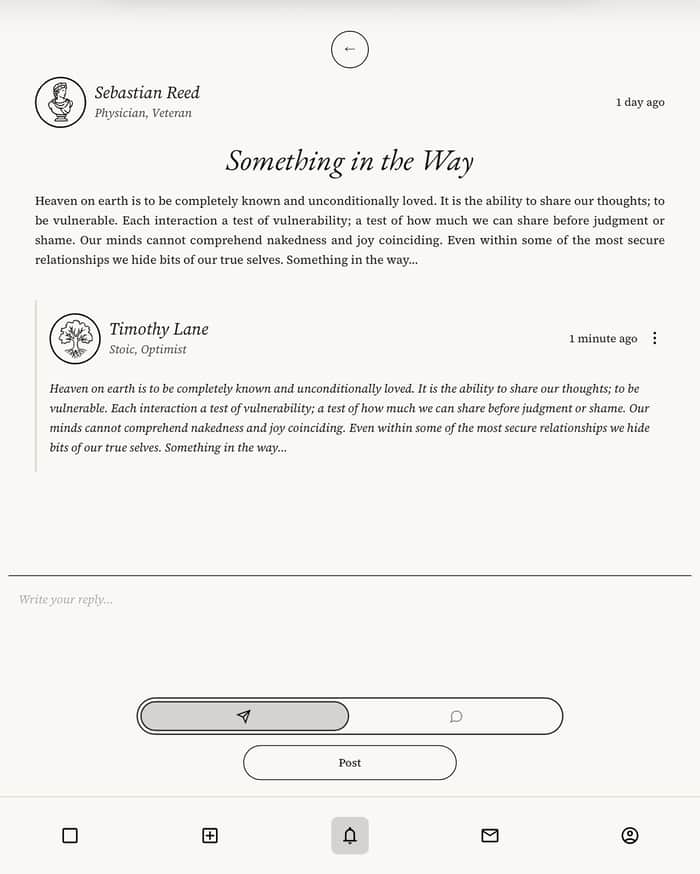
I created a new format for online discussion. The flow is the original poster (OP) makes the post, another user comments (but only gets one comment), and then the OP replies to the comment (he/she only gets one). Before the OP posts the reply to the comment, he/she gets to choose to simply post and be done (paper airplane icon) or to post and continue the conversation in a messenger (the comment bubble). The format is designed for productivity and to eliminate unnecessary noise.

The mechanic is clear, but the question it must answer to survive is missing: why would anyone leave Reddit or Twitter for this? A format constraint isn't a reason to switch, people tolerate noise where everyone already is. New social products die on cold-start, not design.
Who feels the noise badly enough to move? "Eliminate noise" is a benefit everyone nods at and nobody switches for. A specific person might, someone wanting one focused exchange (mentor/mentee, expert Q&A) where the one-comment limit forces quality over pile-on. The constraint that limits casual chatter is a feature for high-signal exchanges.
The one-comment rule reads as a restriction now. Who is it a gift for? Nail that person and the format has a reason to exist.
Agora isn't for everyone. Unlike Reddit or Twitter, I have no motive to obtain millions of users. Not a lot of people will grow to love Agora's constraints: pseudonyms, posts that expire after 90 days, one comment only, no profiles, no likes, no follows, etc. I'm looking for tens of thousands, at most.
It is true that new social media products die on cold-start, but Agora is completely self-funded and costs scale based on user numbers which is paid for by subscriptions. I'm considering different approaches to funding, but I haven't found anything that is stable enough to prevent collapse 100%. I am looking for 1,000 foundering users and am offering them a free, lifetime membership. Time will tell if I can even get that. Haha. But Agora will not shut down. It will be active for decades whether it finds its people or not.
Will people leave Reddit, Twitter, or Facebook? Everyone they know is on these platforms, but I'm not competing with these platforms. Agora is competing with itself to provide a space that promotes quality over quantity. It is not for the passive user, but the active one. Passive readers may see a limited exchange, but the exchange must be quality to move onto a conversation. Otherwise, it is just like every other exchange on any other social media site.
Much clearer vision than the original post conveyed. You've insulated a deliberately small, principled space from the collapse I warned about. Rarer than it sounds.
Your real challenge isn't cold-start, it's density of the right kind. A thousand active people makes Agora thrive; ten thousand passive lurkers kills it. Founding-user selection matters more than any growth tactic: the constraints (one comment, no likes, 90-day expiry) are only a gift to people who already want depth over dopamine. The wrong 1,000 feel friction; the right 1,000 feel relief.
So the question that decides everything: where do people already exhausted by likes-and-follows culture gather now? Not the platforms you're not competing with, the quiet places they left them for. That's your founding pool.
I like the attempt to solve a real problem here: most online discussions become noisy long before they become useful.
The part I’d watch closely, though, is the forced stopping point.
A lot of valuable conversations don’t become valuable on the first reply. Someone makes a claim, another person challenges an assumption, and that is where the useful information starts appearing.
So I’d probably measure this less by “number of messages eliminated” and more by whether people leave with better information than they started with.
If the toggle reduces noise without killing the moment where curiosity turns into a useful back-and-forth, that’s a pretty interesting interaction model.
You bring up some valid points. It is a forced stopping point. The design of the site is to encourage high-quality, long form posting and equal quality comments. Each comment and reply to the comment must be complete thoughts to encourage a continued conversation. Each would stand on their own and will be coherent to viewers in theory. The messenger is there if the two users want more, naturally. But you do bring up some good points. I guess the format will have to be something people get used to.
I think the “each contribution should stand on its own” principle is actually the interesting part here.
From a product/messaging perspective, you’re not really removing conversation — you’re changing the unit of value from back-and-forth to a complete contribution. That could make the public layer much easier to consume while keeping deeper discussion available privately.
The thing I’d watch is the transition between those two modes. If someone reads a strong comment and immediately wants to challenge, clarify, or build on it, the messenger has to feel like a natural continuation rather than an exit from the experience.
That’s probably where I’d test the UX: does the format make people think “I want to continue this,” or “I guess the conversation is over”?
That distinction could tell you a lot more than raw engagement numbers.
Time will tell! Thanks for the feedback!