Corporation vs LLC: Which Business Structure Is Right for You?
When formalizing your business, one of the first critical decisions is whether to form a corporation or an LLC. Although both structures have legal protection and legitimacy, they differ in almost every aspect, including tax, management, and funding. Making the right choice at this stage can mean thousands of dollars and years of administrative hardship. This article provides you with everything you need to know to make this decision with confidence.
What Is an LLC?
With a Limited Liability Company (LLC), you get a combination of the liability protection of a corporation with the tax simplicity of a sole proprietorship or partnership. LLCs, by their nature, shield members' personal assets from LLC liabilities and lawsuits.
LLCs have an operating agreement that articulates the company's management, profit distribution, and outlines the procedures to be followed upon the occurrence of certain events, such as a member’s exit. As a result, LLCs are a great choice for freelancers and small business owners.
What Is a Corporation?
A corporation is an entity owned by its shareholders and has a legally separate structure. Because a corporation is a separate legal entity, it has a rigid structure, unlike an LLC, which does not require a board of directors, corporate officers, or shareholder meetings. Corporations must also keep formal records, such as bylaws and meeting minutes.
Small and medium businesses have access to two types of corporations:
C Corporation: The most common corporate structure. Considered a "double taxation" structure, as revenue is taxed at the corporate level and again at the shareholder level when dividends are paid.
S Corporation: This structure enables revenues and losses to be reported at the shareholder level, thus avoiding double taxation. However, S Corporations have strict requirements: all shareholders must be U.S. citizens or residents, and the S-Corp may have no more than 100 shareholders.
Corporation vs LLC: Side-by-Side Comparison
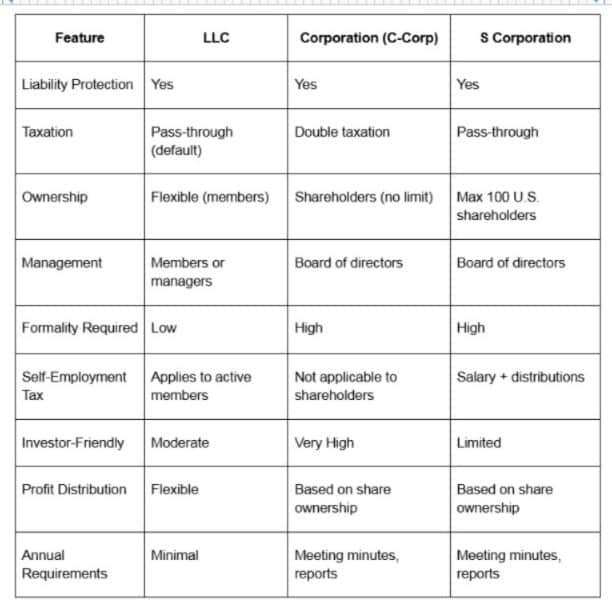
Corporation vs LLC: Tax Differences Explained3.
The tax structure plays a key role in most businesses' decisions about whether to register as a corporation or an LLC. Understanding the tax structure can significantly impact your business.
LLC Taxation
A single-member LLC is treated as a sole proprietorship tax-wise. A multi-member LLC is treated as a partnership. Thus, all profits and losses are reported on the members' individual tax returns. Members also pay the 15.3% self-employment tax (2024 net earnings ceiling: $160,200) on their income.
Electing S-Corp status is advantageous to LLC members for tax purposes. Members who are also owners can avoid self-employment tax by strategically splitting their income between a salary (subject to payroll tax) and profit distributions, which are self-employment tax-free.
Corporation Taxation
Under the Tax Cuts and Jobs Act, C-Corp profits are taxed at a flat corporate rate of 21%. Dividends are then taxed again at the individual shareholder level. This situation creates a corporation's double taxation structure. C-Corps are tax-advantaged for companies that reinvest upcoming profits rather than distributing them to shareholders.
S-Corps pass income directly to shareholders and avoid double taxation. However, they are subject to many restrictions and are less flexible than LLCs.
Liability Protection: How Each Structure Shields You
Both the LLC and the corporation provide a legal barrier between your personal assets and business liabilities. If your business is sued or goes into debt, creditors generally cannot come after your personal bank accounts, home, or savings, provided you maintain the separation between personal and business finances.
"Corporate veil" is the term for when courts shield the personal assets of the corporation's owners from a judgment against the corporation. However, if a business owner treats the corporation as a personal account, commingles funds, or fails to maintain the required documentation, courts may pierce the corporate veil.
LLCs are easier to maintain than corporations. Corporations require a set of formalities that is much more extensive than those of LLCs. Corporations must convene annual meetings, keep minutes, and issue stock, among other requirements. Failure to adhere to these requirements can diminish the liability protection offered by corporations.
Ownership and Investment Considerations
When your business needs to raise investor funds, its legal structure should be a C-Corp rather than an LLC. Venture capitalists will only invest in C-Corps because:
C-Corps allow the sale of different types of stock.
The sale of stock options is easy and clear.
C-Corps have a clear route to become a public company through a stock market listing.
Investors understand how to trade debt and convert notes within a C-Corp structure.
Investors can invest in LLCs, but there are much higher barriers to funding and investing due to strict membership rules. An LLC structure will operate well if you are building a business from your own funds and taking on a limited number of partners.
Management Structure: Flexibility vs Formality
One of the clearest differences in the corporation vs LLC debate is management structure.
LLC Management
An LLC can be structured in two ways:
Member-managed: All members participate in the day-to-day operation and decision-making.
Manager-managed: Designated managers, who may or may not be members, handle the operations.
With this flexibility, your LLC can evolve to suit your team rather than boxing you into a specific structure.
Corporation Management
There are three clear tiers within corporations. Shareholders elect boards, boards appoint the officers, and the officers manage day-to-day operations. Investors are familiar with this structure as it is definitive; it requires consistent documentation and periodic meetings to remain compliant with rules.
When to Choose an LLC
If you identify with one or more of the examples below, an LLC will most likely be your best option:
You are a sole trader or a simple small business owner.
You want the option to choose how you distribute profits to your members.
You operate in real estate or consulting.
You prefer not to have too many formalities.
You want to avoid seeking institutional venture capital.
When to Choose a Corporation
A corporation is typically the better option when you:
Plan to raise venture capital or seek financing.
Want to provide stock options to your employees.
Are likely to go through the IPO process.
Want your business in an industry where the corporate structure gives you a stamp of approval.
Plan to retain profits in the business to fund growth, benefiting from the 21% corporate tax rate rather than the higher individual tax rate.
State-Specific Considerations
Different states offer different rules and different fees for formation and for continuing obligations. For many years, Delaware has been the preferred state for incorporation, especially for startups and companies that will or plan to raise capital. This is largely due to the Court of Chancery, its well-established corporate laws, and flexible statutes. Low fees and strong privacy laws also make Nevada and Wyoming popular states for incorporation.
However, even if you are incorporated in Delaware and operate your business in California, you will be subject to California law and will incur additional fees for doing business in California. Your best first step is to consult your CPA or business attorney who understands your state's rules.
Final Thoughts
There is no single right answer when deciding how you will operate your business in the corporation vs LLC debate. Some factors to consider include what your business is, where it will be in the future, taxes, and the legal paperwork pertaining to the business. For most small businesses and freelancers, an LLC is the perfect fit, as it offers a combination of protection, flexibility, and simplicity. On the contrary, for founders planning an exit, building a scalable tech company, or seeking venture funding, a C-Corp often makes the most sense.
When creating a business, it is very important to choose the right legal structure at the right time. Seeking professional guidance early in the process can help you avoid costly mistakes and create a strong foundation for a successful business. This can create a strong foundation for a successful business.
Frequently Asked Questions
Q: Do LLCs have the ability to convert to a corporation in the future?
Most states allow you to grow your business and convert the LLC into a corporation. It is a process and could lead to adverse tax effects, so consult a CPA before considering the switch.
Q: Which offers a more credible structure?
Corporations are generally the preferred structure for larger clients and financial institutions, so if your large clients are institutional investors, a corporation is likely the structure they prefer.
Q: Will a corporation save me more on taxes than an LLC?
It really depends on your circumstances. Most small business owners are better off with an LLC, especially an S-Corp, as they benefit from pass-through taxation and lower overall taxes. In contrast, the corporation that retains its earnings and pays the 21% corporate tax may be a better tax choice.
Q: Do I have to hire an attorney to create an LLC or corporation?
Not necessarily, but it is strongly recommended to seek professional guidance. Mistakes in the paperwork of an LLC or corporation can create legal and financial problems in the future.

