Corrupted Video File Repair: A Step-by-Step Recovery Guide
There is nothing worse than pressing play and your video does not load. It can be a family memory, a work project, a travel clip, and many more reasons that can result in corruption. Common causes are power failures, faulty storage, or transfer errors. The positive point is that corrupted video file repair is usually possible.
By combining the correct technique, it is possible to revive the bad video files. The steps that we are going to follow in this guide are going to be a step-by-step recovery, beginning with free solutions and then progressing to professional solutions. While we'll explore several methods, for severely damaged files, a dedicated tool like 4DDiG Video Repair often provides the highest success rate, which we'll discuss in context later.
First Aid: Understanding & Diagnosing the Corruption
Before you attempt any fixes, it’s important to know what you’re dealing with.
Common Causes:
Corruption can happen during file transfer, after a system crash, or due to a failing storage device. Virus infections and codec problems are also frequent triggers.
Symptoms:
When a video file is corrupted, you may notice one of several issues:
The video won’t open at all.
Audio and video are out of sync.
Frames appear green, pixelated, or frozen.
Only the audio plays, with no picture.
Immediate Action:
The moment that your video file is corrupted, stop using the storage device. Make a copy of the file and be sure you only work on the duplicate. This avoids the harm as you attempt to salvage a broken MP4 file or any other format.
Method 1: The Quick & Free Fixes
When the damage is not severe, simple solutions can always be used to restore playback.
Change the File Extension
In some cases, the operating system has difficulty identifying a format. To reset recognizing and play the file, it is possible to change .mp4 to .avi by renaming it and then renaming it back to .mp4.
Use VLC Media Player
VLC has an inbuilt AVI file repair feature. To try the VLC repair video feature, follow the steps below:
Open VLC and go to “Tools” then “Preferences” and pick “Show Settings: All >Input/Codecs".
In the option of “Damaged or incomplete AVI file”, select the option of “Always fix”.
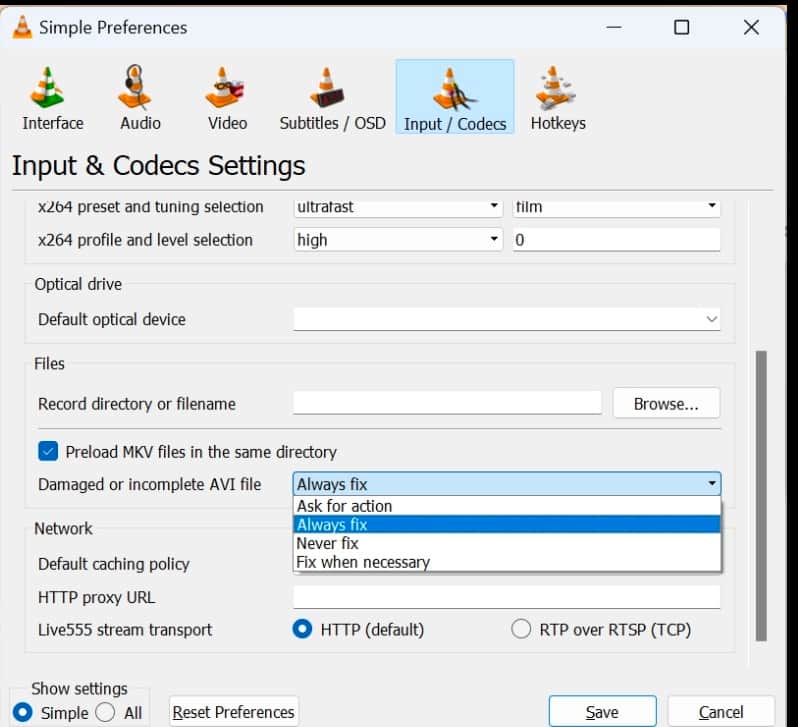
Now, open your video as an AVI file with VLC and click "Repair Now”.
Use Built-in System Tools
At other times, the problem is with the storage device and not the file. On Windows, disk errors that prevent access to videos can be fixed by running chkdsk /f X: or on macOS, by running First Aid.
These are fast and free, but there are restrictions. When the issue is light, free tricks can be used; however, serious corruption will often need more sophisticated tools.
Method 2: Professional Video Repair Software (The Heavy Lifter)
When other free options are unsuccessful, then it is time to think about specific video repair software. This software is focused on the reconstruction of broken file formats, restoration of headers, and recovery of both audio and video streams.
Why use Specialized Software?
The repair programs do not operate at the same level as general players or system tools do. They can repair high levels of corruption, rebuild lost information, and support multiple formats like corrupt MOV file repair.
The General Workflow
The major professional tools take a straightforward procedure:
The process starts by adding your corrupted video to the video repair software.
Then you need to provide a sample healthy video from the same device. It is important because the software uses its data to encode and repair the corrupted video data.
Finally, you can preview the results and check if everything you needed was restored.
The process finishes when you save the file to your offline storage.
The Software Solution
This is where applications such as 4DDiG Video Repair Software are useful. They have MP4, MOV, and AVI formats, so they can be applied to various cases. In the case of corrupted MOV file repair or corrupted video recovery on a large scale, 4DDiG has a clear edge due to its capability to utilize a sample file. This is one of the strategies that usually works where the free systems fail.
Method 3: The Last Resort & Future Prevention
Even software is not always sufficient. In case all the above-mentioned causes are ineffective, there are some final alternatives.
Online Repair Tools
Services are available that will help you to repair corrupted video online, although they have restrictions. There is usually a limit on the upload size, it is slow, and privacy is an issue in case your video is personal.
Data Recovery Services
In case the corruption is caused by a damaged hard drive or SD card, recovery labs are available to the rescue. Nevertheless, it is costly and is normally the final resort.
Prevention Tips
Prevention is the best cure, and you can prevent this problem with the following tips:
You should always safely eject storage devices.
Always use the 3-2-1 backup rule and maintain backups of important files.
Ensure your system is not affected by power surges and ensure that your recording devices are up to date.
These measures minimize the chances of the loss of videos initially.
Conclusion: Choosing Your Path to Recovery
Damaged videos are not necessarily lost and are rather stressful. Begin with simple and no-cost fixes, such as file renaming or VLC. In case they do not, then professional corrupted video file repair software such as the 4DDiG Video Repair. You can be sure to restore your memories and projects with the help of the right tool.
Frequently Asked Questions (FAQ)
Q: Is there any truly free software that can repair severely corrupted videos?
There are free tools, however, which tend to correct minor mistakes. In case of extreme corruption, advanced software is needed to succeed.
Q: The video is repaired, but the audio is still out of sync. What can I do?
Damaged files can cause audio sync problems. This can be corrected by programs having an advanced repair. As an example, 4DDiG Video Repair has a special mode that deals with audio-video mismatches.
Q: Can I repair a video from a corrupted SD card?
Yes. To prevent further data loss, first take a picture of the SD card. Then try repairing the file on the copy with good software. Through this two-step workflow, your original data is secured, and you have the highest chances of recovering it.

