Crawling my way to $500 MRR for OutlierKit- YouTube Research Tool for Creators
For the longest time, I have been reading stories of Indiehackers and I desperately wanted to have my own.
I finally have it now with OutlierKit - AI tool for YouTube Research and Competitor Analytics.
It took me 180 days to make the first $100.
Half a year for $100.
I genuinely thought I was building something nobody wanted.
But here’s the real log of how things actually turned around.
BOFU SEO
SEO: Write First, Learn From Your Own Data
I didn’t start with a sophisticated content strategy.
What I did instead was write BOFU content — the kind of content that people would actually pay for.
Deep, insight-heavy posts.
But here’s the real trick I learned:
Don’t wait to find perfect topics. Publish first, then let the data tell you what to do next.
Every time I published a post, even if it didn’t rank in the top 10, it gave me signals.
Search Console would show me:
unexpected keywords
long-tail queries
variations of what people were actually searching
This was the gold.
Because once you know:
“Oh, this blog is getting impressions for this query,”
you suddenly know:
what users want
how to improve the post
what angle to double down on
what your next 5 blog posts should be
I used ahrefs for demand research, but honestly, nothing is better than your own Search Console data.
That’s the real oracle.
So my “SEO strategy” was basically:
Write solid, BUFU-level content.
Ship it. Don’t overthink.
Wait for Search Console to reveal relevant queries.
Revise the blog to match what people are searching for.
Double down on whatever shows signs of life.
This approach worked so much better than sitting around researching ideas forever.
Just publish → observe → iterate → scale.
That’s how my organic traffic started compounding.

Reddit: The Place That Told Me What to Build
Reddit is wild.
People will tear your product apart but also give you the clearest signal on what actually matters.
I hung out in:
r/NewTubers
r/YouTubers
r/ContentCreators
Not posting my tool.
Just observing.
Creators are very honest about:
What tools they hate
What confuses them
What they wish existed
I’d comment here and there, talk to people, ask questions.
Then one day, I posted about profitable YouTube niches.
This post blew up.
I didn’t expect it.
It was supposed to be a simple post.
Comments were pouring in:
“Do you have more niches?”
“How do I find niches myself?”
“What tools can help here?”
It hit me like a truck:
People REALLY care about niche discovery.
Funny thing?
OutlierKit already had a niche finder.
I just massively underestimated its importance.
That one Reddit post drove a huge wave of traffic.
Then I made a rule for myself:
If something goes viral on Reddit → write a blog about it
If something ranks on Google → make a Reddit post about it
This cross-pollination worked like magic.

Building in Public: The Staircase Growth
I’ve been posting updates on LinkedIn and Twitter with my co-founder.
No glamorous “I made 10k in a weekend” stuff.
Just raw updates about building a tool for YouTubers and struggling and tweaking and learning.
Did we get direct customers from our network?
Almost none.
But whenever a post did well, traffic would spike.
And here’s the interesting part:
the spike never dropped back to the old baseline.
We’d hit a new normal each time.
Like climbing stairs.
I never expected that.
But it happened again and again.
Talking to Users
I do all the support myself.
I’ve spoken to multiple YouTubers who have 1M+ subs.
These conversations were honestly eye-opening.
Turns out:
Creators hate complex tools
They barely use 10% of the features of most tools.
They want actionable insights, not layers of data
OutlierKit’s whole strength comes down to one line:
We tell creators what to make next.
Once I realized this, I doubled down on actionable insights.
It reflected immediately in retention.
Cold Outreach: The Thing That Didn’t Work
I tried cold outreach on LinkedIn.
It didn’t convert.
But it did teach me:
what people hesitate about
why they’re scared to pay
what questions block a purchase
who is NOT my user
Those lessons helped refine everything else.
Even the pricing.
Speaking of which…
Pricing Experiments + Free Credits
We played with pricing a LOT.
We gave free credits early on because YouTube creators want to see value before trusting a new tool.
Conversions got better as soon as we did that.

The Actual MRR Journey (Ugly But Real)
Here’s the true timeline:
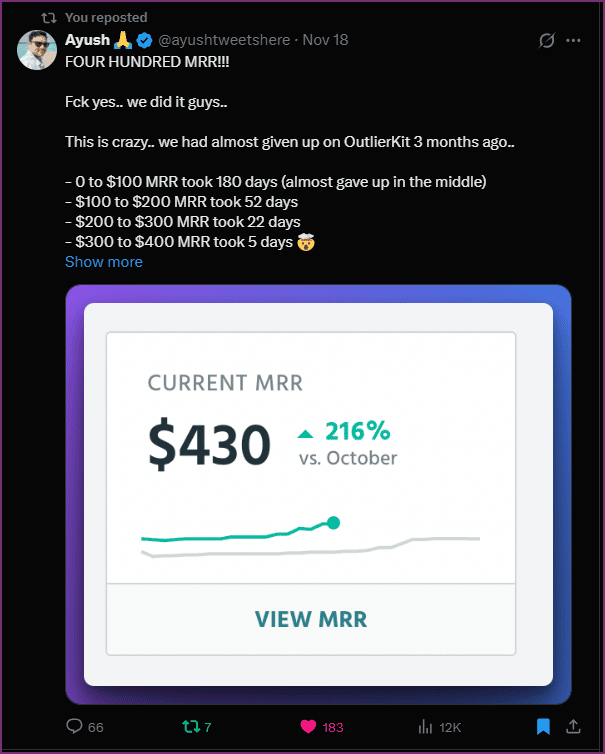
$0 → $100: 180 days
$100 → $200: 52 days
$200 → $300: 22 days
$300 → $400: 5 days
$400 → $500: 8 days
The first dollar felt like a miracle.
The next hundred felt like validation.
And then suddenly everything accelerated.
It was never quick.
But eventually momentum kicked in.
What Actually Worked in the End
Not a single tactic did this alone.
It was the combination of:
Writing long-lasting SEO posts
Writing short-lived Reddit posts
Building in public
Listening to users obsessively
Making the product simpler
And refusing to quit after month 6 with $0 revenue
If you’re reading this and you’re still at the $0–$100 stage:
trust me, I know how painful that part is.
Just keep throwing small experiments online.
One of them will eventually catch.
And when it catches, double down so hard that people think you’re overdoing it.
That's basically it.


Congrats!