Cyberpunk is no longer a genre, it’s the condition of the world we live in
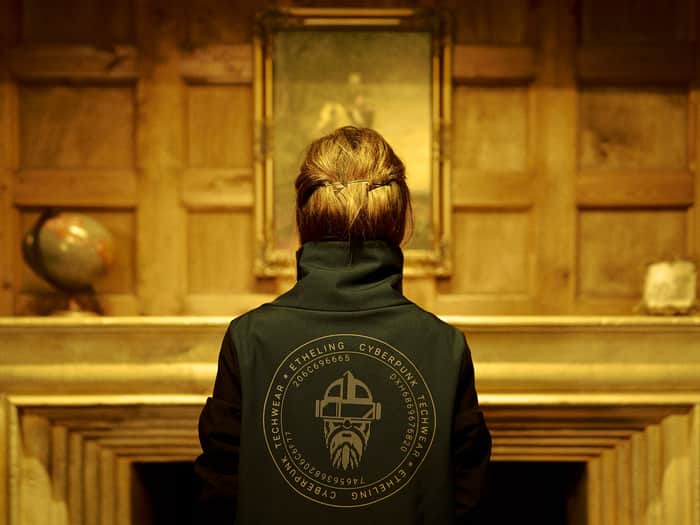
We are entering an era where surveillance becomes ubiquitous, artificial intelligence increasingly shapes human lives, political instability continues to escalate, armed conflicts multiply, and the foundations of the old world order gradually give way to something unfamiliar. Technology has begun to redefine the human condition itself.
Cyberpunk was never about neon lights or futuristic skylines, those were only visual metaphors of some works of art; its true subject has always been the relationship between the individual and an increasingly complex technological civilization.
DXH01 jacket was created as a response to the new reality. Not as fashion inspired by science fiction, but as a functional shell for the world that already exists; a garment designed to confront the environmental, technological, and psychological pressures of contemporary urban life. Protection from rain, wind, pollution, and the constant exposure of modern cities. A silhouette that disrupts familiar human proportions and makes immediate recognition more difficult - for both people and the sophisticated systems observing them.
This philosophy of our product is deeply influenced by the German thinker Ernst Jünger and his concept of The Forest Passenger. The Forest Passenger (also known as The Forest Rebel) is not a revolutionary, he doen’t seek attention, crowds, or public confrontation, he resists quietly, preserving his freedom where others surrender theirs. The Forest, in Jünger’s philosophy, is not a physical or geographical place, it’s a state of being. The Forest may exist in the streets of a modern metropolis, inside a crowded subway station, within a nightclub in central Berlin or Tokyo, inside a prison cell, or anywhere an individual finds themselves surrounded by pressure, surveillance, uncertainty, and systems demanding conformity. It is the inner territory that remains free when external freedom becomes increasingly limited. Jünger believed that when such solitary individuals recognize one another, they become capable of resisting forces far greater than themselves. For that reason, symbols matter: they become quiet signals between people who share the same understanding without the need for explanation. The emblem on the back of the DXH01 jacket follows this idea - it’s not intended as branding or decoration, it exists as a cipher, a discreet sign for those who recognize themselves in the same condition.

The philosophy is genuinely compelling, and the Jünger Forest Passenger framing is a more sophisticated brand foundation than 99% of clothing labels ever attempt. The "emblem as cipher, not branding" idea is a real one. But I flagged this on your last post too, and it's worth saying directly: this is a beautifully written manifesto, and it's the wrong content for IH.
IH is founders talking to founders about building businesses. There's no business here, no traction, no numbers, no ask, no question. A reader can't engage because there's nothing to engage with except agreeing the prose is good. The philosophy sells the jacket to a customer, but here you're posting to other builders, and they want the story behind the brand: how you're reaching the people who'd get the cipher, what's converting, what's hard about selling $400 techwear to a niche that by definition resists marketing.
There's actually a fascinating business tension inside your own philosophy that would make a great IH post: your buyer is someone who rejects branding, conformity, and being marketed to. How do you market to people whose entire identity is resistance to marketing? That's a genuinely hard positioning problem, and it's the kind of thing this room would dig into. The manifesto is your product's voice. The business challenge is your IH post.
What's actually working to reach these people, and what isn't? That's the post that gets you real engagement here.
I like that you're starting from a philosophy rather than trying to borrow the aesthetics of cyberpunk.
I'm curious which part resonates most with customers in practice—the functional design, the underlying ideas, or the sense of belonging to a shared worldview. That often reveals what people are actually buying.