Day 8 of building StartupHQ: How would you visualize AI agents working in the background?
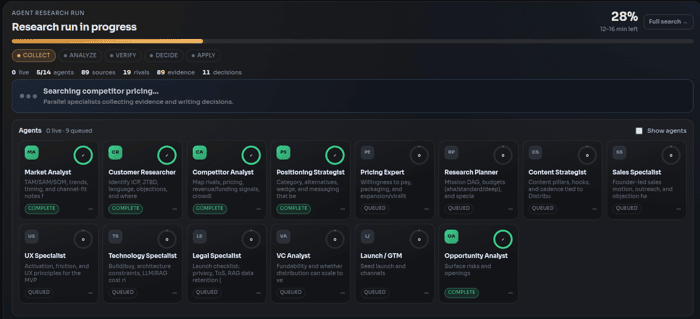
Day 8 of building StartupHQ.
A small milestone today: 6 founders have now tried the product. 🚀
Watching real people use it has been incredibly different from testing it myself. Every session uncovers something I never considered.
One thing I'm actively thinking about is how to make AI feel transparent instead of magical.
Instead of sending one giant prompt to an LLM, StartupHQ runs multiple specialized AI agents in parallel.
For example:
📈 Market Analyst
👥 Customer Researcher
🥊 Competitor Analyst
🎯 Positioning Strategist
💰 Pricing Expert
🚀 GTM Specialist
⚠️ Risk Analyst
...and more.
Each agent researches a different part of the startup, writes evidence, and eventually debates with other agents before producing recommendations.
The challenge is...
Most of this work happens in the background.
Right now I've built a live dashboard (screenshots attached) that shows:
which agents are working
completed milestones
research progress
evidence collected
current stage of the pipeline
But I'm not convinced this is the best UX.
I'm trying to avoid the typical AI experience of:
spinner... spinner... spinner... here's your answer.
Instead, I want founders to actually see the research happening and build trust in the process.
If you were using a product like this...
How would you want the AI's work to be visualized?
Would you rather see:
Every agent thinking in real time?
A timeline of discoveries?
Live evidence appearing as it's found?
Agent conversations/debates?
Something else entirely?
I'd genuinely love UI/UX feedback before I go too far down one direction.

Live evidence appearing as it's found is the one I'd bet on — a timeline of "what was discovered and why it matters" builds way more trust than watching agents think in real time. Streaming raw agent chatter feels transparent but usually reads as noise to non-technical founders. Maybe progressive disclosure: a calm summary up front, with the agent debates one click away for those who want to dig in.
Agreed I tried lik 10 different UI design now but still unhappy. I will try your suggestions
I think transparency is important, but I'd avoid showing every agent's reasoning. Most users (from my experience) care about why a recommendation was made, not every intermediate thought. A timeline of milestones with supporting evidence sounds like the best balance between trust and usability.
Yes agreed
The part that stood out to me was wanting founders to trust the process rather than just watch it.
One thought: transparency isn't necessarily about showing more activity. It's about making the reasoning behind the outcome easier to follow.
Watching ten agents work in parallel is interesting, but understanding why they collectively arrived at a recommendation is what would build my confidence. I'd probably optimize for explaining the path to the conclusion over exposing every internal step.
That's a great way to put it. I think I was leaning too much toward "showing the work" instead of helping people understand why the recommendation makes sense.
My goal isn't for users to watch 10 agents doing busy work. It's for them to feel confident enough to say, "Okay, I see why it came to this conclusion."
I'm thinking the live progress is useful while the research is running, but after that the focus should probably shift to the reasoning and the evidence behind the final recommendation.
Definitely something I'm still figuring out, so I appreciate the perspective. It gives me a lot to think about.
We run background AI jobs in a consumer app (extracting structured data from videos, ~30-90s per job), and the lesson that survived every iteration: users don't actually want to watch agents work. They want three questions answered - is it moving, what has it found so far, and can I leave.
What worked for us: stream partial RESULTS, not activity. Every time an agent lands something concrete (a finding, an extracted item, a claim with its source), it appears in the list immediately. A real artifact does more for perceived transparency than any "Market Analyst is thinking..." animation, because it's evidence rather than theater. And stage labels beat percent bars when duration is unpredictable - "3 of 7 agents reported" is honest, an invented percentage isn't.
The single biggest engagement save: let them close the screen and notify when it's done. We assumed people would watch the magic; they left anyway and came back for results. Once leaving became the designed-for path instead of an edge case, completion-to-return rates went up.
For your debate step specifically I'd surface the disagreement itself ("Pricing Expert and GTM disagree on X") - that's the one moment where exposing agent internals genuinely earns its screen space.
The thing your seven panels will run into is not visibility during the run, it is what a founder can do the moment they disagree with one of the recommendations. If the pricing call reads wrong to them and the only option is re-running everything, they file it as a report. Letting them reject a single evidence item or correct one input and re-run just the affected agent turns it into something they argue with, and arguing with it is what actually produces trust.
Second thing: render confidence unevenly. Seven agents shipping seven equally polished panels implies seven equally supported conclusions, which is never true. Marking the ones resting on thin or missing evidence costs you nothing and buys belief on the parts you do stand behind, because a system that admits a gap reads as honest.
With 6 founders through it so far, does anyone come back and change something, or do they read it once and leave?
https://gist.github.com/renezander030/ecf2954d4411a6bb809778bffade9abb
Plugiva's framing stuck with me. Transparency isn't about volume of information, it's about making the reasoning followable. I think the real trap is that showing activity and building trust feel like the same thing but they're not. Watching ten agents run in parallel is visually impressive yet cognitively exhausting. What I'd actually want as a founder using this: show me the live feed while it's running so I feel like something real is happening, then collapse it into 'here's what we found and why it led here' once it's done. The live view earns the trust, the summary is what I actually act on. Mocktomer's narrative-over-state point is right — timestamped events read as real work in a way that a spinner with a label never will.
I build with exactly this shape (a bunch of specialized agents running in the background), and the pushback I'd offer is that "transparent" doesn't mean "show more." A live wall of token-by-token output is actually the least transparent option - it reads as noise and makes people more anxious, not less.
What actually builds trust, in rough priority:
Structure and outcomes visible by default, reasoning tucked away but reachable. And that 6-founders signal is gold - keep watching exactly where they get confused, that's your real spec.
I’d prioritize live evidence and milestone-based progress over showing every agent’s raw thoughts in real time.
I’m building an AI product that learns a user’s personality, and I faced a similar trust problem: users can’t see what the AI has actually learned. I added diagnostic results not as a separate feature, but as visible proof of the learning process.
For StartupHQ, I think the equivalent would be showing: what each agent discovered, which evidence changed the recommendation, and where agents disagreed before reaching a conclusion.
That would make the system feel transparent without overwhelming users with internal reasoning.
Founders don't want to watch agents work, they want to know what changed and what to do next. At SocialPost.ai we killed our fancy progress view because a plain summary of what the AI did, with evidence one click deeper, beat every animated version we tested. Show state, not motion: activity theater builds distrust the first time "thinking" produces nothing.
I'd lean toward evidence appearing live over watching the agents think in real time. Raw agent-to-agent debate sounds compelling in a demo but in daily use it risks becoming noise, most people don't want to read a transcript of seven agents arguing, they want to see what was found and trust that it's grounded in something real.
What builds trust for me isn't watching the process, it's being able to check the process after the fact. So maybe: a compact live feed of "Competitor Analyst found X" style evidence drops as the default view, with each one clickable to expand into that agent's actual reasoning if you want to dig in. That gets you the transparency without forcing everyone to sit through the full pipeline every time.
The debate format could still be worth keeping, just as an optional deep-dive rather than the default, for the founders who do want to see agents disagree before landing on a recommendation.
hmmm, sounds interesting!
I ship a product whose whole UI is watching AI agents work, so this question is my life. What we learned: don't visualize state, visualize NARRATIVE. A spinner that says "agent working…" builds zero trust; a timestamped event feed — "02:09 checked pricing page… all clear ✓ / 03:12 add-to-cart stopped responding 🚨" — makes people believe the agent is real, because they can follow its reasoning like a story. Concretely: (1) a log line per meaningful step beats a progress bar; (2) show the agent's current "thought" in plain words, streamed; (3) status chips per agent (queued / working / done) so a fleet reads at a glance; (4) when something fails, show WHAT the agent saw at that moment — a screenshot or snapshot turns "it broke" into "here's the proof." People don't trust invisible work; they trust work they could have supervised.
Great advice thank you
Six founders testing it is what makes this question answerable, so I'd use them on something narrower than "which visualization."
The item I'd question is agent conversations/debates, and not on UI grounds. If those seven agents share the research context — same evidence, same framing — then their disagreement is bounded by what that frame allows them to disagree about. Not worthless, but it isn't adjudication, and shown as a debate it invites a founder to read the recommendation as having survived scrutiny it didn't get. The disagreement that has actually changed an output on my side came from a model spawned with no context at all, handed the finished draft and nothing else: it flags the overclaims and the misattributions the working model wrote without noticing, because it has no stake in them. Agents sharing a context haven't done that job for me.
Which is why nicominetti's line is the one I'd build against — trust breaks when an agent reports done and it isn't. That's verification, not display. A live stream of "thinking..." reads as work whether or not any happened, so it can't be the fix.
On your five options I can't improve on what's already in the thread: jkjone and siwydym have it (calm conclusion up front, evidence one click behind), and Korelyy and indie_builder_hk have the per-agent state line. If it were mine I'd treat that as settled and spend the remaining build on something none of the five covers — one adversarial pass over the finished recommendation by a reviewer that gets the output and nothing else, with that verdict on the dashboard. It's the only panel that would tell a founder something your seven agents structurally can't.
6 real users on day 8 is genuinely impressive. Most founders hit 100+ views with 0 signups because they optimize for traffic instead of conversation quality.
The transparency question maps directly to something I learned building AI tools: when you show what the AI is doing (not just the result), users trust it 3x more. For my Japanese document AI tool, showing a side-by-side of the original document vs the parsed output made users go from suspicious to confident in seconds. Even simple progress indicators like "Reading your document... → Identifying key sections → Translating" reduce the magic feeling you described.
One suggestion: let users inspect the AI's intermediate outputs before the final result. Transparency isn't magic-revealing — it's trust-building.
Not a UI answer, but from the user side: what I'd actually want to see isn't a progress bar, it's the moments where two of your agents disagree before landing on a recommendation. That's the part that builds trust — watching the debate, not just the output. I run something similar (two AIs coordinating) and the disagreement points are always more interesting than the agreement points.
I think the progressive-disclosure idea above is the right instinct, but I'd separate two different problems that look like one: watching it happen live (trust in the moment) versus being able to come back to it later (trust after the fact). Live agent chatter is great for the first and basically useless for the second, nobody rereads a stream of "thinking..." three weeks later to remember why a decision got made.
What's actually held up running multi-agent work here: a durable, written artifact that outlives the session, not just a nicer live view. Each agent's findings collapse into a structured conclusion, what it found, what it recommends, why, and the ones that matter get written into a plain document, not just displayed and then gone. A month later, when the question is "wait, why did we decide X," the live dashboard from that day is long gone, but the doc still answers it.
So, if I were prioritizing: get the live view decent, not perfect, calm summary plus one click into detail sounds right. In my opinion the bigger trust-builder is making sure whatever each agent concludes survives past the browser tab, in a form a founder could actually reread weeks later, not just watch it happen once.
the transparency angle is the right instinct. what worked for me building small browser tools is showing state, not steps: a tiny status line per agent (idle / thinking / done) beats a slick animation people can't map to reality. the moment users can't tell if it's working or frozen, "magical" turns into "is this broken?". are your 6 testers asking what it's doing, or just staring at a spinner?
the framing i'd push back on slightly is transparency. watching work happen doesn't really build trust, being able to correct it does. so the unit worth surfacing probably isn't "market analyst is thinking", it's "here's a finding, here's where it came from, do you agree" with a way to reject it while the run is still going. we hit the same thing building a local-first assistant: the moment a user could throw out one wrong finding mid-run, they trusted the rest far more than any progress view earned. it also has an architecture consequence, findings need to be individually addressable rather than a stream.
I've spent months on the other side of this — directing AI agents to build my product, not designing an interface for them. The moment trust broke for me was never "I can't see what it's doing." It was the agent reporting done on something that wasn't.
So the state I'd add isn't about progress, it's about verification. "Working" and "finished" aren't enough — there's a third state, "finished but unverified," and it's the one users actually care about, because it tells them whether they still have work to do.
And when an answer turns out wrong, the first thing I want isn't the reasoning trace. It's the inputs: what did you actually look at? Showing the evidence an agent used is cheaper to build than showing how it thought, and it's what lets someone judge the output instead of just trusting it.
For background agents, I've found that less is more on the UI side. A simple status indicator with three states — idle, working, done — plus a collapsed log that expands on click. Users don't need to watch the agent think, they just need confidence that something is happening and a clear signal when it's finished. The real UX challenge isn't visualization, it's trust — how does the user know the agent didn't mess up?
The instinct with background work is usually a progress bar, but agents don't have honest progress — they have states. "Reading files," "waiting on approval," "stuck" aren't points along a line, and rendering them as one makes the UI lie in a way users notice quickly.
The thing I'd optimize for is answering "does this need me?" at a glance. Everything else is detail I'll open the panel for. So: a compact row per agent, with the only visually loud state being blocked-on-you. Running agents should be quiet — even calm — because the anxiety with background work isn't not knowing the progress, it's suspecting something has silently stalled.
What's the upper bound on concurrent agents you're designing for? Three and thirty are completely different UIs, and the answer probably decides this for you.