Des Traynor on building and growing Intercom to $400M
ARR

A love of Web 2.0
My background is entirely in computer science and software engineering. After graduating college, I pursued a PhD, which I eventually abandoned. I lectured for a while before discovering my love for Web 2.0.
Blogging and participating in Web 2.0 communities cemented my position in software and helped me meet my cofounders, leading to Intercom and Fin.
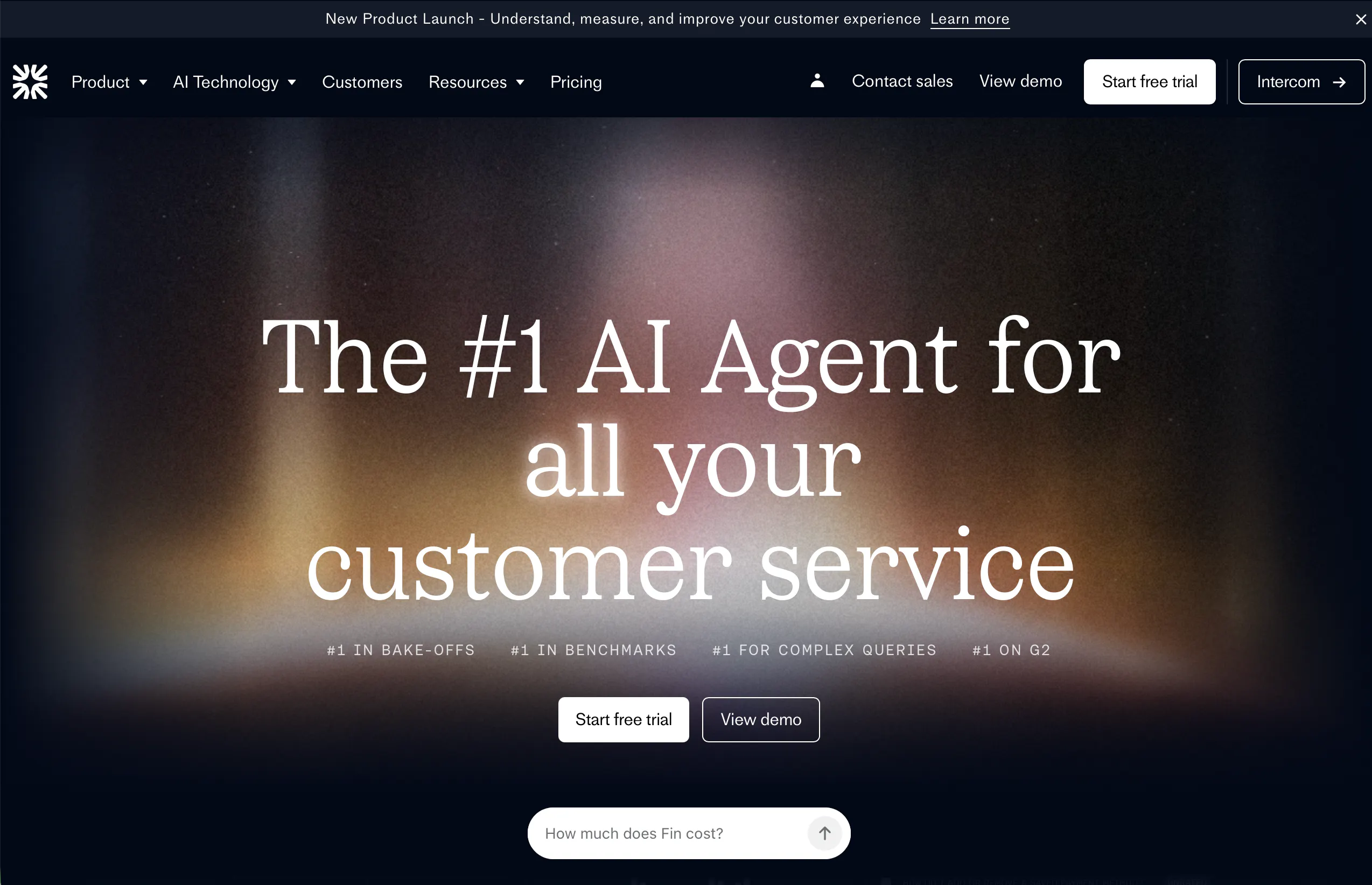
I work solely for Intercom, developing Fin, the best AI agent for customer service, and soon the best customer agent, full stop. It's a truly exciting time for software. So much uncertainty, so much opportunity — a combination of fear and excitement at every single turn.
Currently, Intercom is at $400M ARR, and Fin is about to cross $100M ARR.
Starting Intercom
When we initially built Intercom, our goal was simply to connect internet businesses with their customers. That is, to make it really easy for businesses and customers to communicate.
We thought that would be relatively straightforward, but 15 years and $400M in ARR later, it proved not as simple as we first hoped!
The first release included a JavaScript snippet, a user list, and an inbox. That was enough for every SaaS business back then to realize what they had been missing out on. It was a relatively large MVP at the time, because making it work reliably, securely, and at scale was no joke.
We primarily Ruby on Rails and React, but these days, most of the complexity in our domain is in the AI architecture, not the web app. You can learn about the technical challenges we face in our AI research blog, and see the Fin CX models we've shared data on.
Intentionally damaging the company
Our biggest challenge was reacting to AI. Before AI, we sold help desk seats to humans who manually answered questions. When we first saw ChatGPT, it became incredibly obvious that nothing would be the same again. No humans would buy seats, there would be no seats, and possibly no help desk. We had to adapt and react to survive.
We scrambled, and about 14 weeks later, we unveiled Fin. Fin has grown into one of the fastest-growing initiatives I've ever been involved with, certainly far faster than the original Intercom. It has significantly changed every aspect of our company: how we build, price, and market our technology, who buys our products, and how we sell them. Every aspect had to change.
I credit this to reading "The Innovator's Dilemma" by Professor Clayton Christensen in 2011, back when we were starting out. It has been massively beneficial as we've realized we're going through this extreme tectonic shift.
Had we perhaps not been as aware of how these technological trends play out over time, we might have been caught more flat-footed. Understanding the true nature of disruptive innovation—that it can happen very fast and that the path to survival almost always involves damaging your existing business — is essential.
So I'll say this: Being well-versed in classic business literature — not popular here-and-now blog posts, but things that have stood the test of time — has been really advantageous as we've navigated this kind of shift in tech.
If we started over, we would likely begin with an AI-native mindset, which would have upsides and downsides. The upsides would be not having to undo or unwork 15 years of tried-and-tested progress and processes. The downside would be lacking the same business stature, customer base, team, and so on.
I think it's right for a startup to constantly ask: "If you were reincorporated or reincarnated as a YC startup tomorrow, what would you build and why? Why aren't you building that today?"
Pioneering a new business model
Our SaaS business, Intercom, charges per seat. We've had trials and tribulations with our pricing, but it is now clear, and I'm quite proud of it. Our CEO, Eoghan, made many bold decisions to get it to this point, and it has paid off for us.
With Fin, we pioneered outcome-based pricing. We only get paid when our product does customer support properly for you. Neat, right?
Outreach, content, and webinars
People often ask me how Intercom got its first customers, so I wrote a post about it. The short answer is cold emails. And we did it 100% by hand. Then, we switched to content and webinars.
However, I warn readers that I don't think this advice is timeless.
We're moving to a post-trust world where people assume all content and outbound are slop (or at least AI-Generated), so punching through the noise is getting harder.
Where to focus when even AI faces the threat of AI
To paraphrase the unnamed narrator played by Ed Norton in Fight Club: "You've met software at a very interesting time in its life."
I don't know how to advise anyone these days. All my old principles are dead and gone, and the young ones are turning gray. Sometimes, restating the problem more clearly helps people, so here's how I see it.
You need to build a software business that still matters at a time when everything is becoming promptable. Even AI itself faces the threat of AI. So, I would focus on needs that don't change (à la Bezos), but also in areas where you credibly believe no company should ever solve them.
That might mean your price point has to change or the amount of ownership you take — e.g., don't be a small tool in a daisy chain, be a complete solve. I don't know.
But no matter what you build, assume someone will upload your screenshots, your HTML, and your feature list into Claude Code and effectively clone it. Make sure you still have a business when that happens — because it'll happen 5-10 seconds after you launch.
What's next?
From here, my goal is to ensure Fin and Intercom achieve their full potential, thereby improving the default internet experience for customers and the lives of internet business owners.
We share lots everywhere, our Fin Ideas blog, our AI research blog — and check out Fin, which has 8,000 customers from Anthropic to Asana and from Mercury to Miro — it works very well.

Leave a Comment
I actually built something similar but focused on detecting hidden financial leaks (subscriptions, fees, even crypto wallets).
Thinking of selling the full system — curious if this is something founders here would be interested in.
First off, I appreciate you sharing the book. I will definitely be reading Innovator's Dilemma. I think you did a great job by saying "You need to build a software business that still matters at a time when everything is becoming promptable. Even AI itself faces the threat of AI". Ironically, that is one of the main issues that I'm working on solving in the company I'm building. Many business moats are becoming meaningless. I know you mentioned two different companies and your post, the one that caught my attention most is Fin, because I work in customer service. How do you find and sell to businesses that would benefit from using Fin as a service? Also, is there an affiliate or referral program to refer Fin?
You can easily check your metro card balance online using Nol Balance Check . It’s a quick and simple way to view your remaining balance anytime without any hassle. Just enter your card details and get instant results, making your travel planning smooth and convenient.
Disruption hits business models before products.
whoever shifts monetization first captures the upside, the rest defend legacy.
Experience the latest features we’ve implemented—now available for free for a limited time. You can access and install the update directly via the Chrome Web Store: https://chromewebstore.google.com/detail/marginix-%E2%80%93-amazon-profit/gmgajlccniogemeeocgcnagpfngomloe Try it out today and let us know what you think. I'm available if you need any assistance or have questions during your trial.
NIce post. The line that stuck with me: "assume someone will upload your screenshots, your HTML, and your feature list into Claude Code and effectively clone it. Make sure you still have a business when that happens." That's the new defensibility question in one sentence. The old moats likeUI polish, feature breadth, even clever positioning can be replicated in an afternoon now. What's left is relationships, proprietary data, distribution, and owning a specific outcome end-to-end. Everything else is a commodity with extra steps.
Great read. Where to focus in the time of AI is an interesting question, as technology evolves ass fast as it is born.
HACKER EXPERT ALPHA KEY DATA RECOVERY
My name is Destiny Rodrigues, and I'm from Canada. After learning about cryptocurrency investments and how my coworkers have been profiting from them lately, it really caught my attention to invest as well. However, I had no idea that this was my biggest mistake—investing with the worry brokers and falling into the hands of scammers. Thank you again to Alpha Key Recovery for helping recover every coin and clear my credit card debit. Please get in touch with them right away if you become a victim of this kind.
WhatsAPP: +15714122170
Signal : +15403249396
Stories like this surprise me time and time again - not because of the build, but the scale. Never take for granted how big some markets are - I did not expect $400M would be in the "help chat" market.
Don't assume a market's size, and there is often room even in a crowded space. Well done!
Nice! How did you get your first users?
This looks really interesting 👏
Have you considered localizing for Japanese users? It could open up a strong market for you.
This is a great reminder, that distribution and community were always a huge part of building successful products, not just the product itself. The Web 2.0 angle is interesting too. Feels like we're seeing a similar shift now with AI, where the winners aren't necessarily the ones with the best tech, but the ones who understand how to position and evolve it over time .
Fascinating journey of yours! appreciated
HIRE BEST AI HACKER RECOVERY CRYPTOCURRENCY / BANK ACCT RECOVERY EXPERT OPTIMUM HACKER RECOVERY
I'm so delighted to be able to share this story with you all
I put 880k USDT in an online cryptocurrency investment platform and I was scammed out of everything! I lost hope and all my efforts have been given up! I had obligations to my family, and I was worried that I wouldn't keep them. I spoke with a few of my colleagues, but they were all unfavorable in their opinions. When I went online, I found a piece advertising "OPTIMUM HACKERS RECOVERY," a hacking collective with a reputation for recovering cryptocurrency / Bank account recovery, that had received a lot of favorable feedback. I decided to get in touch with them, and within a short period of time OPTIMUM HACKERS RECOVERY was able to retrieve all of my stolen USDT through AI Machine . Being able to recover my misplaced money was incredible. This piece of writing is for everyone who has also lost money investing in cryptocurrencies. please reach out to them on
Em ail: support @ optimum hackers recovery . com
Wha tsApp: + 1-256-256-8636
Web site: https :// optimum hackers recovery. com
Love the insight here. Being in that stage ourselves with ChaChing (launched on Product Hunt — #2!) it's refreshing to read about how Intercom got their first customers. We have more tools at our disposal now, but the core principle hasn't changed.
The line he ends with in their internal post stuck with me: "Just do all of it and one of two things will happen: either it starts working eventually, or you just can't do it anymore."
A breath of fresh air in a world that's always chasing the magic solution.
HIRE BEST AI HACKER RECOVERY CRYPTOCURRENCY / BANK ACCT RECOVERY EXPERT OPTIMUM HACKER RECOVERY
I'm so delighted to be able to share this story with you all
I put 880k USDT in an online cryptocurrency investment platform and I was scammed out of everything! I lost hope and all my efforts have been given up! I had obligations to my family, and I was worried that I wouldn't keep them. I spoke with a few of my colleagues, but they were all unfavorable in their opinions. When I went online, I found a piece advertising "OPTIMUM HACKERS RECOVERY," a hacking collective with a reputation for recovering cryptocurrency / Bank account recovery, that had received a lot of favorable feedback. I decided to get in touch with them, and within a short period of time OPTIMUM HACKERS RECOVERY was able to retrieve all of my stolen USDT through AI Machine . Being able to recover my misplaced money was incredible. This piece of writing is for everyone who has also lost money investing in cryptocurrencies. please reach out to them on
Em ail: support @ optimum hackers recovery . com
Wha tsApp: + 1-256-256-8636
Web site: https :// optimum hackers recovery. com
Great insight on embracing disruption early. The idea of “intentionally damaging the company” to adapt to AI is powerful—many businesses struggle with that shift. Fin’s growth really shows how fast things change when you move decisively.
Wow, this is a fascinating journey! I love how you framed the evolution from a simple messaging tool to an AI-driven platform like Fin. The point about disruptive innovation “damaging your existing business” really resonates it’s a hard truth many startups overlook.
Also, the shift from per-seat SaaS to outcome-based pricing is such a bold and smart move. The emphasis on building solutions that truly matter, especially in a world where AI can replicate features almost instantly, is a lesson for every founder and product team.
Thanks for sharing the insights and resources the AI research blog and Fin Ideas blog look like goldmines for anyone looking to understand the future of SaaS and AI-driven customer experience.
What stands out most:
— 'We intentionally damaged our existing business to survive AI.' That's rare. Most companies protect what they have until it's too late.
— Outcome-based pricing (Fin only gets paid when it actually does customer support) is bold. It forces the product to be good.
— 'Assume someone will clone your product 5-10 seconds after launch.' Brutal but true.
The Innovator's Dilemma mention is key. Most founders haven't read it. They should.
Quick question: What's the #1 piece of advice for a small SaaS (like TempQR, a tool for freelancers) trying to find its first 100 customers in 2026? Cold email? Content? Something else?
Thanks for sharing this.
Scaling to $400M ARR is more than just product-market fit; it’s an evolution from a Tool to a Systemic Philosophy. In 2026, the real challenge for platforms like Intercom is maintaining "Architectural Purity" against the pressure of enterprise bloat. How do you ensure the core "User Logic" doesn't get buried under layers of technical and cultural debt as the organization grows to this level of scale?
A Heartfelt Thank You to CYBERBERSPY for Recovering My Stolen Bitcoin
I am incredibly grateful to CYBERBERSPY for helping me recover my stolen Bitcoin and ensuring that I didn’t fall victim to another scam. Their professionalism and unwavering support throughout the entire recovery process were invaluable to me. In such a stressful and uncertain time, they provided the guidance and expertise I desperately needed.
I can’t thank them enough for their dedication and the peace of mind they gave me. If you’re ever in a similar situation, I highly recommend reaching out to CYBERBERSPY for assistance. They truly make a difference.
You can contact them at. (support (@) cyberberspy (.) c o m
Alpha Key continues to be the sole authorized cryptocurrency recovery hacker.
I'd like to extend a special greeting to everyone here and around the world. When it comes to cryptocurrency investing, you should be cautious about who you deal with. I thought things were going well at first, but after investing over $96,670 worth of bitcoins, things went south, and I was on the verge of suicide until I learned about Alpha Key Recovery Expert. Knowing them is one of the best things that has happened to me this year. Contact them right away if you have fallen victim of a bitcoin scam.
WhatsApp:+15714122170
Signal:+15403249396
This really highlights how much of early growth comes from talking to users directly.
I think many developers underestimate how much manual work is needed at the beginning.
Also interesting to see how small changes in onboarding can have massive impact.
That part about someone cloning your UI/HTML in 5 seconds with Claude Code is a massive reality check. It’s honestly a bit terrifying for anyone building right now. It feels like the 'moat' has shifted entirely from what the software does to the trust and distribution you already have. If you were starting Intercom today from zero, without the 15 years of brand authority, do you think a superior AI agent would even be enough to win?
Respect
The "intentionally damaging the company" point resonates deeply.
We faced a version of this when launching Novara Labs — we had
to decide whether to build a traditional agency model (proven,
safe, retainer-based) or go fully AI-native from day one
(unproven, risky, sprint-based).
We chose AI-native: 12 AI agents handling code, design, content,
and QA in parallel. The result is we deliver MVPs in 7-day
sprints for $10K–$15K that traditional agencies quote $50K–$150K
over 3–6 months.
Des's point about outcome-based pricing with Fin mirrors what
we're seeing — clients don't want to pay for hours anymore. They
want shipped products. The AI-native model makes fixed-scope
sprint pricing work because AI compresses production time by 3–5x.
The "clone it in 5 seconds" threat is real for features. But
it's not real for methodology. Our Compound Search Engine
framework for AI SEO (optimizing for Google + ChatGPT +
Perplexity simultaneously) took months of research to develop.
That's the moat — not the code, but the system.
Curious if other founders here are going AI-native from day one
or layering AI onto existing models?
Congratulations on your success. It is impressive to see how you transformed a side project into something with meaningful value. Alongside your persistence and ability to build trust, your decision to broaden the product when the opportunity became clear was evidently a key factor in that growth. Thank you for sharing your experience.
That “assume it gets cloned in 5 seconds” line really changes how you think about building.
Feels like the real shift now is from building features → building systems that are hard to replace. Not just the product, but the data, workflows, and how everything connects.
Also interesting how Fin wasn’t just a product shift but a business model shift (outcome-based pricing). That feels like the real moat, not just the AI layer.
Curious — do you think most early-stage founders should start AI-native today, or still build a simple wedge first and layer AI later?
If Intercom solved the human-to-business gap, I believe the next $400M ARR opportunity lies in the infrastructure that manages these agent-to-agent gaps. Would love to hear if anyone else is seeing these 'coordination failures' in their current AI workflows!
"Assume someone will upload your screenshots, your HTML, and your feature list into Claude Code and effectively clone it." That line should be printed and taped to every founder's monitor. The moat isn't the code anymore. It's the product decisions, the positioning, and the speed of iteration. Building is getting commoditized. Knowing what to build is not.
Comment 1: For intentionally damaging the company. ~
I found interesting that part about “intentionally damaging the company”. It is painful but also very real.
I’ve seen this happen in smaller projects as well what got you the first bit of traction slows you down later. This is especially the case when linked with identity (‘this is how we do’).
That is a simple way to see it.
At first, do the things that don’t scale.
In phase 2, put a system to what is working.
Phase Three: Ask Everything Again
That third step is often skipped.
How do you determine personally if something still works but needs to be broken? Is it about a slowdown in growth, or more of a gut feel?
Sick. You have my respect
Good move with Fin. I feel its pricey though to have to pay so much for ticket resolutions.
All these AI bots were a total disaster and humans need to be rehired back.
ohhhhh
"Don't be a small tool in a daisy chain — be a complete solve" is
the most underrated line here.
Most builders (myself included) default to building the smallest
useful thing. But in a world where Claude Code can clone your UI in
10 seconds, the only defensible position is owning the full workflow.
I'm rethinking my current project because of this.
great post 👏 really helpful
Des Traynor’s journey with Intercom and Fin is a masterclass in adapting to massive technological shifts. He emphasizes starting with a clear problem (connecting businesses with customers), building a strong product, and being ready to “intentionally damage” your own business when disruption hits - in their case, AI. Intercom’s success came from thoughtful MVP design, iterating on pricing, and leveraging content and outreach to gain early customers. With Fin, they pioneered outcome-based pricing and AI-first thinking, recognizing that old strategies may no longer apply. His advice for builders today is to focus on problems that matter, anticipate cloning or automation, and design businesses that remain valuable even when everything becomes easily replicable.
It’s a strong reminder that deep understanding of your market, openness to radical change, and leveraging timeless business principles are key to scaling and surviving disruption.
yes
The Innovator's Dilemma point lands differently when you're on the startup side of a disruption rather than the incumbent side. You had to damage Intercom to save it, most founders in that position convince themselves the threat isn't real until it's too late.
The 'assume someone will clone it 5 seconds after launch' framing is something I think about constantly building ResumeChiefz. My answer to it is the same as yours with Fin — the moat isn't the feature set, it's the domain credibility. I spent 10 years recruiting before building a resume tool, so when I say something works with ATS systems or hiring managers, that's not a prompt. That's pattern recognition from thousands of real hiring decisions.
The post-trust content observation is sharp and honestly a little unsettling. Curious how Intercom is thinking about cutting through that noise for Fin specifically.
great post 👏 really helpful
The bit about staying close to customers even at scale is something most founders say but few actually do past Series A. Des walking into support queues personally is such a flex.
The other takeaway for me: they didn't try to be everything on day one. The messenger was the wedge, everything else grew from understanding what customers actually needed next. So many of us (myself included) try to launch with the full vision instead of the minimum wedge.
The moat question hit home.
I'm building EchoLive, a live streaming platform for small and mid-tier creators. The tech is replicable. What isn't is the community of creators who chose us before we were anything.
Your point about Fin: the business model change was the real innovation, not the AI itself. That's what I keep coming back to. Twitch and YouTube's problem isn't their tech, it's their economics. 50% cuts and algorithm bias that rewards who's already winning. We flipped it: 60/40 in the creator's favor, discovery based on engagement not spend.
The 'reincorporated as a YC startup' question is one I ask myself constantly. The answer keeps coming back to the same thing: build the community before you build the product. The product can be cloned. The trust can't.
Great piece. The Innovator's Dilemma reference is underrated, most founders read it too late.
the 'intentionally damaging the company' framing hit hard. we've been going through something similar — rebuilding parts of our PM tooling around AI agents even though the old workflow was fine. hardest part is getting the team to accept the timing feels premature. what did internal resistance look like when Des pushed to build Fin?
Really insightful — the idea of “intentionally damaging your own business” to survive AI shifts really stood out.
Feels like most founders try to protect what’s working instead of adapting early. Also agree that when everything becomes easy to clone, distribution and real value matter way more.
Curious — do you think MVP speed still matters as much today?
Really enjoyed this — especially the part about Intercom coming from a real problem they had themselves.
Feels like that’s the common thread with a lot of the best products. It’s not “let’s build a startup”, it’s “this thing is painful, let’s fix it properly”.
Also interesting how unglamorous the early days actually were — reaching out to customers one by one, figuring things out as you go. That part often gets skipped over, but it seems like that’s where most of the real learning happens. :contentReference[oaicite:0]{index=0}
I’m kind of in that stage myself at the moment — built something to solve a problem I kept running into, and now realising the hard part isn’t building it, it’s getting it in front of the right people and actually understanding how they use it.
Did you find that early customer conversations shaped the product more than anything else, or was there a clearer vision from the start?
Curious—are you replying to every signup instantly or manually?
The outcome-based pricing move with Fin is worth pausing on — it's not just clever pricing, it's a structural moat play. Seat-based pricing meant customers were paying for access regardless of value delivered. Outcome-based pricing only works if your resolution rates are high enough to justify it, which means Intercom is voluntarily raising the bar on themselves. Competitors who can't match the resolution rate can't match the pricing model, which means they can't compete on the buyer's preferred terms.
The "intentionally damage the company" framing is exactly right and almost nobody does it. The instinct is to protect the existing revenue line. The companies that survive platform shifts tend to be the ones who treat their current business model as a liability to be eliminated before a competitor does it for them.
One thing I'd add: the clone-it-in-5-seconds threat Des mentions is real for the feature surface, but not for the corpus. 15 years of B2B support conversations, trained on actual resolution flows, is not promptable. That's the durable part of Fin's moat — the model trained on their proprietary data, not the chat widget anyone can replicate.
This is such a rare mix of founder honesty and long‑term thinking. The way you describe “intentionally damaging” a successful seat-based business to bet on Fin, plus pioneering outcome-based pricing, feels like a live case study of Innovator’s Dilemma done right. The reminder that we’re in a world where anyone can screenshot your product and clone it with AI in seconds really sharpens that last point: you can’t just ship features, you have to build something that still matters after you’ve been copied.
The rapid growth of online shopping in the UAE has created exciting opportunities for businesses of all sizes. However, success in the digital world requires more than just a great idea—it requires the right tools, strategies, and professional support. That’s why Shopify Partners in UAE have become essential partners in the modern business landscape.
The "intentionally damaging the company" framing is the most honest description of what AI adoption actually requires from established products. Most companies talk about AI transformation while secretly trying to preserve the existing revenue model. The ones that survive are the ones willing to cannibalize themselves before someone else does — which is exactly what Innovator's Dilemma predicts and almost nobody actually executes. The last paragraph is the one that matters most right now: assume someone will clone you 5 seconds after launch. The only defensible position is either a network effect, a proprietary dataset, or a relationship with the customer that a clone can't replicate instantly. For most AI-native startups launching today, that's the real strategic question — not "can we build this" but "what do we have that Claude Code can't reproduce in a weekend.". Great Read btw!!!
This comment was deleted 3 months ago
This comment was deleted 2 months ago
This comment was deleted 3 months ago