Dialing in an AI product's ICP and growing it to $400k ARR

Snow Lee is a 3x founder who is currently solving a problem he faced at his last company by building Runbear.
After struggling to find his ICP, he finally dialed it in and grew his company to $400k ARR.
Here's Snow on how he did it. 👇
A 3x founder solving his own pain points
I'm a 3x founder and have been building software startups for the past 16 years with my co-founder, Liam. I previously founded and sold two companies, and also led products as CPO at Buzzvil, where I helped grow annual revenue to $80M.
At my previous company, I led seven teams simultaneously. It was exciting, but exhausting. I was constantly context-switching, and the cognitive overload was brutal.
That experience made me realize how much time teams waste on repetitive communication. I wanted to build something that could help people offload that mental load, something that works with you, not for you.
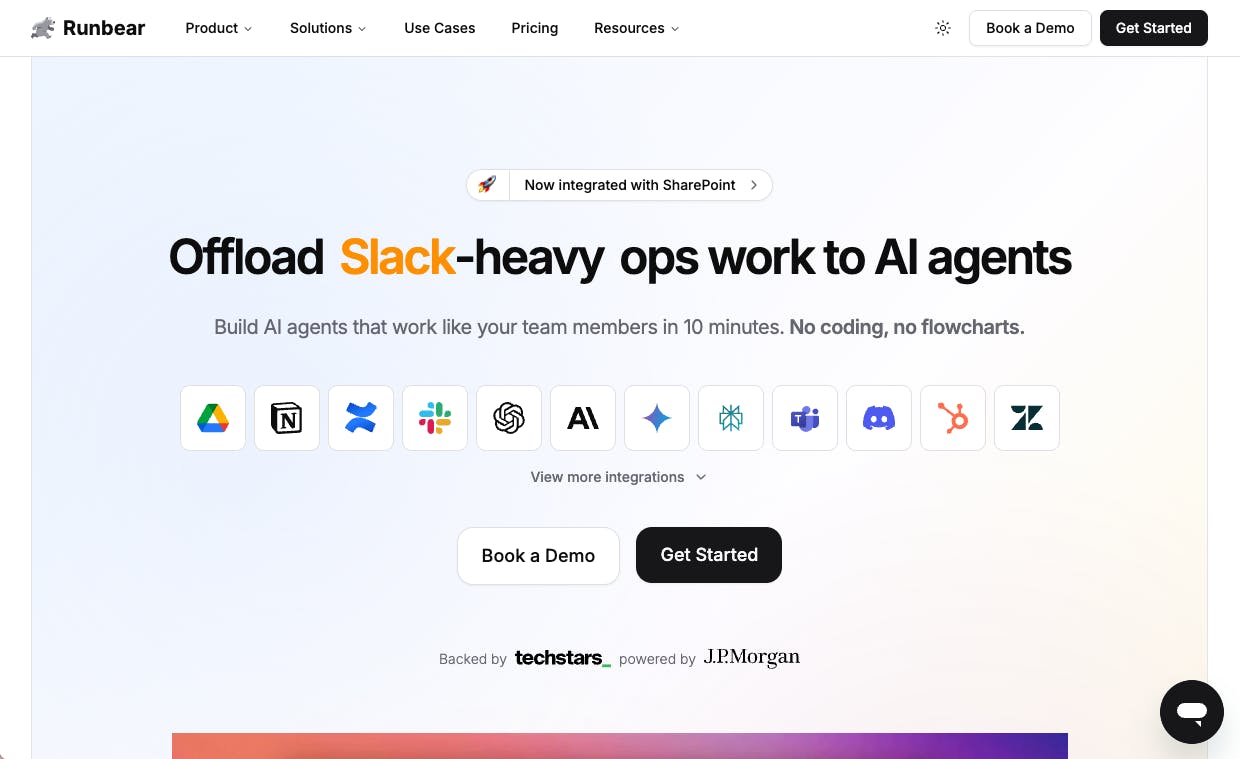
That's why I’m building Runbear, a platform that helps non-technical teams create their own AI agents effortlessly. Our mission is to make AI feel like a real team member — one that can understand conversations, take initiative, and proactively help teams get work done.
We're currently at $400k ARR.
The challenge for finding your ICP
Our biggest challenge to date was defining our ideal customer profile. Since Runbear could technically help anyone build AI agents, we had to learn who got the most value.
Our first version was an AI copilot for DevOps engineers, but we quickly realized we were competing with our own customers — engineers wanted to build their own agents. So, we pivoted to helping teams utilize AI agents more easily.
Then, we discovered something surprising: Non-technical users — leaders, customer success, account managers, and operations teams — were the ones most eager to use our solution. The reason was that these communication-heavy roles benefited hugely from Runbear's ability to monitor messages and automatically take over tasks.
What surprised me most was how clear their intent already was. Even without understanding how AI works technically, our customers knew they needed it. They weren’t curious about the technology itself; they were focused on outcomes.
So, we refocused Runbear on helping non-technical teams harness AI effectively. And now, our strongest champions are team leaders, people who want to stay ahead and empower their teams through AI. And almost every customer starts with the same use case: answering repetitive questions.
It’s a simple but powerful entry point that quickly demonstrates value and builds trust in what AI can do for them.
If I had to start over, I’d focus on finding the killer use case first, before expanding the product’s capabilities.
How to find your ICP
To find our ICP, we started by analyzing existing use cases and identifying which customers were getting the most consistent value from Runbear. Then, we conducted in-depth customer interviews to understand their workflows, pain points, and expectations for AI assistance.
From there, we mapped out industry opportunities and prioritized problems that were either urgent, frequent, popular, or expensive, ideally hitting more than one of those criteria.
This framework helped us narrow down to customers who rely heavily on communication, such as account managers, support teams, and operations leaders, who now form our core ICP.
Boosting revenue per account
Until July, we had a single subscription plan, which helped us simplify growth early on. We had only one hard limit: the number of AI agents customers could create.
Many of our customers started reaching out to remove that restriction, which showed us a clear demand from power users. So, instead of just unlocking the limit, we decided to introduce a new business plan that better supported those teams, while charging more fairly for the added value. We wanted to test if enough customers were willing to pay more, and the strong response confirmed that they were, giving us confidence to move forward. We have already onboarded over 20 higher-paying customers, which has significantly boosted our revenue per account. There has been no churn from these users so far.
A tech stack that learns
Here's our tech stack:
TypeScript
Vercel
Supabase
Multiple AI models
Claude: Core generation model
OpenAI: Evaluation, knowledge extraction, and response compression
And we support Gemini and Perplexity if users want them as their core generation model
Runbear’s biggest advantage is our team-member approach.
Instead of asking users to build complicated rule-based workflows, our AI learns how to work like a human teammate: observing, understanding, and acting naturally.
The agents analyze message intents to understand what’s happening in conversations, then decide whether to step in or stay silent, just like a thoughtful coworker would. When action is needed, the AI can plan the task completion process, execute steps, and even learn how to improve through ongoing conversations. Over time, it adapts to the team’s workflow naturally, extending its capability.
Although there are many ways that we ensure that AI acts as a teammate in this way, one example explains it best. When you ask the AI to do something it can’t do yet, it will ask you how to complete the task, just like a new hire would. You might say, "You can find the revenue data from Stripe," and it will learn and remember that instruction for the future. Over time, it builds knowledge across 2,000+ services, gradually becoming smarter and more capable, truly acting like a teammate who learns by doing.
That simplicity means anyone, not just engineers, can have AI agents that truly collaborate with their team.
Organic growth
We’ve grown mainly through content marketing and creator collaborations.
For content marketing, we mostly publish use cases, building guides, and customer success stories. For creator collabs, we publish youtube videos, X posts, and LinkedIn posts to introduce use cases of AI agents, and how to build them using Runbear.
Our SEO strategy has been effective, too. We’ve secured keyword positions that keep bringing in new users organically. To get there, we published content that was centered on keywords related to using AI agents in communication channels. Now, we're changing our focus slightly to keywords related to our ICPs and their use cases.
Success comes from staying in motion
Just start. Don’t overthink it. But once you start, keep evolving fast.
The market moves constantly, and your job as a founder is to adjust quickly. Build, learn, pivot — repeat.
Success comes from staying in motion.
What's next?
My life goal is to build a company that lasts 100 years. For Runbear, our vision is to become the de facto standard for hiring AI teammates.
In the short term, we’re focused on reaching $2M ARR and continuing to expand our customer base globally.
You can follow along on my personal blog. And check out Runbear!

Leave a Comment
charlesgagnon055@gmail is my google email.
As a software engineer, I am very interested in your idea.
Please discuss about your project.
I am open.
Thank you.
Charles Gagnon.
Great post here! Would you be interested in writing about BigIdeasDB too?
We will find it pretty helpful. Is there any price you charge?
The ICP clarity shift you described — from "anyone using Slack" to "ops-heavy teams with repetitive internal requests" — is exactly the conversation we keep having in B2B enterprise deployments, except the pressure to have it comes from a different place.
In enterprise, the buyer forces the ICP question before the contract. In product-led, you often don't get that pressure until you're already staring at churn data.
The brutal part: the signal is the same. Someone is paying you to solve a specific operational pain, not to "use AI." Once you find the person whose pain is specific enough, the ICP usually writes itself.
The pivot from DevOps engineers to non-technical users is the key insight here. Building for people who can build it themselves is a losing game — they'll always prefer their own solution. Building for people who desperately need it but can't build it themselves is where the money is. We learned something similar. Started building a multi-model AI tool aimed at developers. Developers just use the APIs directly. The people who actually pay are teams who want AI collaboration without managing multiple subscriptions and API keys. Same pattern — the less technical the user, the more willing they are to pay for a clean solution. The "find the killer use case first" advice is gold. We wasted months building features nobody asked for when the thing users actually wanted was the simplest feature in the stack.
The ICP pivot from DevOps engineers to non-technical teams is such an underrated lesson. So many AI startups try to sell to developers who can just build it themselves. Going after people who CAN'T build their own solution but desperately need one is way smarter positioning. Wonder how much of their churn dropped after they made that shift.
This is incredibly valuable! I am 17 years old from Kerala India currently trying to dial in the ICP for CompeteIQ — my AI competitive intelligence tool for early stage SaaS founders. The hardest part I am finding is that everyone says they want better competitive intelligence but the ones who actually feel the pain urgently enough to pay are a much smaller specific group. From what I am learning the most important ICP signal is not demographics but urgency — founders who have an investor meeting coming up or just lost a deal to a competitor they didn't know about. How did you identify the difference between people who were interested versus people who were truly urgent buyers for your AI product?
Snow, the ICP pivot story is underrated. Most founders think the product is the problem when growth stalls — you figured out it was the audience.
I'm building InnerSpark Idea Engine, an AI clarity system that helps founders define who their product is really for before they build. The "struggling to find ICP" phase you went through is exactly the bottleneck I'm trying to eliminate. Getting clear on the right customer early would have unlocked your $400k ARR path months sooner.
Runbear's story is a strong case for why ICP clarity isn't a marketing problem — it's a product strategy problem. The product didn't change much; the customer definition did. That's the kind of insight InnerSpark is built around.
Great post.
“A river cuts through rock not by power, but by persistence.”
Simple, but really beautiful and true.
The ICP clarity is impressive. Most people (me included) start with "anyone who uses AI tools" which is way too broad. How did you narrow down to that specific profile? Was it through customer interviews, analytics, or just testing different messaging and seeing what stuck? I'm at the validate stage right now and struggling with whether to niche down or stay broad to see what resonates first.
The ICP pivot is something I'm going through right now with TubeSpark. Initially targeted all content creators, but YouTube creators specifically have a much more acute pain point (73% quit due to creative block).
How did you validate the new ICP before fully committing? Did you run ads to test or just pivot based on early user conversations?
icp work is boring but its the whole game. most ai products fail bc they try to be general.
one trick: write the 10 job titles you sell to, 10 keywords they use, and the 3 outcomes they pay for. then cut everything else.
This is a great breakdown.
One thing I’m curious about: did your ICP become clear before or after the AI started working?
We were scoping an AI feature and realized our problem wasn’t intelligence. The problem was that different user segments expected very different outcomes from the product. The 'smart' behavior made that mismatch more obvious.
We paused the AI work and spent time narrowing down who the product was really for. Once that was clear, the AI use cases looked very different (and smaller) than what we initially planned.
When you were dialing in your ICP, was there a moment or metric that made you confident you’d found the right one?
This post shows how defining the right customer can change everything. The founder of Runbear struggled at first, then shifted focus from engineers to non-technical, communication-heavy teams and hit $400k ARR by learning from real use cases. It’s a great lesson on product-market fit and staying flexible.
This part about dialing in ICP really stands out. I’ve seen teams assume the problem is distribution, when it’s actually clarity on who the product is not for. Curious how long it took before you felt confident saying no to certain segments.
Looks like a great product. I am also currently figuring out my ICP.
The pivot from targeting DevOps engineers to non-technical teams really resonated with me. It's a perfect example of how the "wrong" customer can reveal the right one.
I'm curious—when you realized engineers preferred building their own agents, was there a specific moment or pattern in customer conversations that made the non-technical opportunity click? Or was it more gradual observation through usage data?
The "AI as a teammate" framing is powerful, especially the example of the agent asking how to complete tasks it doesn't know yet. That learning behavior feels like the real unlock for adoption beyond early adopters.
Interesting, I wish there was a blueprint we can follow of getting customers for SaaS
Really relatable journey. The way you refined your ICP through real users not guesses shows how clarity drives growth. Great lessons here.
Dialing in the ICP through real usage rather than assumptions is a strong takeaway here. The “AI as a teammate” framing—especially starting with repetitive questions as the entry use case—feels like a smart way to build trust and expansion. Curious how you decide when an agent should proactively step in versus stay silent without creating noise for teams?
Lately I’ve been thinking less about feature velocity and more about long-term system responsibility.
A lot of products don’t just “serve users” anymore — they shape behavior, decisions, even emotional states. That puts developers in a role that looks a lot more like stewardship than just shipping code.
Perhaps Developers will need to become behavior experts.
I’m also struck by the human costs, jobs and hardships on some.
Social responsibility and ethics in Development must be discussed
Really enjoyed this — finding who truly gets value first before expanding makes such a difference. The shift from a broad technical audience to non-technical teams who benefit from clear outcomes feels like a universal lesson for AI products. Congrats on the $400k ARR milestone and thanks for sharing concrete ICP learnings!
This article is amazing! The content is very in-depth, and I've learned a lot. Looking forward to reading more!
Really interesting take on narrowing the ICP for an AI product.
What was the hardest signal to trust when deciding who not to build for as you refined the ICP?
The moment you described non-technical teams caring about outcomes, not AI itself - that's such an important insight. Feels obvious in hindsight, but painful to discover.
I'm building CTOx AI (ai.ctox .pro) around this exact problem: helping founders slow down just enough to make the right early calls. This story is a great example of why that matters.
Really appreciated how you showed that growth becomes more predictable once the right data starts coming in. It was great to see how your research led you to focus on defining your ideal customer profile.
I spent 15 years managing brand and marketing teams, and now, as a solopreneur I build most of my research myself. Getting clear on your WHO saves time, strengthens partnerships, and prevents wasted spend. You're positioned for exponential growth. Many companies are looking for the "HOW" and direction.
How did you validate your ICP early on before you had much volume?
If you'd like to try AI-powered marketing, I recommend Amplift .ai . It can help solve problems you encounter in marketing, including SEO, AEO, writing, and more.
Amazing breakdown, Snow, especially the part about refining your ICP by observing who actually gets repeated value. That’s where most AI founders get stuck.
One thing worth noting as you scale Runbear: the exact non-technical roles you’ve now identified as your strongest ICP (CS, Ops, AMs, team leaders) are extremely active on Reddit. Sub-communities built around workflows, productivity, and AI-assisted work consistently outperform traditional channels for products like yours, especially when the content frames AI as a “teammate,” not just a tool.
I help founders map their ICP to the right subreddits and craft posts that avoid moderation issues but reliably drive real engagement and conversions. If you’d like a quick breakdown of where your ICP already hangs out and the content angles that work best, happy to share it.
I followed your work. I wish you success.
This was a great read — especially the part about how your ICP shifted from DevOps engineers to non-technical, communication-heavy teams.
I’m curious about one thing: When you realized engineers preferred building their own agents, how did you validate the pivot direction so quickly? Did you run structured interviews, or was it mostly observational from early usage patterns?
The “AI that behaves like a teammate” approach is a strong differentiator. The example of the AI asking how to complete a task it can’t do yet feels like a huge unlock for adoption.
Amazing progress so far — $400k ARR with such a clear ICP is really impressive.
James, your background is seriously impressive. Interviewing hundreds of founders gives you a storytelling advantage that fits perfectly with how trust is built on Reddit. dbrief and LoomFlows also align really well with the kind of transparent, insight-driven content that performs in niche subreddits. If you ever want feedback on positioning these tools or your newsletters across relevant Reddit communities, I’m always happy to share insights.
Great read. The way you tied product evolution to ICP clarity is something a lot of founders overlook.
I’m curious: when you increased revenue per account by introducing higher tiers, what gave you confidence that existing customers wouldn’t churn? Pricing transitions are tricky, so your experience here is super valuable.
IF YOU WANT TO RECOVER YOUR STOLEN BTC CONTACT GEO COORDINATES RECOVERY HACKER FOR ALL KINDS OF HACKING JOBS
The internet today is full of scammers. But here is some good news to everyone who has been a victim of internet scammers. You can get your money back from the scammers. If you have been a victim to internet scammers, then you should contact GEO COORDINATES RECOVERY HACKER. I have been a victim of online scams. I lost $723,000 worth of BTC. I saw where so many people recommended GEO COORDINATES RECOVERY HACKER. Hackers who have dedicated time to helping individuals to get back their money from internet scammers. Recovering lost Bitcoin can require unique hacking skills and expertise that are possessed by only a handful of professional hackers, it’s best to seek out a trusted hacker like GEO COORDINATES RECOVERY HACKER who can help you recover your funds. Am here to give glory to GEO COORDINATES RECOVERY HACKER. You guys did a great job for me. And all of this was done at an affordable price. Thanks a lot. To get in touch with the recovery hacker, you can contact them via
Telegram; @Geocoordinateshacker
Great post! Scaling AI products takes careful planning. For founders looking to launch AI agents fast, RubikChat is a no-code platform that lets you build and manage AI agents in minutes — from customer support bots to research assistants.
HOW I RECOVERED MY LOST CRYPTO FROM FAKE BROKER ONLINE.
I had lost over $752,000 by someone I met online on a fake investment project. After the loss, I had a long research on how to recover the lost funds. I came across a lot of Testimonies about THE HACKANGEL RECOVERY TEAMS. I contacted them providing the necessary information and it took the experts about 48 hours to locate and help recover my stolen money. If anyone is looking for a Recovery firm to Recover your lost Crypto. You can contact THE HACKANGEL RECOVERY TEAMS . I hope this helps as many out there who are victims and have lost to these fake online investment scammers. You can contact them by using Email OR Phone
WhatsApp +1(520)200-2320
Awesome breakdown! Dialing in the ICP clearly is key, and scaling an AI product to $400k ARR shows how targeted growth strategies really pay off.
great writing and thoughtful work
Trabajar con empresas que recién están adoptando IA te obliga a pensar distinto.
Aprendimos que:
• Las empresas no quieren más dashboards, quieren decisiones.
• La IA que no se integra al negocio, muere.
• La clave no es automatizar más, sino automatizar mejor.
• Cuando se explica la tecnología en lenguaje humano, la adopción se acelera.
• Cada caso de uso tiene su propio “mapa operativo”.
En Nexia Capital no hacemos implementaciones genéricas.
Cada proyecto requiere entender la cultura, la operación y los límites reales del negocio.
La IA sin contexto es ruido.
La IA con contexto es valor.
Snow, this story captures the quiet turning point every founder faces — when clarity about your ICP stops being a metric and starts being a mirror. That’s when real growth begins.
that's ingenious. “A river cuts through rock not by power, but by persistence.”
This is such a refreshing and insightful post — really loved how clearly you walked through the evolution from DevOps focus to empowering non-technical teams.
The “AI teammate” angle feels spot-on. Most tools still treat AI like an assistant that waits for commands, but building something that acts like a proactive team member is a real paradigm shift. Also love the practical approach to pricing — letting usage and customer behavior guide the next tier is exactly how it should be done.
Congrats on hitting $400k ARR and building something with such strong product-market clarity. Excited to see Runbear grow into that “AI teammate” standard you’re aiming for!
Thank you for sharing, it has been very rewarding.
Love the focus on making AI feel like a real team member rather than just a tool. Your approach to finding the ICP through observing real workflows and zeroing in on communication-heavy roles is really smart—it shows the power of starting with the problem, not the tech. The ‘learns by doing’ feature is such a clever way to reduce onboarding friction and build trust. Lots of actionable lessons here for anyone building AI products for non-technical users.
This is a solid breakdown, Snow.
Your journey in refining the ICP is valuable. Many founders skip that step and end up marketing to everyone. I’ve seen similar patterns on Reddit while helping startups grow there. Posts that speak directly to a well-defined audience always perform better than generic launches.
Runbear’s “AI teammate” angle is clever positioning. If you ever plan to test Reddit for organic visibility or feedback loops, there are a few niche subreddits where this type of product story does really well.
I appreciate the focus on staying in motion. That mindset works for every channel.
Those numbers are crazy for me, nice to see what can be achieved! I also found it hard to manage so many people in my old job, always needed to change the attention so fast. I'm also struggling to find the ICP for my first startup, because its pretty generic. I think I need some users first du then analyse.
Loved this breakdown. The way you narrowed down the ICP and aligned product messaging around real pain points is textbook product-market fit execution. Also appreciate the transparency around pricing experiments and the “no free tier” decision—bold but clearly effective. Thanks for sharing the playbook!
Helping AI Startups Secure Their Cloud (Free for 2–3 Founders)
Hey founders, I’m cyberdammiy, a former SOC analyst now focused on cloud security for AI startups in health, fintech, and legal tech.
I’m currently building a new portfolio of case studies and looking to collaborate with a few early-stage B2B startups who want to:
✅ Get investor-ready on cloud security
✅ Understand LLM-specific risks (prompt injection, data leakage)
✅ Avoid common AWS/GCP misconfigurations
✅ Build trust with partners and enterprise clients
If you’re building something amazing but know your cloud security posture isn’t where it should be I’d love to help you fix that. For free.
What I’m offering:
A lightweight Cloud Security Starter Review
LLM threat surface check
Compliance readiness checklist (SOC 2, HIPAA, GDPR)
A short PDF report you can share with investors or partners
This is ideal if:
You don’t have a security hire yet
You’re preparing for a raise or enterprise deal
You want to avoid security debt while scaling fast
I’m taking on 2–3 startups right now in exchange for honest feedback and a testimonial I can use in my portfolio.
Drop what you’re building below or DM me let’s make your security posture a competitive advantage.
The transparency is top notch. Followed your work. wishing you the very best
Amazing journey, Lee! I’m also building an AI project in the emotional support space, but struggling to find real user engagement. How did you first test your idea before finding your ICP?
Thanks for sharing all this information, its a gold mine
Yes found some same correlations, though behaviour of a very cold machine was devout of that comarardriship i found that they stuck with me as long as i had the dosh [money for everyone else], it was like in the olden days you insert money into the meter and the electricity came on, that is how AI is , and everytime its a person with Parsons disease no idea until you tell them, though hard it was also good
Really interesting. I’ve been building a few AI tools myself (like an interview prep kit and a PDF reader), and finding ICP clarity is easily the hardest part.
Did you narrow down through data or user conversations? I’m trying to refine mine now and could use some perspective.
thanks for the work ! very useful
that is amazing
I followed your work. I wish you success.
Awesome breakdown, Snow The shift from targeting DevOps engineers to focusing on non-technical, communication-heavy teams is so smart. The “AI as a teammate” mindset really resonates, and your journey to $400K ARR shows how crucial finding the right ICP is. Thanks for the transparency and lessons!
The transparency in your ICP discovery process is totally refreshing and obviously hectic. I can totally relate to your ICP struggle coz I know how much clarity comes from user interviews vs assumptions.
By optimizing outreach, focusing on high-value segments, and improving retention, we were able to drive steady growth and achieve $400K ARR.
Really interesting journey.
I’m experimenting with a few AI side tools now, and nailing the ICP feels like the hardest part. Did you find clarity through usage data or conversations with your users?
This was a truly insightful read on the journey from identifying the ICP to achieving significant ARR. It's fascinating how Runbear pivots to empower non-technical teams with AI agents, addressing real pain points. The emphasis on a 'team-member' approach for AI agents is particularly brilliant, making AI feel more integrated and less like a tool. I also appreciate the breakdown of how to identify the ICP and the strategy for organic growth. Great work!
Cool project! I’m working on something travel-related too and love seeing early MVPs like this.
HR in SMBs would benefit exponentially. The tactical part of HR is brutally repetitive and could be better served with AI so the value-add work (career pathing, leadership development, employee relations et al., which require human judgement and a wholistic view of the employee lifecycle) can be built, delivered, improved.
Love this breakdown — especially the part about competing with your own customers when the ICP was engineers.
Your pivot toward communication-heavy, non-technical teams is such a sharp insight: people don’t want “AI agents,” they want mental load removed and outcomes they already understand.
Also enjoyed how you framed the entry use case:
repetitive questions → quick trust → expansion
That’s a playbook worth borrowing.
Thanks for sharing the lessons in such a transparent way — cheering for Runbear’s 100-year plan. 🚀
Dialing the ICP from “AI for everyone” to a narrow job-to-be-done is exactly how you unlock $400k ARR without burning cycles.
The wins you called out map cleanly: sharper persona → clearer promise on the homepage → onboarding tuned to one “first win” → pricing that mirrors the value moment. That sequence is the difference between scattered interest and compounding retention.
Curious on two fronts:
What single activation best predicts a paying account; first successful workflow, a second project created, or inviting a teammate?
Of your channels, which consistently brings paying users (not just trials); problem-led SEO, founder content, or integration marketplaces?
P.S. I’m with Buzz; we build conversion-focused Webflow sites and pragmatic SEO for product launches. Happy to share a tight 10-point GTM checklist if useful.
Super inspiring journey. The pivot to non-technical teams feels like a huge unlock — curious how Snow validated that shift early on. Was it through usage data or direct customer interviews?
It's great!
Great insights on refining ICP and scaling efficiently 👏. I’ve also seen how focusing on user habits and retention can drive long-term growth. In the health-tech space, we’re building an BrushO AI-powered smart toothbrush with a lifetime free brush-head program. By combining smart feedback with consistent user engagement, retention and referrals improve dramatically.
As an AI product manager, I strongly resonate with Runbear’s idea of “AI as a team member.” In our own product, we also try to make AI more integrated into users’ workflows, rather than just a tool. Snow’s point about “finding value by observing user behavior” has given me a lot of inspiration. It would be even more helpful if he shared how he specifically identified these pain points during early user interviews!
This really hit home. I love how you turned your own burnout and cognitive overload into a product that helps others solve that exact pain. The “AI as a teammate” idea makes so much sense. Most people still think of AI as a tool you have to command, not something that can observe and act like a human coworker.
Also totally agree about the ICP part. I made the same mistake early on - building something too broad and assuming everyone could use it. Took me months to realize that one narrow, high-intent use case is what actually drives adoption.
I’m curious, when you shifted from DevOps to non-technical teams, did your product messaging change a lot too? I always find that part the hardest , making technical products sound approachable without dumbing them down.
What an excellent idea! A month ago, I had a similar concept that I intended to develop, but I am currently validating one of my other ideas. I am delighted to see such a product. I wish you all the best in your endeavors, Snow!
Really appreciate how you approached growth through ICP clarity rather than quick acquisition tactics. Most AI founders rush into scaling without truly defining who they’re building for, and this post shows the opposite , focus first, then growth follows. It’s a reminder that alignment and discipline are what compound over time.
Really inspiring story — dialing in an ICP is one of the toughest yet most defining parts of building an AI product. The way Runbear focuses on turning AI into a real teammate is impressive. I’ve recently been exploring how creativity and usability shape user experience, both in AI tools and visual platforms. One of the projects I follow for design inspiration is a creative platform called PicsArtDownloadAPK dot com, which shows how user-focused design can drive engagement. Great insights — especially about learning from user intent and keeping the product evolving!
Love how clearly you framed the ICP pivot, I went through something similar and it’s wild how obvious the right audience feels after you find them. Really sharp lessons here.
Phenomenal breakdown, Snow! The journey from DevOps-focused users to non-technical teams is such a critical pivot that many founders miss. I love how you found your ICP by actually watching who got value vs who you thought would. The 'AI as a teammate' positioning is brilliant and solves real team communication overload. Congrats on $400k ARR - excited to see you hit that $2M goal!
This was such a solid breakdown of how to find and refine an AI product’s ICP — I really liked how you tied it back to customer discovery and iteration loops. I’m currently building an app, and this post helped me rethink how I’m defining my user personas. Thanks for sharing such a detailed playbook — super valuable for indie founders like me. Thanks for sharing, Snow!
Really enjoyed this, Snow. The way you discovered your ICP through real user behavior and then focused your offering is gold. I’m working on a similar path with one of my own tech businesses — building toward a clearer customer profile, and yes, prepping for what comes next (including a possible transition).
If anyone here is ever interested in a venture that’s ready for next steps, feel free to DM me — I’d love to connect with folks who have been through that process.
Worthful Insights
Super inspiring story love how you turned a complex AI concept into something approachable for non-technical teams.
The “AI as a teammate” framing is brilliant. Following along, and congrats on the $400k milestone!
wonderful read!
This content is very very helpful
wow great insights
Now that you've onboarded 20+ customers onto the higher-paying plan, have you identified a common thread among those teams that allows them to scale with Runbear more quickly than others?
Really insightful read! I love how Snow identified the real pain points and adjusted Runbear’s focus to non-technical teams shows how important it is to stay flexible and listen to your customers. The approach of AI as a teammate rather than just a tool is especially refreshing. Looking forward to seeing how Runbear evolves and hits that $2M ARR milestone!
Thanks for the thoughtful comment! It’s true focusing on real user needs is key to growth. By the way, if anyone’s interested in tools to help with investment decisions, I recently created a handy stock average calculator that simplifies tracking your average stock price. Would love for you to check it out!
Scratching where it itches - is the best way to create an awesome product
This is great
solving your own problems is the best pmf.
Good insight
Love how burnout was turned into a product that eases mental load — the “AI as a teammate” concept is especially impressive.
Love this story — turning burnout into a product that actually reduces mental load is brilliant. The “AI as a teammate” idea really stands out.
That's a remarkable feat. Getting the perfect client profile right transforms everything; once you know precisely who you are catering for, expansion becomes very more predictable. I have seen this same idea hold true throughout several marketing efforts; audience clarity always yields better outcomes.
Great insights
Great insights, Snow! Your pivot to non-technical teams for Runbear’s AI agents is brilliant, solving real communication pain points with a $400k ARR to show for it is no small feat. The "stay in motion" mindset is key in this fast-moving AI world, and your story proves it.
For anyone chasing high-octane thrills instead of workflows, check out for the ultimate modded racing experience with unlimited cash and cars. What's next on your roadmap, Snow? Keep rocking it!
Great insights, Snow! Totally agree with focusing on the right user base and tackling communication overload—looking forward to seeing your journey unfold!
I found this story really insightful, especially the part about refining the ideal customer profile. It’s interesting how often the best users turn out to be different from who we first expect.
The point about focusing on urgent and frequent problems also stuck with me. It’s easy to build something useful but not truly necessary, and this article makes that distinction clear.
I’m still early in building my own product and going through the same challenge of narrowing my ICP and making sure the problem is painful enough.
I’m curious how you recognized the moment when your target audience had really “clicked”.
Was it based on data, or more on qualitative feedback and intuition?
how large is the team ? and what is your monthly marketing spent?
Many AI products are keen on boasting, "We use the latest models" or "We can do everything." However, Runbear's success lies in its focus on its founder's own pain points (inefficient team communication and excessive duplication of work), then capturing an often overlooked but clearly valuable user base: non-technical, communication-intensive roles. This positioning is worth learning from.
That pivot from engineers to non-technical teams is a classic founder story. The jump to $2M is about reaching them proactively now your ICP is locked in. A targeted cold email machine aimed at those account managers & ops leaders would be pure fuel. Built one for a B2B SaaS founder that added $20k MRR in 4 months just by targeting their new user profile :) prospectai.dev
Incredible journey, Snow The way you identified your ICP through real-world observation instead of assumptions is such a powerful takeaway. The “killer use case first” mindset is something every founder should note. Congrats on $400K ARR can’t wait to see Runbear scale even further!
This is incredible traction for such a focused pivot. Curious how did you approach those early customer interviews to uncover the strongest use cases?
The “find your ICP by starting with the killer use case” line hit hard. I’ve seen the same thing — it’s easy to get lost chasing features instead of solving one high-frequency, high-pain problem. I’m building TaskWrench for trades, and narrowing focus to one clear pain point has been the biggest unlock so far.
Really like how he narrowed down the ICP by watching who actually got value instead of guessing. Most founders try to target everyone at first and waste months.
Adjusting while you move on to adapt the market is the right choice.
Hi everyone, I’m Gifted! I’m a no-code developer specializing in Bubble and other no-code tools. I help founders and creators build web and mobile apps, set up workflows, integrate APIs, and design user-friendly interfaces. Excited to connect and collaborate with this community!
Very interesting read. Don’t over think is such a barrier I am trying to get over. I feel like I do more thinking than doing. Love following your success as a 3x founder. You are an inspiration!
Loved the approach.
This was a great read. Truly looking forward to launching my own app now.
Finding ICP always sounds simple until you actually try to do it
We made $117 pre-launch using our own AI that turns ideas into products — launching tomorrow 🎯
How'd you make $117 pre-launch?
Was it from pre-orders?
Great sharing, I should also quickly realize my own ideas and help those in need
Such an inspiring journey! Love how you turned your own challenges into something that genuinely solves a team problem. Can’t wait to see where it goes as AI becomes more collaborative and context-aware. Huge congrats on hitting $400K ARR!
Great points! I’m curious about how you identified and validated your initial ICP. Did you conduct interviews with potential users or analyze usage metrics? I’m working on a UX audit tool myself, and aligning features with the right user segment has been crucial. Also, as you scaled, did your ICP evolve or stay mostly the same? Appreciate any insights you can share!
Impressive journey — love how you turned your own challenges into a product that actually solves a real pain point. The vision behind Runbear feels very grounded in real team dynamics, not just hype. Excited to see how it evolves as AI becomes more collaborative and context-aware. Congrats on hitting $400k ARR!
Thanks for sharing
Really inspiring journey, Snow 👏 The pivot from DevOps-focused users to non-technical teams makes so much sense — identifying your ICP through real use cases instead of assumptions is such a key lesson. Love how Runbear treats AI as a true “team member” that learns like a human. The organic growth through SEO and creator collaborations is also a smart, sustainable approach. Wishing you continued momentum toward that $2M ARR goal 🚀
In your experience, how long does it usually take 2 cofounders to reach $400K ARR?
How long did it take for Runbear?
Pensando em como posso fazer uma solução aqui no Brasil, alguma ajuda mestre?
I believe this roughly translates to
Really inspiring journey, Snow. What stood out to me most was how you found your ICP not by guessing but by observing real usage patterns and being willing to pivot—even when it meant walking away from your initial assumption. That’s something a lot of builders struggle with.
Love the idea of AI acting as a real team member - not just a tool, but a proactive collaborator. 💡 At ActlysAI, we’re building something similar: AI agents that integrate into the Google ecosystem (Docs, Gmail, Calendar, etc.) to automate daily and business workflows. You just describe what you need, and the agent figures it out. Great to see others pushing in the same direction. 🚀
Love how you framed the ICP journey here. It’s wild how often the “real” audience ends up being completely different from who you thought you were building for. The “killer use case first” point really hit home.
This comment was deleted 7 months ago
This comment was deleted 9 months ago
This comment was deleted 10 months ago
This comment was deleted 10 months ago