Did AI make inbox overload worse? From 10 to 100 unwanted emails a day
Hey, my name is Pavel.
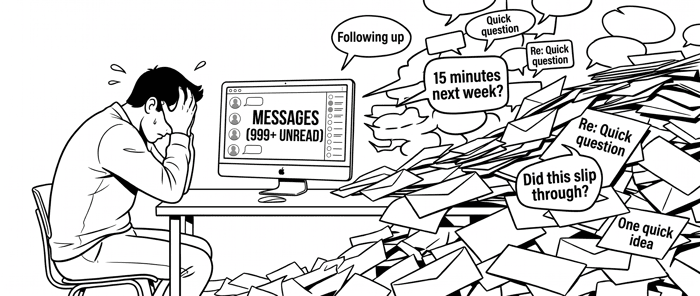
For years I've struggled with the same problem: my inbox feels like an endless party full of uninvited guests. 100+ messages a day: cold pitches, "quick questions," newsletters I never subscribed to and more. Somewhere in there, the two emails from a customer and a teammate I actually needed to see.
Then ChatGPT shipped, and the economics of email broke. Before late 2022, a personalized cold pitch took a human a few minutes. Today a single person can spin up a thousand "personalized" messages in an hour, each one referencing your company, your LinkedIn, your last podcast.
Barracuda (working with Columbia and University of Chicago) found that 51% of spam is now AI-generated. SlashNext tracked a 1,265% rise in phishing emails since ChatGPT shipped — later updated to 4,151%. The average knowledge worker now gets 117 emails a day, and only about 10% are actually business-critical (Microsoft Work Trend Index 2025; Mailbird Email Overload Survey 2025). Global daily email is projected to climb from 376 billion today to 424 billion by 2028 (Radicati Group).
And it's not just email. More than half of long-form LinkedIn posts are now likely AI-generated. The cost of producing plausible text fell to zero, and every channel that depends on human attention is being flooded by the supply response. Email is just where I noticed it first
Five years ago I got maybe 20 unwanted emails a day. Today it's 100. No Gmail filter catches it.
So my co-founders and I started building. The thing we're building is Quartz (https://quartzmail.ai). It's an email app that sits on top of Gmail. It sorts every message by how much it actually deserves your attention, learns what you think matters, and runs all the AI locally so your inbox never leaves your laptop. When it drafts a reply, it tries to sound like you, not like an LLM.
It's free for beta users. I'd love to hear what you think.

The deeper issue may be filter failure rather than message generation. Humans already struggle with information overload; AI just accelerated the rate at which information arrives.