Disk Prices: Finally, a Sane Way to Shop for Storage
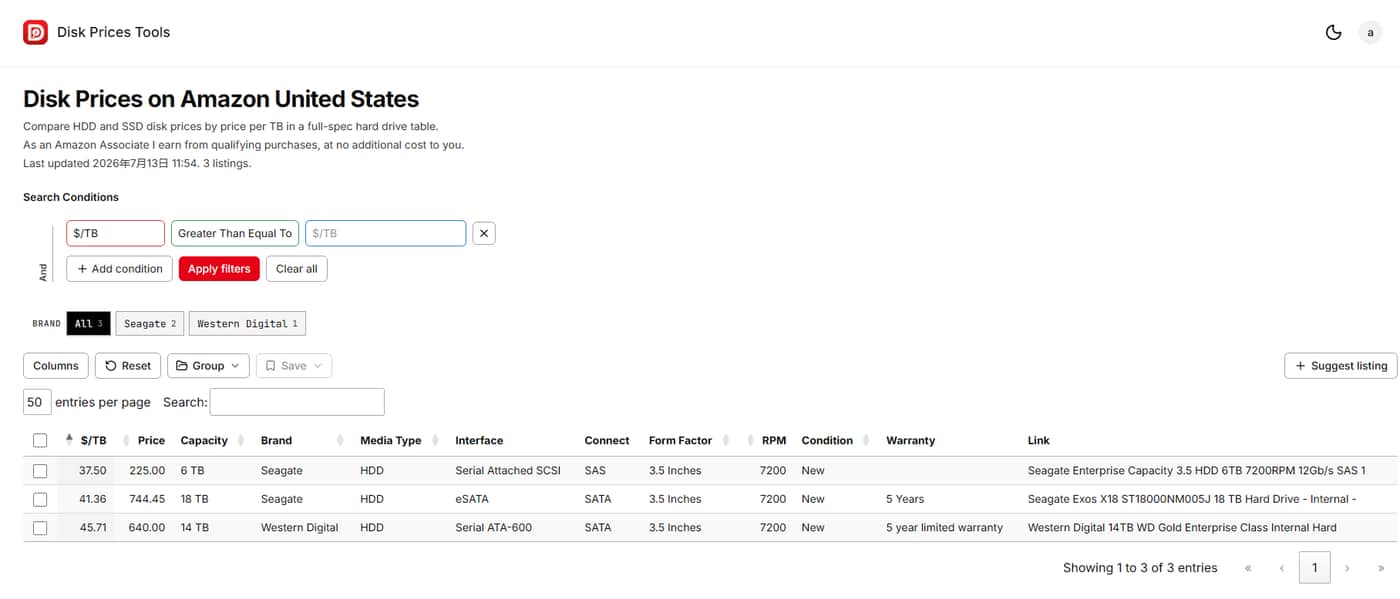
Look—nobody enjoys comparing hard drives. It’s a ritual that involves twenty open tabs, a calculator app, and a sinking feeling that you’re probably getting ripped off. That’s exactly the problem Disk Prices set out to solve.
Disk Prices is a free, no-BS comparison tool that aggregates every HDD, SSD, and NVMe drive listed on Amazon and lays them out in one clean, sortable table. No fluff. No affiliate-fueled top-ten lists. Just real listings, real specs, and real math—all normalized by price per terabyte so you can actually compare a 4TB drive against an 18TB drive on equal footing.
## Why This Even Exists
I built it because the existing tools were either frustrating or incomplete. He wanted something that answers practical questions like "What's the cheapest drive?" and "Okay, but what's the cheapest one from a brand I actually recognize?" with as few clicks as possible. The philosophy is simple: in most cases, just scrolling down the page should tell you everything you need to know about the current storage market.
## What You Can Actually Do With It
One table to rule them all. Every listing shows up with full specs—capacity, interface, form factor, RPM, the whole deal. No jumping between product pages to figure out whether a drive is CMR or SMR (yes, that matters for NAS builds).
Sort by what actually matters. Raw price is misleading. A $90 2TB SSD looks cheaper than a $200 4TB HDD, but the HDD is actually the better value per gigabyte. Disk Prices calculates $/TB and $/GB for every listing so you're comparing apples to apples.
Filters that don't suck. Stack conditions like maximum $/TB, minimum capacity, media type (HDD/SSD/NVMe), recording type, brand, or seller rating. It narrows thousands of listings down to the few that are actually worth buying.
Live search. Type any keyword—brand, model number, interface, speed—and the table updates in real time. No page reloads, no waiting.
Community editing. Spotted a wrong RPM or a missing CMR label? Edit it directly in the table. Approved corrections sync to everyone, so the data keeps getting better.
## Who’s This Actually For?
Pretty much anyone who buys storage:
NAS builders hunting for high-capacity CMR drives with solid warranty and low $/TB.
PC gamers looking for NVMe drives that won't bottleneck their rig.
Homelab operators comparing used vs. new drives, filtering by endurance (TBW), and stacking specs for server builds.
Budget shoppers who just want to know "how much is a terabyte?" without doing the math themselves.
Small business owners who need reliable backup storage without overpaying.
## What’s Coming Next
Disk Prices launched on Amazon US first, with support for the UK, Germany, France, Canada, Italy, Spain, and Japan already in development. Each region will show local pricing, currency, and language so you can shop where you actually live.
## Bottom Line
Disk Prices isn’t some static deal feed that gets stale after a week. It’s a community-driven, spec-rich platform that actually respects your time. Instead of doing spreadsheet math and second-guessing yourself, you get a clean table that shows you exactly what each drive costs per terabyte—right next to every spec that matters.
Buying storage shouldn't feel like doing homework. Disk Prices makes sure it doesn't.


I love this, it's something I've been looking for since I have my own NAS and I'm constantly looking at storage prices. This is a great way to get a quick summary/snapshot.
Thanks, really appreciate that! Glad to hear it hits the spot for you—especially when you’re constantly keeping an eye on storage prices like the rest of us 😄
That’s exactly the kind of use case I had in mind when putting this together. Would love to hear your feedback once you’ve had a chance to run it on your NAS setup—any suggestions or feature ideas are more than welcome.
Cheers!
The interesting challenge isn't helping people compare drives—it's becoming the source they trust before every storage purchase. I'd keep validating whether users are buying lower prices or confidence they're choosing the right drive without hours of research. That's a much stronger position.
You're absolutely right—price comparison is just the surface. The deeper win is saving people those hours of digging through specs, endurance ratings, and mixed reviews just to feel okay about hitting "buy." If this tool can get someone to that confident decision in 30 seconds instead of 3 hours, that's the whole game.
Appreciate the context.
The confidence before purchase angle is the interesting part here.
Would be good to understand more about what you're seeing from users as you validate this.
What's the best email to reach you on?