Does my homepage suck?
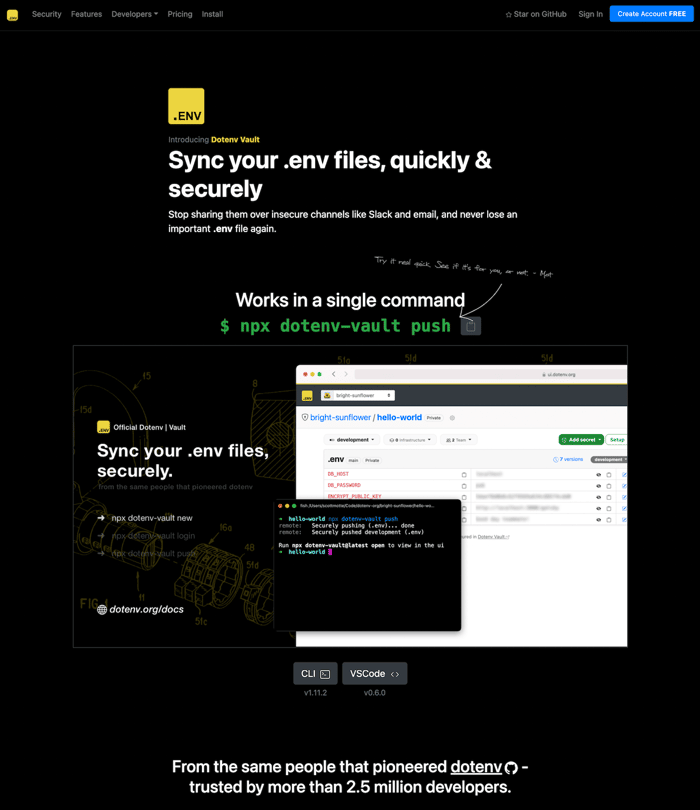
Does my homepage suck? What's the good, the bad, and the ugly? It's a developer tool and so targets developers.
Why I'm Asking
I revamped our website over the past 2 days. The inspiration for it is from this quote:
The function of a landing page is to build trust. [1]
AND this awesome reductionist list by @wagslane. [2]
1. What do you do?
2. Okay. Why should I care?
3. Am I alone in caring – or do others (preferably others like me) care?
4. You’re starting to win me over. But I’m skeptical. So show me: how do you do what you say you do?
5. And if I believe you and your process / solution, how will my life improve?
6. I’d like to believe you, but first tell me: why is it safe for me to believe you?
7. Okay, let’s say I believe you. Now what?
So does it answer the questions above - or not really? What's the good, the bad, and the ugly?
Thank you Indie Hackers 💛
[1] https://www.indiehackers.com/post/how-do-you-build-trust-on-your-landing-page-share-your-page-and-experience-9749ddb2eb
[2] https://www.indiehackers.com/post/how-do-you-build-trust-on-your-landing-page-share-your-page-and-experience-9749ddb2eb?commentId=-N9qMAiWtV-ROjweVzIT

Overall good. Simple, to the point. My one suggestion would be to spend a little more time explaining exactly how it works. I assumed from context that you store .env files on your secure infrastructure, but you never actually say that on your homepage.
Part of my confusion came from your UI, which is so identical to GitHub that it took me a long time to realize that your screenshot wasn't actually just showing a repo in GH, which didn't make sense. I may be an idiot, but I'd be willing to bet I'm not the only idiot with this problem.
A short intro video that goes through the basic Dotenv Vault workflow would help a lot I think.
In any case, congrats on the launch! This solves a real problem, and you've got a serious tailwind behind you in that hordes of devs already trust and use dotenv (myself included). Good luck!
Thanks @GriffinJohnston. I'll make that video happen next - going over the workflow. That's spot on.
FYI: Yes, currently the only Vault is dotenv's proprietary vault, but we have plans very soon to Bring Your Own Vault. Then dotenv-vault just becomes the interface and cli used to manage those secrets - stored comfortably on your own vault. This could be AWS Secrets, a PostgresDB, etc. This gives maximum flexibility. As a dev myself, I also want this flexibility.
Glad to hear that. That's a feature I would absolutely be interested in myself. I'll be following your progress!
Wrapped up a first pass at the video: https://www.youtube.com/watch?v=z-lBjxfhWeY
If that had been available to watch when I first landed on your homepage it would have answered my biggest initial questions. Just what's needed. Nicely done. 👍
Hi Mot, I see some of the suggestions already implemented, like the short introduction video, which clears any questions one would have on how exactly it works. 👍
I made a CodePen with all the content and whitespace changes here: https://codepen.io/djsiddz/full/XWEGOGe .
To summarize:
gitandcdin the How-to use sectionborder-radiusto make all buttons on the page have the same style. (I tried experimenting with different border-radius values, but it wasn't looking cohesive with the rest of the website.)npx dotenv-vault pushcommand is your call-to-action, which is fine, and if it is required, it can be re-iterated here at the bottom instead of the 'Sign Up' button.Also, I second @me22kar's suggestion to make the header sticky.
P.S. I'm going to start using dotenv-vault right away!
WOW, thank you for this amazing and generous critique. Love what you did with some things in the CodePen too. Going to borrow aspects!
Glad you liked it!
Looks solid to me. Your target audience must be devs, because, well... dark website :P
I would add that your landing page should:
That's it.
In my first software company (sold last year) I started with a two-page blog. My landing page was garbage, but had a simple sign-up form and stated the benefit. When launch occurred, I had a few thousand people on the list and was in profit from day 1.
Keeping it simple is what won the day. Granted, the internet was different 10yrs ago, visual demands are higher now - but the principles are the same. I'm using that same principle on my new software company today and it's paying off (in terms of getting sign-ups).
Good general advice - I think you're good on point #1 though. You have an extremely large existing user base who will immediately understand the value you're providing. I think that part is quite clear as-is. I actually think your issue is that you don't spend enough time explaining how you provide it. (See my separate comment)
«I started with a two-page blog. My landing page was garbage»
Hi Justin, I am also in the Product Market fit too, how you find your first customers was it easy for google to rank your site with SEO?
Hey Daniel.
I went all-in on content marketing (blogging specifically). It's a slower process, but I have found that writing useful information with a little keyword research can go a long way. I used these tools (and I'm using them today as well) for finding good content ideas.
YouTube wasn't as big back then but that's another avenue worth exploring. I think I'll probably be looking into that again. I got into it late with my previous company and was able to grow to 13K subscribers by creating short, useful content (repurposed content from the blog actually).
Indeed. I like that thought.
The CTA here is attempting to be the command
npx dotenv-vault push. Is that too tricky to do as a CTA since it required a dev to bounce to their terminal?Took a look at your GapScout. I like how it started with phrasing the problem as a question and then it answered that problem with the benefit you provide.
Dotenv could be:
h1 Sharing your .env files over insecure channels like Slack and Email?
p Sync your .env files quickly & securely across your team, machines, and environments with Dotenv Vault, and never lose a .env file again.
Yeah! Someone way smarter than me once said that if you can pose a major benefit in the form of a question, then it gets people subconsciously "nodding" (agreeing) with you from the get-go. They think... "wow, they understand my problem"
Okay, no one thinks that at any real depth, but it's relateable.
Looks good, I understand what problems it is solving, but I don't understand how. I am a bit skeptical that using this as a 3rd-party to share .env files is more secure over an e2e encrypted Telegram message, for example.
As a security-minded dev myself, I completely understand. We've tried to address that on this page https://dotenv.org/security. But we also want to do more. We're working on Bring Your Own Vault™. This way you can use all the conveniences of dotenv-vault but the secrets would actually be encrypted and live on your own datastore - rather than our encrypted Vault.
Regarding Telegram, that is interesting. How would that work? Could I do that directly from my terminal somehow?
Looking great. Straight to the point, tells me what you do and how it works in the first 2 sentences.
This byline summed up the problem for me beautifully:
We've been using a password manager vault to manage ours but definitely been at places where I've been guilty of sharing like this in the past.
Following the testimonials on the home page it would be cool to see links to some articles highlighting the dangers of sharing this type of information via Slack. I'd say this is how .env files are shared 99% of the time. Slack are a great target for hackers now because of the sensitive data shared there and their messages aren't end-to-end encrypted.
What password manager vault do you use?
We use 1Password - not specifically for env variables, just generally for sharing sensitive data
Me too. We will build a 1Password integration - so that values can sync securely for convenient access.
You and me both. I have a friend that is extremely security minded - almost tin foil hat type. Even he, without prompting, a couple times just shared things over Slack because the friction otherwise was too high to share securely.
Dotenv's long-term goal is to minimize that friction everywhere. We're starting in your terminal.
This is a great idea. Thank you.
Interesting. I use one of your competitors, https://www.doppler.com/
Personally, I highly value Doppler’s integrations and its many secrets export formats for different services.
In comparison, clicking on your how-to integrations guide for NextJS and Express didn’t work for me. Maybe they are just the same article under a different title. Maybe they don’t exist yet.
Plus, your cli depends on NodeJS, which is a non-starter. I use NodeJS in several places, but I need my secrets to be used everywhere. Installing or bundling NodeJS with the cli is an unacceptable performance penalty.
At the end of the day, I’m already too ingrained into the doppler system to ever consider switching.
Also I want to address:
We can actually do this and do it special case for one customer right now. But we're focused on the node, javascript niche of developers currently. In practice, installing or bundling Node is only a performance penalty for very very high-performance needs - which we don't want to service yet. Someday.
Yes, they are. Their integrations are ahead of us right now. I think we're ahead on DX.
Doppler's mechanisms are also entirely proprietary. Dotenv Vault is trying to be a tool that you can leave if you want to without heavy lock-in. Under the hood, it's still just open source .env files and setting environment variables. Vault just helps you orchestrate it better. This is important to me as a developer who's worked in open source for a long time.
Our guides are way behind our product. This will change soon.
As a developer myself committed to specific tools I understand. Thanks for checking out Dotenv Vault though!
P.S. We do hope to open source parts of Dotenv Vault - it will just take time. Revenue from the startups and companies joining us will help finance that.
That’s important. I think https://www.vaultproject.io/ is open source too. But, it’s just not practical to setup/host/maintain and they don’t have a free tier. I keep hoping serverless will make self-hosting cheaper.
That should help a lot! While this post was about your homepage, I immediately went to the docs and examples.
Just a sidenote, I don’t use env files at all. I was specifically checking for functionality like https://docs.doppler.com/docs/accessing-secrets#downloading
Nah your hompage is goat
Thanks. :)
I think if you go by feature vs benefit, your headline could be more on the lines of "Protect your API keys from getting hacked." or "Even if your websites get hacked, dotenv will makes sure your API keys are always safe."
I dunno. Could be good for a split test.
I agree, I'd start with a problem statement, e.g. around inadvertent sharing of private keys etc, how it causes a gazillion breaches. Then a simple solution statement which maybe is not just about syncing .env files but more about what that achieves. Preferably "in 2 minutes flat.".
Smart. I'll try to weave that in re "inadvertent sharing of private keys etc, how it causes a gazillion breaches".
Hey @mot, I don't think your homepage is suck, it just needs a bit polish with spacing and text size. I would increase the overall text size for headings and body copy to make them easier to read on dark background. Also, the top nav bar should use white text instead of grey.
Hope this could help you!
Generally, it looks pretty slick & clean. But u should definitely work on the paddings a bit more like the paddings between each testimonial, titles "For your team", "For your infra" and so on
It's great and to the point. Fortunately your target segment is already spending hours on the Internet, looking at tools or libraries to improve their workflow.
Your landing page copies are to the point and addressing the problem. The founder's note definitely helps in adding trust. Just a small suggestion- keep the CTAs with a bigger font and button. (the copy to clipboard button in this case.)
Secondly, would also love to see the features on the same page instead of routing to another. You can make the header sticky as well. That way header links are always accessible even when I scroll down.
Everything's great other wise IMO.
Very smart suggestion on the CTA size. I overlooked that. Thank you.
I really love this. The concept, UI, and copy all really speak to me.
I'm a dev, and my previous job used hashicorp to send 1 time links for environment variables, which I really never liked. After a transition, I advocated for use of vercel's cli tool which I really really love, and can pull .env variables from remote. Sounds really similar and I LOVE that concept.
Yes, as a dev myself, I used both Hashicorp Vault and Vercel's CLI at different times during my career - I've done a lot of consulting for startups.
Same annoyance around Hashicorp's current implementation. Vercel does a good job of thinking 'developer first' - which we are also trying to prioritize.
Think it looks pretty good. One thing that jumps out to me straight away though is that you might have too many primary CTAs. Try deciding on the main action you want the user to take and focus on that.
Perhaps test reducing it down to focusing on "sign up" — you've described the problem you're solving, and if they're interested in solving that issue, then they can learn more about how to do that once they've signed up.
I see your point and I agree. Many different blue 'cta' buttons and also many copy/paste buttons. Tightening up.
Not to bad compared to mine lol
mine is very simple (probably too simple)
https://www.writableai.com
This comment was deleted 4 years ago