Don't Fall for the Follower Count Trap
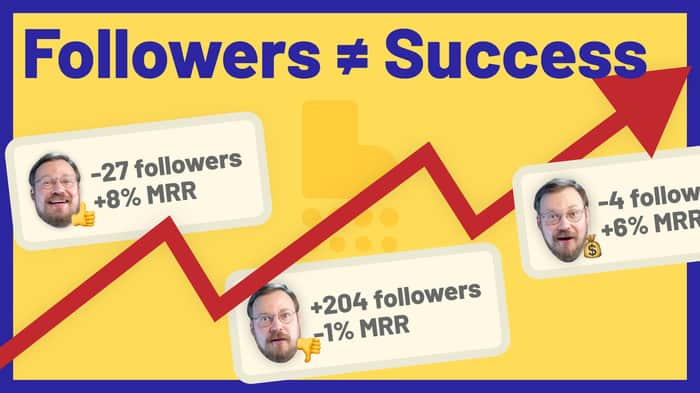
"When a measure becomes a target, it ceases to be a good measure." These are the famous words of economist Charles Goodhart, who introduced this concept in 1975. The idea is that when a particular metric is used to describe progress toward some goal, people tend to optimize their behavior to meet that target. That itself is not the problem. The issue is that this optimization can turn counterproductive and lead to unintended consequences.
A classic example of Goodhart's law in action is the education system. In schools, grades are often seen as the most important measure of success. It certainly was when I was in school. As a result, students —like myself back in the day— focus their efforts on studying to pass a test rather than learning for long-term benefit. This happens because passing the test is the target, not actually learning and understanding the material. People have exceptional grades but understand nothing. I don't think that is the goal of education — but it is the optimized system we have put in place. No wonder people have lost the joy of learning and reading. We made it irrelevant to what it means to be educated.
Today, we can see Goodhart's law in action in the world of social media. On platforms like Instagram and Twitter, people dream of building sizeable audiences of followers. But when follower counts become the target, it can lead to undesirable outcomes.
The Pitfalls of Focusing on Follower Count
For example, people tend to over-optimize for follower count, which can result in many low-quality followers. These followers may not actually be interested in the content being produced but are merely following in the hopes of receiving a follow-back or something else that benefits them, like winning a contest or getting a free download link.
Optimizing for follower count alone does not create meaningful relationships. It makes for shallow ones at best, and they end up creating very few opportunities for growth down the road. And that means it's a huge mistake to put quantity over quality.
Here's why so many people still fall for it: while follower counts can be easily measured, the depth of a relationship cannot. But how strong your connection is ends up being more important than your number of followers. It's the quality of each relationship that matters, not how many you have. It's just like with real-life friendships: when you're in trouble, your select few faithful and most loyal friends will be there for you, not the thousands of acquaintances you made along the way. Humans require meaningful connection, and they will put in the work to make these relationships valuable — if they are reciprocated. Don't gloss over the depth of the connections you forge, even if it is "just" on Twitter.
Another factor for over-focusing on follower counts is the loss-aversion bias, amplified by discrete data. The emotional impact of a dip in followers is very noticeable when you track them daily on some dashboard. If you see your numbers go down, it hurts. But when we look at real-life relationships, we don't have that same problem. The natural ebb and flow of relationships are much more subtle. Some days, people are in a good mood, and on other days, they're not. We expect that. But the moment we see that follower count dip by even one person, we freak out.
So stay off the metrics. Or measure something that doesn't have discrete real-time numbers. It's better to use unmeasurable factors as the north star for your audience building. These include the quality of the relationships you build over time, the size of the opportunity surface that the relationships create eventually, and the perceived desire for reciprocation between you and your audience.
None of these are easy to measure. But they all contribute to a fulfilled audience-building journey.
And that highlights another problem of focusing on just the follower count: other important and more specific measurements are often neglected. It's never just one number that can describe something as complex as a massive web of interpersonal connections.
This is also a recursive problem. Even when you look at other metrics, you might look into something way too general. For instance, you might focus on the frequency of engagement with your audience.
That's good, right?
Well, yeah, but it also glosses over the actual value that a virtual relationship is supposed to produce for everyone involved. People on the internet yell at each other all the time, and that's a relationship, too, but not a very useful one, is it?
That's what you get when you're looking at the frequency of engagement rather than its quality. You end up optimizing for pointlessly overblown exchanges and content that creates outrage and dissent, which drives low-quality engagement. A net loss for everyone.
The Negative Consequences of Over-Optimizing for Follower Count
At its worst, this obsession with follower count can lead people to literally buy into the hype: they buy followers, which artificially inflates their numbers. This is a clear example of how Goodhart's law can be perverted. Those followers are not real people, and building an audience is about attracting human beings so they can find you and your work. A high follower count might signal credibility —and that's why most shady audience-builders buy followers— but a real person can quickly tell if your audience is legit or not. So you only attract followers who are either bots or humans with minimal capacity to judge good from bad. Again, a big net loss; you don't want to perform in front of either of these groups.
We've seen the long-term effects of such optimizations play out over the last decades.
Goodhart's law is very evident in search engine optimization (SEO). If you try to find a cooking recipe online, you will come across whole essays leading into what ends up being just a two-step recipe. This is what happens when we optimize for the Google PageRank algorithm. The content becomes tailored to the algorithm, not the human reading it.
In our efforts to make our recipes more visible, we made them less accessible. And then we kicked into a whole other gear. When people thought they understood the secrets of SEO, they started bot farms and traded links with each other —all to please the algorithm— instead of creating more interesting websites.
Prevention Methods
So how do we stay clear of this mistake when building an audience?
The key is to be aware of Goodhart's law and to actively work against it. It starts with how well we can isolate our follower counts from our personal identity. Your worth doesn't rely on followers, and a big crowd around you doesn't make you more important. What matters is what you do with the people who care about you.
For this, frame your emotional reaction to follower counts —up or down— as something less important than having a good conversation every day. Make your interactions count qualitatively by ensuring one in-depth daily exchange instead of twenty shallow ones.
Don't keep follower numbers visible for the dopamine hit. Loss aversion will kick you in the face should this number ever drop (and it will occasionally drop, particularly as you find more followers). Don't check too much, and don't get displays like the LaMetric Time LCD screen that many Twitter users like. They are cool, a pleasant diversion, and might even be encouraging initially, but they will pull your focus towards the quantity, not the quality of your relationships.
Measure more than just one thing. If you want to track your followers, also track how often you feel intellectually engaged daily. Measure something you can actually personally impact, something that doesn't require someone else to take the first move, like a follow would. If you need to track something, pick something positive, practical, and empowering that you have agency over.
How to Build a Quality Audience on Social Media
Tracking, tracking, tracking.
It's so easy to become fixated on numbers and metrics. You can take a screenshot and post your wins so quickly. We need to remember that these metrics are not and should not be the end goal. Instead, our focus should be on creating meaningful relationships and producing valuable content for the people who choose to pay us attention.
The goal should never be to amass as many followers as possible. What's the point? What are you going to do? That's what they'll wonder before hitting that follow button. Being in your audience alone already needs to give them something useful. And fortunately, that's an area you have control over.
So focus on building a community of engaged and interested individuals around you. Introduce them to each other. Celebrate when they are kind and helpful to new followers of yours. This means creating content that is valuable, informative, and, most of all, relationship-forming rather than simply trying to game the system by posting controversial or sensational content. The relationships coming out of that are haters and trolls in your comments. Not much community there!
And people won't trust you if you're playing a role. There's a need for authenticity for communities to form. In a world where social media can be highly curated and very selective, it's essential to be genuine and honest with your audience. People can tell when someone is not being authentic, which will lead to a loss of trust and a reduction in engagement, both with you and each other.
Audience building is not a one-size-fits-all approach. People use social media differently within and between the platforms. Different tools require different strategies, and what works for one person may not work for another. That's why it's essential to experiment with different approaches and find what works best for you.
But successful audience-builders have one thing in common: they focus on engagement rather than follower count. They take the time to respond to comments and messages, engage in conversations with their followers honestly and intentionally, and create content that encourages engagement and relationship-building.
Remember that building a quality audience takes time. It's not something that will happen overnight, and it requires consistent effort and dedication. You'll have to be patient and persistent and not give up when results don't come quickly — because they won't. And they're not easily measured.
When it comes to engaging with people, I have one central rule: a lesser-known formulation of Immanuel Kant's Categorical Imperative from 1785. It's called the "formula of humanity" and goes like this:
So act that you treat humanity, whether in your own person or in the person of any other, always at the same time as an end, never merely as a means.
When it comes to making friends online, this rule requires me to always think of the other person's benefit in anything I do. I'll ensure that any comment I write doesn't just serve me — it has to help them too. They can not just be an enabler for my own success. They have to succeed from it as well. Anything I post, anything I say, I have to find a way to make it worthwhile for someone else.
And not optimizing for the wrong things is part of following that rule.
In the end, Goodhart's law is an important concept to keep in mind at all times. It's easy to become fixated on numbers and metrics. We have to remember that these metrics should not be the end goal. Instead, our focus should be on creating valuable content, engaging honestly with our audience, and building a community of interested and engaged individuals around us. By keeping these principles in mind, you will create a successful and sustainable social media presence that delivers real value to your audience.
So, let me ask you this: have you fallen for this? Have you spent more time and attention on tracking your follower count? Or any other metric, such as MRR or new signups, for that matter?

This is such an insightful thread that everyone should read and keep in mind.
I started becoming active on Twitter to share my knowledge and how I solve problems and learn from others but one thing I didn't realize was engaging with others. Just recently I realized that and started actively responding to the messages, comments etc.
In that process, I started observing the follower count and it kept increasing for a while but after a while, it got decreased and I was not feeling good about it.
Then I started observing the big accounts that have thousands of followers and realized that their follower count is increasing but their engagement has dropped terribly then I understood instead of getting such big follower numbers and realizing lately about building a quality audience, why don't I start doing that now?
So now I'm concentrating on building a quality audience those who find quality in my content, and the posts. And all this has happened just in the last two months.
These metrics for measuring the progress made people participate in a race that has low-quality output ranging from schools to social media. And I think its difficult for people to get out of this race.
Thank you so much @arvidkahl for this great piece of info.
Most appreciated!
This is really good stuff! You have my support. You don’t need a huge social media following to build a successful company.
Yeah they are extremely weakly linked. Does it help? Absolutely. Is it needed? Definitely not.
A super insightful thread. Thank you!
Thank you!
This post can be faulted for going on a bit too long, but the core idea is very important - way too many posts and comments on this site talking about how to cheat one's way into a large follower count.
One thing I have a hard time understanding - how can you focus your work around educating builders when your own product is that actual education?
Shouldn't you be a successful builder before teaching others to build?
It's the same issue I have with the activity of people like Daniel Vassallo. His small bets philosophy falls a bit short when you realize all his working bets are based on motivating others to pursue that idea.
I suppose you're selling the shovels here instead of doing the digging, but do you have a different view on this?
That's a classic problem of many media businesses, too, and I am experiencing this right now: in building up my podcast, newsletter, and YouTube audiences, I often talk about the process of just that! Which in turn fuels my audience-building efforts. It freaks me out quite often, but I remember that this is what building in public is about: showing the truthful ups and downs of the journey that is creating a product. It's supposed to facilitate both learning and profits, two things that used to be distinct.
Not sure if we can avoid this dynamic in the just-in-time world of social media. I've had @dvassallo on my podcast, and we looked into his approach. He followed it long before he packaged it up as a product (check out this tweet about the performance of his bets: https://twitter.com/dvassallo/status/1548091119380021252) — but there definitely are a lot of shovel-sellers (or even worse, the "build your own shovel-factory with these schematics" sellers) out there with no proven track record.
Personally, I would never have taken up the role of "educator" if I hadn't built and exited a SaaS before. Wouldn't have been honest, and I don't want to burn my reputation in this community. This, I think is the crux of the matter, and one of the only ways I personally weed out the scammers from the real teachers. When I want to learn about audience-building, I make sure the person has built a sizeable audience (of real people with real relationships). For SaaS advice, I go to people who run a successful SaaS. For writing, writers who are read. And so on.
It's almost hilarious that removal of gatekeepers essentially forces us to mentally gatekeep ourselves.
Thanks Arvid, great points. Calm Twitter is very useful in this regard (not affiliated, just a happy user).
https://chrome.google.com/webstore/detail/calm-twitter/cknklikacoaeledfaldmhabmldkldocj
Very cool. Removing the stats sure makes you care less about them :D
Brilliant post, thanks for taking the time to write it!
Hadn't heard of Goodhart's law or Kant's formula of humanity until now but I feel these ideas can be applied to a lot of areas of entrepreneurship, or even life. Really valuable lessons.
Yeah, I came across Goodhart's law somewhere on Twitter, and I dove into the topic. Just like the Pareto principle, Parkinson's law, or Hyrum's law, these things easily transcend the fields they originate from.
I've seen it happen a lot, especially with creators who fall into the trap of chasing numbers at any cost, even resorting to buying followers. It's a short-term boost that usually ends up damaging your credibility in the long run.
For me, it's always been about building genuine connections with my audience. It's those meaningful interactions that make all the difference. Quality over quantity, as they say. It's like having a few close friends who truly support and engage with your content rather than a sea of strangers. Still, sometimes, buying followers can give a boost to a fresh account. For instance, you can get instant Soundcloud plays https://www.smm-world.com/buy-soundcloud-plays to promote your songs and make them reach your potential audience.
You've touched on a critical aspect of the social media game. It's so tempting to get fixated on those follower counts and other metrics, but as you've pointed out, that can often lead to shallow relationships and a focus on the wrong things.
This comment was deleted 3 years ago
This comment was deleted 3 years ago
This comment was deleted 3 years ago