Drop your landing page URL. I'll use Ferguson to tell you why visitors might be leaving
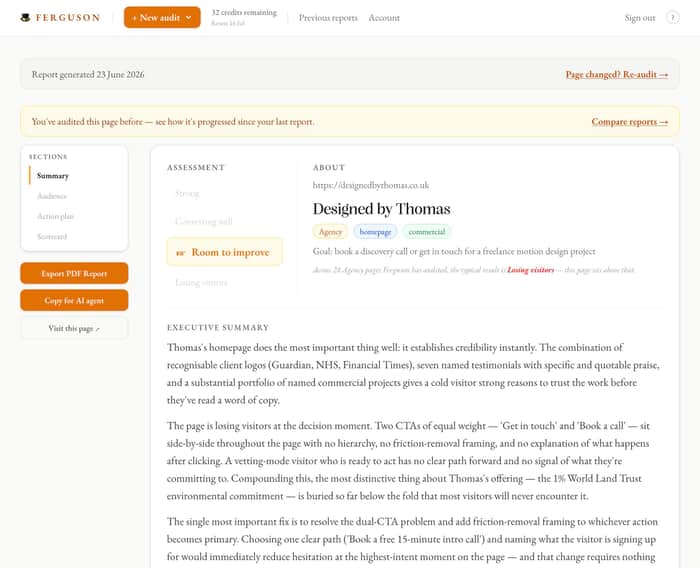
Built an AI landing page auditor called Ferguson.
He reads your landing page cold, the way an actual stranger would. He'll tell you what's right, what's wrong, who your target audience is and who you might be accidentally turning away, plus a fix list written in your brand voice.
Unlike a generic AI prompt, every audit feeds a benchmark so you can see how you compare to other landing pages in your category.
Drop your URL in the comments and I'll run it through Ferguson. I'll reply with a quick summary of what he finds!
Or run it yourself on useferguson.com: There's 496/500 free audit packs left, no card needed.
First few URLs, I'll get to today.
** Thanks for the comments everyone! I've audited a fair few pages in the comments now - if you'd like to get yours there are still some free packs available over at https://useferguson.com**

One thing I'd be curious about is whether it can tell the difference between a messaging problem and an audience problem.
Those can look almost identical in analytics, but the fixes are completely different.
Honestly the most accurate answer is: partially. Ferguson does separate audience analysis (who the page seems to be speaking to, who it might be quietly excluding) from messaging execution (CTA clarity, social proof, etc.), so it's not blind to the audience side. But it's core feature is that it reads the page itself, it has no access to your actual traffic data (yet), so it can hypothesize a mismatch but can't confirm whether you're getting the wrong visitors versus failing to persuade the right ones. That last step still needs your own analytics in the mix.
Analytics data integration is something I'd love to include further down the line because I think it would really help.
That's exactly what caught my attention.
The same pattern can end up reinforcing a messaging explanation when the underlying issue is audience—or the other way around.
Happy to explain what I mean properly over email if that's useful.
What's the best email to reach you on?
This comment was deleted 2 months ago.
Hey! Just a quick note to say I’ve launched on Product Hunt today, would mean a lot if you could check it out and leave a comment if you’ve found the audit useful: https://www.producthunt.com/products/ferguson. No pressure either way, just wanted people who'd already shown interest to be first to know.
The benchmark angle is the interesting part. A cold read of a landing page is useful, but knowing you're in the bottom 20% of SaaS tools for CTA clarity is actionable in a completely different way. Curious how you're building the category taxonomy, that's where the benchmark lives or dies.
Hey! Just a quick note to say I’ve launched on Product Hunt today, would mean a lot if you could check it out and leave a comment if you’ve found the audit useful: https://www.producthunt.com/products/ferguson. No pressure either way, just wanted people who'd already shown interest to be first to know.
Totally! The category benchmark is something that I wanted to add early on because it provides that extra level of context. As with any taxonomy it's a big job to get right and it's going to be a work in progress as the site evolves. The current buckets are quite broad with a view to narrowing them further down the line, potentially taking into account user feedback on assigned categories too.
Awesome tool. Just used it for my site and was able to get better insight.
Hey! Just a quick note to say I’ve launched on Product Hunt today, would mean a lot if you could check it out and leave a comment if you’ve found the audit useful: https://www.producthunt.com/products/ferguson. No pressure either way, just wanted people who'd already shown interest to be first to know.
Awesome! Glad it helped! You can track your progress over time too.
This is a useful thread because it separates a landing-page problem from a wrong-audience problem.
For tiny data products, the failure mode I keep seeing is that the page explains what the dataset contains, but not the decision the buyer can make faster because of it. The cold-read question I’d want answered is: can a stranger tell within 10 seconds whether this helps them decide, buy, or ignore a lead?
If the answer is no, adding more records or more proof probably won't fix the page yet. The first fold needs to make the buyer's next decision obvious.
Hey! Just a quick note to say I’ve launched on Product Hunt today, would mean a lot if you could check it out and leave a comment if you’ve found the audit useful: https://www.producthunt.com/products/ferguson. No pressure either way, just wanted people who'd already shown interest to be first to know.
Exactly! One of the primary checks Ferguson makes is the “5 second test” which covers that messaging issue.
Dropped my landing page through Ferguson. The audience vs messaging split is where the real value is. Most tools tell you what's wrong with your page. Few tell you if you're talking to the wrong person entirely.
Hey! Just a quick note to say I’ve launched on Product Hunt today, would mean a lot if you could check it out and leave a comment if you’ve found the audit useful: https://www.producthunt.com/products/ferguson. No pressure either way, just wanted people who'd already shown interest to be first to know.
I cannot post links yet from this new Indie Hackers account, but I would still love a cold read if you are willing to look up Tokens Forge.
It is a token-first AI API gateway for GPT, Claude, Gemini and routed model pools, with usage tracking, backup routing, API key management, and an included AI Researcher workflow.
The thing I would most want Ferguson to judge: does the first screen make it clear that the core product is model tokens / API gateway access, not just another generic AI research app? Also curious whether the primary CTA feels obvious for developers who want to start using the OpenAI-compatible endpoint.
Hey! Just a quick note to say I’ve launched on Product Hunt today, would mean a lot if you could check it out and leave a comment if you’ve found the audit useful: https://www.producthunt.com/products/ferguson. No pressure either way, just wanted people who'd already shown interest to be first to know.
I'm currently behind with the checks but you can claim a free pack over at https://useferguson.com to run the audit if you like!
The social proof gap is the right call. What moved the needle for us at SocialPost.ai wasn't more logos, it was one named testimonial tied to a specific outcome placed right next to the CTA. Vague badges like '4.9/5' with no source actually create doubt, because the visitor's brain immediately asks 'says who?'
That's exactly the type of thing Ferguson would highlight! FYI I just ran SocialPost through Ferguson and it's one of the strongest results so far, kudos! In terms of the inferred audience this might be a useful insight:
"Who it's unintentionally repelling
The founder who is already posting consistently and wants advanced analytics or team collaboration features — the page's entire framing is built around the 'dead feed' problem, which doesn't resonate with someone who isn't silent"
It also suggested bringing the smaller footnote of "(across 200 customers, Q1 2026)" more inline with the headline stats but I'd perhaps push back on that one, I think the design is visually clear enough that people will get it.
sure, i'll bite: https://referralful.com/?utm_source=indiehackers.com&utm_medium=community&utm_campaign=feedback
it's affiliate software for SaaS founders, built on Stripe. the one job of that page is getting a pre-revenue founder to start a free program without feeling like they signed up for a $49/mo tool. curious whether Ferguson thinks the "free until your first affiliate" line lands or gets buried under the rest. disclosure: i'm the maker.
Hey! Just a quick note to say I’ve launched on Product Hunt today, would mean a lot if you could check it out and leave a comment if you’ve found the audit useful: https://www.producthunt.com/products/ferguson. No pressure either way, just wanted people who'd already shown interest to be first to know.
Your landing page came out as "Strong" which means you're doing a lot right!
Here's the executive summary:
"Referralful's homepage does a lot right: the headline is precise, the pricing model is genuinely differentiated, and the founder story lands with exactly the emotional register that early-stage SaaS founders respond to. The 'free until your first affiliate joins' concept is the kind of specific, repeatable idea that visitors actually forward to colleagues — it is the page's strongest asset and it is correctly placed at the centre of the value proposition.
The most meaningful gap is social proof. The 4.9/5 rating badge has no platform attribution or review count, making it unverifiable; the three 'Trusted by' logos are not recognisable brands; and there are no named customer testimonials with specific outcomes anywhere on the page. For a medium-ask conversion (free trial sign-up), this is the friction point most likely to cause a hesitant founder to pause and look for validation elsewhere.
The single most important fix is to source and display attributed reviews — a platform name, a review count, and two or three named testimonials with specific results. This does not require a redesign; it requires gathering the evidence and placing it near the primary CTA. A founder who has read the pricing model and the origin story is already warm — a credible third-party voice at that moment would close the gap between interest and action."
There were 10 flagged issues of potential improvement, but overall a good score!
Ferguson reading a page like a stranger is a really good frame. Curious about the after part though: when someone applies your fix list, can they usually tell if it moved their numbers, or is traffic on most of these pages too thin to see it? That measurement gap is the thing I keep running into with small sites.
Ferguson doesn't currently have access to any analytics in order to say: these numbers changed. That would still need to be tracked by the user themself e.g: numbers were X before the audit, changed to Y after we applied the fixes.
If numbers are too thin then proper A/B testing probably wouldn't be much use anyway.
That being said, Ferguson's re-audit IS the measurement tool for sites too thin to A/B test. In a sense, you don't need 10,000 visitors to know if your page got more convincing, you need a reader who doesn't know the product yet. That's what the re-audit gives you: a fresh stranger's read before and after.
Whenever you re-audit a page after making fixes, you can then compare the two reports and see what's improved and whether the score for the page has moved (e.g: moving from Losing Visitors to Room to Improve for example).
Would love a cold read on NotaWA: https://notawa.com
It’s a WhatsApp-first cashflow tracker for freelancers and solo founders. The promise is simple: log income/expenses from chat, review summaries later in the dashboard.
I’m especially curious if the page makes the “why WhatsApp instead of another budgeting app?” clear enough.
Would love your take on NotaWA: https://notawa.com
It’s a WhatsApp-first cashflow tracker for freelancers and solo founders. The idea is simple: instead of opening an expense app, you just message things like “+500 client payment” or “-12 lunch,” then see balances and summaries in a dashboard.
I’m especially curious whether the positioning is clear quickly enough, or if the page needs to explain the WhatsApp workflow better.
Thanks for the comment! The URL drop has closed for now but you can audit the site over at https://useferguson.com - there's still a few launch packs left so you can try it out for free!
A score means very little in isolation, but compared to your category, it immediately gives the results context. Curious how granular your industry segmentation gets.
dropping my site below so u can tell me exactly why my bounce rate is so high lol. having an ai roast my landing page before real users do is such a cool idea, definitely snagging one of those free audit packs!
https://eleayuen-png.github.io/OpenAPI-to-MCP-Converter-MVP/
Hey! Just a quick note to say I’ve launched on Product Hunt today, would mean a lot if you could check it out and leave a comment if you’ve found the audit useful: https://www.producthunt.com/products/ferguson. No pressure either way, just wanted people who'd already shown interest to be first to know.
the audit kind of only captures my loading screen, so maybe it would be better to add a delay and let the program wait for a certain time before actually producing a report. good luck to u man!
Would love to see what Ferguson thinks of my landing page! Built a free health calculator — all client-side, no signup, no ads. Curious if the single-page layout is clear enough or if visitors bounce before trying the calculators. Cheers!
Hey! Just a quick note to say I’ve launched on Product Hunt today, would mean a lot if you could check it out and leave a comment if you’ve found the audit useful: https://www.producthunt.com/products/ferguson. No pressure either way, just wanted people who'd already shown interest to be first to know.
Hey! Sounds good, run your url through https://useferguson.com - there’s some more free packs available to try it out
One pattern I keep seeing in landing pages that still bounce even after copy fixes: the visitor understands the words but cannot picture what the product actually does.
Ferguson catches text-level issues well. But some products are hard to explain because they involve a workflow transformation, a before/after, or an interaction that reading about does not replicate.
Pages that tend to convert well in those cases pair a clear headline with something visual in the first fold that makes the outcome obvious in under 10 seconds. Not necessarily a full product demo, just enough to make it click.
Worth asking before rewriting copy: is this a words problem or a visualization problem? The fix is pretty different.
Hey! Just a quick note to say I’ve launched on Product Hunt today, would mean a lot if you could check it out and leave a comment if you’ve found the audit useful: https://www.producthunt.com/products/ferguson. No pressure either way, just wanted people who'd already shown interest to be first to know.
Ferguson uses visual analysis as part of the report, if it deems something to be unclear or too technical (e.g: full of jargon) it will flag it and suggest it be remedied.
Useful concept! Visitors bouncing after 30 seconds is almost always one of three things: weak value prop above the fold, slow perceived load time (even if real load is fine), or the CTA does not match the intent that brought them in. Which does Ferguson flag most often in your analysis?
ran Ferguson on naxely.com — really useful. flagged some jargon I'd gone blind to ("NRA insight cards" — nobody outside my head knows what that means) and the AI trust objection point was spot on. fixed both before my Product Hunt launch this Wednesday. good tool.
Hey! Just a quick note to say I’ve launched on Product Hunt today, would mean a lot if you could check it out and leave a comment if you’ve found the audit useful: https://www.producthunt.com/products/ferguson. No pressure either way, just wanted people who'd already shown interest to be first to know.
Just comment on product hunt check now
Awesome, thank you so much for the support
This was genuinely helpful and exposed some things that had to be cleared up about my site, it pointed out things that I think my high-intent visitors will appreciate. Definitely a useful tool.
Hey! Just a quick note to say I’ve launched on Product Hunt today, would mean a lot if you could check it out and leave a comment if you’ve found the audit useful: https://www.producthunt.com/products/ferguson. No pressure either way, just wanted people who'd already shown interest to be first to know.
Rewrote my landing page hero twice. First time for clarity, second time based on actual sales conversations. The second version converted 3x better because I used language from real customers.
This is brilliant — the "cold read" framing is exactly what makes it feel credible vs a generic AI prompt output.
One thing I've noticed building KuberAgent (100+ browser tools, no uploads): landing pages for privacy-first or free tools are the hardest to write because the value prop sounds too good to be true. "Free, no login, no server uploads" reads like a scam to most visitors even when it's legit.
Would love to see what Ferguson picks up on kuberagent — genuinely curious whether it flags the trust-signal problem or something I haven't noticed.
Hey! Just a quick note to say I’ve launched on Product Hunt today, would mean a lot if you could check it out and leave a comment if you’ve found the audit useful: https://www.producthunt.com/products/ferguson. No pressure either way, just wanted people who'd already shown interest to be first to know.
Thank you! There's plenty of free packs available over at https://useferguson.com - if you sign-up you'll get 3 free audits for whichever URL's you choose!
ok ill try it: https://fullsendorganicks.com/
https://alloceraintelligence.com/
Hey! Just a quick note to say I’ve launched on Product Hunt today, would mean a lot if you could check it out and leave a comment if you’ve found the audit useful: https://www.producthunt.com/products/ferguson. No pressure either way, just wanted people who'd already shown interest to be first to know.
Hey, thanks for the comment! Here's Ferguson's summary:
"Allocera Intelligence has built one of the sharper B2B homepage arguments I've reviewed in this category. The headline lands immediately, the 'Not AI' positioning is genuinely brave and well-placed, and the four-step intake process does real trust work for a high-stakes data-sharing ask. The Distortion Calculator in the hero is a smart micro-commitment that lets a sceptical buyer self-qualify before committing to anything.
The page is losing some of the visitors it earns through two gaps: first, the only testimonial is anonymous and unattributed — for a service priced up to $15,000/month, that is a meaningful credibility shortfall that the G2/Capterra listing claim does not compensate for. Second, the free audit's strongest selling point — that the audit credit applies toward any retainer started within 30 days — is buried in the Pricing section rather than sitting beside the primary CTA where it would actually influence the decision.
The single most important fix is adding one named, attributed client result to the homepage — ideally near the hero or the free audit CTA. A specific outcome ('We identified $X in misallocated spend in the first audit') from a named operator would do more conversion work than any copy refinement, because it transforms the page's credibility from 'this sounds plausible' to 'this has been proven on a real account like mine'."
Very useful information for anyone trying to create traction
Hey! Just a quick note to say I’ve launched on Product Hunt today, would mean a lot if you could check it out and leave a comment if you’ve found the audit useful: https://www.producthunt.com/products/ferguson. No pressure either way, just wanted people who'd already shown interest to be first to know.
The 'who it's unintentionally repelling' line is the most valuable output here, and most founders never audit for it. In my experience pages rarely lose people on the headline, they lose them on the one objection the page refuses to answer, like that non-refundable deposit. The fix is usually not better copy, it is moving the answer to the scariest question above the fold instead of burying it.
Hey! Just a quick note to say I’ve launched on Product Hunt today, would mean a lot if you could check it out and leave a comment if you’ve found the audit useful: https://www.producthunt.com/products/ferguson. No pressure either way, just wanted people who'd already shown interest to be first to know.
The world with AI will never be the same again, and to our delight, all of this is within our reach; we just have to know what to choose, given the sheer number of tools being released daily. Congratulations and good luck on the journey that is about to begin...
Hey! Just a quick note to say I’ve launched on Product Hunt today, would mean a lot if you could check it out and leave a comment if you’ve found the audit useful: https://www.producthunt.com/products/ferguson. No pressure either way, just wanted people who'd already shown interest to be first to know.
I built an AI social media post generator called Buzzly — enter brand name + niche + tone → get 3 platform-specific posts instantly. No signup required. Would love your take on the landing page clarity: Is it obvious what it does within 5 seconds?
Hey! Just a quick note to say I’ve launched on Product Hunt today, would mean a lot if you could check it out and leave a comment if you’ve found the audit useful: https://www.producthunt.com/products/ferguson. No pressure either way, just wanted people who'd already shown interest to be first to know.
I'm currently behind with the checks but you can claim a free pack over at https://useferguson.com to run the audit if you like!
https://boothkeepos.polsia.app — convention business manager for indie creators. Getting traffic but struggling to convert. Would love to know what Ferguson finds.
Hey! Just a quick note to say I’ve launched on Product Hunt today, would mean a lot if you could check it out and leave a comment if you’ve found the audit useful: https://www.producthunt.com/products/ferguson. No pressure either way, just wanted people who'd already shown interest to be first to know.
Hey, here’s what Ferguson said in its summary:
“The page's critical gap is trust proportionate to the ask. Charging $29/mo from a cold visitor requires more than 7 users and a .polsia.app subdomain — both of which actively signal 'early prototype' to a creator who has been burned by tools that disappeared. There are no named testimonials, no founder story that builds credibility, and three competing conversion paths (paid, free trial, waitlist) that create confusion at the exact moment a visitor is ready to decide.
The single most important fix is replacing '7 indie creators already joined' with a named testimonial from one of those creators — even one quote with a first name and a specific outcome would do more for conversion than any other change on the page. Pair that with a clear decision between 'paid now' and 'free trial' as the two paths, and the page's strong narrative would have a worthy landing point.”
devora.sh please
Hey! Just a quick note to say I’ve launched on Product Hunt today, would mean a lot if you could check it out and leave a comment if you’ve found the audit useful: https://www.producthunt.com/products/ferguson. No pressure either way, just wanted people who'd already shown interest to be first to know.
I'm currently behind with the checks but you can claim a free pack over at https://useferguson.com to run the audit if you'd like to do it manually!
theogeo.ai
Would genuinely love to know if the "are you actually showing up when AI answers questions about your category" hook lands for someone seeing it cold, or if it needs more context before it clicks. Curious what Ferguson flags.
Hey! Just a quick note to say I’ve launched on Product Hunt today, would mean a lot if you could check it out and leave a comment if you’ve found the audit useful: https://www.producthunt.com/products/ferguson. No pressure either way, just wanted people who'd already shown interest to be first to know.
I just tried to audit the site however I think there may be a cloudflare block on the browser rendering and as such it can't produce a valid audit. If you were to audit the page in the future I think you'd just need to disable cloudflare for a moment and then audit the page fresh!
I'm currently behind with the checks but you can claim a free pack over at https://useferguson.com to run the audit if you'd like to do it manually yourself!
https://subradar-inky.vercel.app
SubRadar — detects subscriptions from Gmail and sends reminders 7 days before renewal. Just launched, curious what Ferguson finds. The main value prop is on the hero but I'm not sure if "connects to Gmail" reads as a feature or a concern to cold visitors.
Hey! Just a quick note to say I’ve launched on Product Hunt today, would mean a lot if you could check it out and leave a comment if you’ve found the audit useful: https://www.producthunt.com/products/ferguson. No pressure either way, just wanted people who'd already shown interest to be first to know.
Hey, your instincts were right, here’s what it flagged about the Gmail integration:
“ The page's most meaningful gap is the unresolved privacy objection. Connecting Gmail to an unknown tool is the single biggest hesitation for this audience, and while the page says the right things ('lecture seule', 'jamais stockés', 'OAuth certifié'), it never names the exact permission scope SubRadar requests. A privacy-conscious visitor — the most likely to hesitate — leaves without knowing whether SubRadar can see their personal emails or only confirmation receipts. That ambiguity costs sign-ups.
The single most important fix is adding one sentence that names the exact OAuth scope in plain language, placed directly beside the Gmail connection step: 'SubRadar demande uniquement l'accès en lecture aux emails de confirmation — jamais à vos emails personnels.' This turns the vaguest anxiety into the clearest reassurance, at the exact moment the visitor is deciding whether to trust you with their inbox.”
cool stuff !
but I don;t think we are allowed to share links in the comments
Hey! Just a quick note to say I’ve launched on Product Hunt today, would mean a lot if you could check it out and leave a comment if you’ve found the audit useful: https://www.producthunt.com/products/ferguson. No pressure either way, just wanted people who'd already shown interest to be first to know.
There's a bunch of free audit packs to grab over at https://useferguson.com if you want to try it yourself!
This is a very helpful tool that I will be exploring in more detail. I offer local businesses support regarding their digital presence. Not just the website, but other factors too. Right now I am doing this manually and looking at simple things like is there a clear call to action for example. I'm sorry if I sound disorganized in thought right now... but my mind is a little blown at the moment!
Hey! Just a quick note to say I’ve launched on Product Hunt today, would mean a lot if you could check it out and leave a comment if you’ve found the audit useful: https://www.producthunt.com/products/ferguson. No pressure either way, just wanted people who'd already shown interest to be first to know.
Thank you! This use case was exactly the type of thing I had in mind and probably something that would suit the Pro or Agency plan where you can produce multiple audits per month. It also unlocks the competitor analysis (Compare two URL's side by side e.g: your client vs. their competitor).
Still taking URLs? I'd be curious how it reads this one: https://tom-digital-lab-checklist.pages.dev/
It's a free tool set for validating affiliate/content ideas before building. The thing I'm trying to test is whether a cold visitor understands the first action to take, or whether the page feels too broad because it has a checklist plus calculators.
Hey! Just a quick note to say I’ve launched on Product Hunt today, would mean a lot if you could check it out and leave a comment if you’ve found the audit useful: https://www.producthunt.com/products/ferguson. No pressure either way, just wanted people who'd already shown interest to be first to know.
It passes the 5-second test that's on there and the first paragraph it gave in the executive summary was excellent:
"The page does several things unusually well for a free-resource landing page. The zero-friction download ('no email required'), the anti-hype positioning, and the in-hero checklist preview all work together to build trust with a sceptical audience quickly. The headline is clear, the offer is specific, and the post-CTA microcopy removes hesitation before it forms."
Hope that provides some insight!
A very nice tool built ... Out of curiosity I want to ask that is it online or open source people can use ,because I'm currently building a product and will love to use this tool to track what's wrong
Hey! Just a quick note to say I’ve launched on Product Hunt today, would mean a lot if you could check it out and leave a comment if you’ve found the audit useful: https://www.producthunt.com/products/ferguson. No pressure either way, just wanted people who'd already shown interest to be first to know.
Online now! Head to https://useferguson.com
Interesting, would love the insights on "accesslumens" Accessibility Compliance Intelligence which is my new SaaS product. Search google for accesslumens as i'm not allowed to post URLs yet.
Hey! Just a quick note to say I’ve launched on Product Hunt today, would mean a lot if you could check it out and leave a comment if you’ve found the audit useful: https://www.producthunt.com/products/ferguson. No pressure either way, just wanted people who'd already shown interest to be first to know.
Hey! Here's what Ferguson suggested as the single best fix you could do right now:
"The single most important fix is adding a sample report preview. The question 'what do I actually get?' is the most predictable objection on this page and it goes completely unanswered. Even a single annotated screenshot of a real output — score, WCAG mapping, top issues — would answer that objection, create the 'I want to see mine' reaction, and meaningfully increase scan completions."
Hope that helps!
I'd love to get your thoughts on mine.
DataCrawlPro helps businesses understand what data can be scraped from their websites and provides custom web scraping and data extraction services.
I'm especially interested in whether the value proposition is clear to a first-time visitor and if anything on the page creates unnecessary friction before contacting us.
Looking forward to your feedback!
Hey! Just a quick note to say I’ve launched on Product Hunt today, would mean a lot if you could check it out and leave a comment if you’ve found the audit useful: https://www.producthunt.com/products/ferguson. No pressure either way, just wanted people who'd already shown interest to be first to know.
Hey! So it passed the value prop check, here's the overview:
"DataCrawlPro's homepage does its most important job well: a cold visitor knows within five seconds what the service does, who it's for, and what it costs to get started. The fixed $20 audit price, the four-step workflow, and the founder transparency are genuine strengths that distinguish this from generic freelance listings.
The page's most meaningful gap is the absence of real social proof. The only client-facing evidence is a scripted chat mockup — a sophisticated buyer will recognise it immediately as fabricated. Combined with two hero CTAs of near-equal weight that force a choice before the visitor has been guided, the page creates hesitation at the exact moment it should be building momentum.
The single most important fix is adding 2–3 real testimonials — Upwork reviews are ideal because they are publicly verifiable — placed near the hero CTAs and the pricing section. A service asking for payment, even $20, needs at least one named client with a specific outcome. That one change would do more for conversion than any copy or structural improvement on the page."
Hope that provides some insight!
This is a really cool tool, Tom! I'm building Goldenweeks , a 2-week deep work retreat for founders and makers. I'd love to get a cold read on our landing page if you're open to it. Curious what a stranger would think about our conversion flow and whether the value prop lands clearly.
Also curious — how does Ferguson handle landing pages that aren't traditional SaaS? We're selling an experience (a retreat in Zanzibar), not software. Would love to see how the AI handles that.
Hey! Just a quick note to say I’ve launched on Product Hunt today, would mean a lot if you could check it out and leave a comment if you’ve found the audit useful: https://www.producthunt.com/products/ferguson. No pressure either way, just wanted people who'd already shown interest to be first to know.
Thank you!
Ferguson will sort the page into the category it thinks is the closest match based on a carefully selected list and various requirements - for goldenweeks it came up as lead gen, do you think that matches? (In the report UI there's the option to feedback on the classification so that we can improve!)
Here's the inferred audience section for goldenweeks:
--
Market type:
prosumer
Buying context:
Individual decision, self-funded, moderate-to-high commitment — €1,099 plus travel costs, two weeks away from home. Buyer is weighing opportunity cost of time and money against the promise of finally shipping a stalled project.
Who they are:
Digital nomads, remote employees, freelancers, and founders who already earn from their laptop and have a specific project they've been postponing — typically 25–40, self-directed, frustrated with their own lack of follow-through.
Arriving from:
Frustrated and self-aware — they know they keep postponing the project, they've probably tried other retreats or accountability systems that didn't stick, and they're actively looking for a structured environment that removes their usual excuses.
Primary fear:
Paying €1,099 plus travel costs, taking two weeks away, and still coming home with nothing shipped — the same outcome they've had before. Also: will the group be the right calibre? Will the structure actually hold?
Comparing against:
Other digital nomad retreats (Hacker Paradise, Remote Year, etc.) or simply booking a solo workation in a cheap destination and hoping willpower is enough this time.(medium confidence)
Who it's unintentionally repelling:
The non-refundable deposit policy and strict 'no drift' framing may repel right-fit applicants who are genuinely interested but cautious — people who want to apply but hesitate because the financial commitment feels one-sided before they've met Lakisha or the group.
Biggest unanswered question:
“Who else is in the group — what's the calibre and mix of the other 7 participants I'd be spending two weeks with?”
--
Hope that helps! Re-audits can also be tracked over time to see how your site improvements stack up!
curious what Ferguson makes of lennygrowth dot lol — Threads growth tool for creators, built by a practitioner. drop it in.
I got a cached result which suggests someone else may have checked it recently, here's the summary response:
"LennyGrowth's hero does a lot right: the Threads-exclusive badge, the free-forever entry point with no-card commitment, and the named testimonials with real follower counts and measurable outcomes give this page a credibility foundation that many early-stage SaaS tools lack. The proprietary feature naming (Brand DNA, Viral Vault, ContentForge AI) is genuinely memorable and reinforces the specialist positioning.
The page is losing some visitors at two points: first, the hero contains no quantified outcome claim — the 40% reach increase and doubled engagement data are buried in testimonials below the fold, where a meaningful portion of visitors won't reach them; second, the most important technical question for a scheduling tool ('does it actually publish directly to Threads?') is hidden in a collapsed FAQ accordion rather than answered in the Smart Scheduler feature card where the visitor is actively looking for it.
The single most important fix is pulling a specific outcome stat into the hero — even a single line like 'Creators report up to 40% more reach within 2 months' beneath the subheadline would give cold visitors an immediate reason to believe the transformation claim before they've scrolled an inch. That one change would strengthen the hero's persuasive case significantly."
Thanks mate! And tbh yeah I couldn't wait any longer cuz the tool looked exciting, so I ran it on my own haha. Anyway I appreciate you, tool saved for later.
Haha glad it worked though! If you do make changes to the site and re-audit you can compare how your site changes over time too.
Cool thanks for reminding, I def gotta re-audit now. Helped me to change some things on the LP
Hey Lenny! I’ve launched on Product Hunt today, would mean a lot if you could check it out and leave a comment if you found the audit useful: https://www.producthunt.com/products/ferguson. No pressure either way, just wanted people who'd already shown interest to be first to know.
Cool I'll be voting for sure. The audit was geniunely helpful for my LennyGrowth build.
This is a useful angle. One thing I would be curious to see in a landing page audit is the difference between "unclear value proposition" and "wrong visitor expectation."
Those can look similar from the outside, but the fixes are very different. If the visitor is right but the message is vague, the page needs sharper positioning. If the visitor is wrong, the page may need stronger qualification before the CTA.
Do you plan to include that kind of split in Ferguson's output?
Hey! Just a quick note to say I’ve launched on Product Hunt today, would mean a lot if you could check it out and leave a comment if you’ve found the audit useful: https://www.producthunt.com/products/ferguson. No pressure either way, just wanted people who'd already shown interest to be first to know.
Ferguson currently handles half of that distinction, the "right visitor, vague message" side. To confidently assess the other half would require either a form of analytics integration OR the ability to paste in some context - both of these are in the roadmap for future development.
At the moment Ferguson excels at helping site owners get a clear picture of the target audience their page is speaking to and what else they might need to fix in order to present the best version of the site to them