Dropping everything to seize a 7-figure-ARR
opportunity

Rachit Khator saw an opportunity and left it all behind, quitting his corporate job and moving back to India to start Stackby. Eight years later, it's bringing in a 7-figure ARR.
Here's Rachit on how he did it. 👇
Quitting the 9-to-5
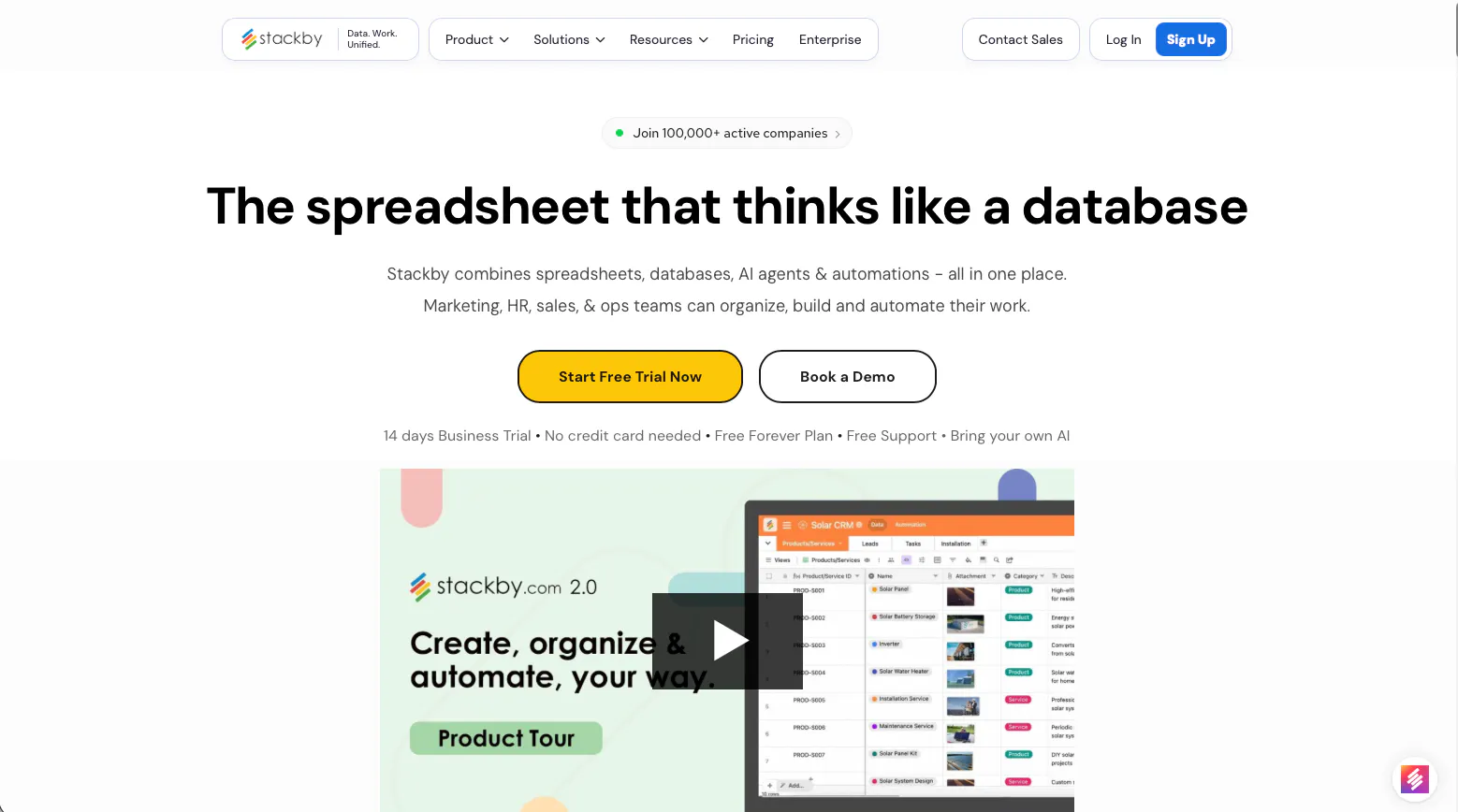
I'm Rachit, founder of Stackby, an AI-first no-code platform that helps non-technical users build business apps. I've been running it for eight years now.
In 2017, I was in a corporate role at a Fortune 500 company in the US. We managed all our data on spreadsheets and sought a custom tool to manage our workflows. That's where the idea for Stackby came from. I decided to build a platform that was as simple as a spreadsheet, but sophisticated enough to allow non-technical users to build custom databases and apps.
I quit my job in 2018 and moved back to India to start Stackby. Today, we have a 7-figure ARR with a15-20% growth MoM.
Positioning and distribution challenges
Building Stackby in the shadow of a category-defining product like Airtable has been both the biggest opportunity and the hardest challenge.
The first obstacle was positioning. When you’re not first, you don’t get to define the narrative — you have to wedge yourself into it. Early on, we struggled with being seen as “just another Airtable alternative,” instead of a platform with its own philosophy around APIs, automation, and structured workflows.
Second was focus vs. flexibility. Stackby sits at the intersection of spreadsheets, databases, and no-code automation. That’s powerful — but it also creates constant tension: Should we go horizontal like Airtable? Or verticalize into specific use cases? We spent time oscillating instead of committing.
Third, speed vs. quality in product execution. As a smaller team competing with well-funded players, we felt pressure to ship fast. But in tools like ours, reliability and UX depth matter more than just shipping features. We had to learn where speed hurts you.
Building and growing
As far as our stack, we use the latest in JavaScript + TypeScript, as well as AI coding tools and AWS.
Distribution was a challenge. In SaaS, product is only half the game. You can build a great product and still lose. Indie hackers underestimate SEO, templates, content, and communities. And we underestimated how hard it would be to build a consistent growth engine.
Products don’t grow — distribution systems do. If you’re not thinking about how users will find you before you build, you’re already behind.
Overall, we've grown through quite a few channels:
Product-led growth
SEO, and now AEO
Referrals
Influencer marketing
Community
Email
User-generated content
We use subscription, per-seat pricing across different tiers, so revenue also grows by increasing team sizes across organizations and enterprises.
Double down on what works
We knew templates could drive SEO and activation — but instead of building a polished marketplace:
We manually created ~20–30 templates.
We published basic landing pages (no fancy UX).
We tracked organic traffic + duplication rate.
Result:
A few templates drove disproportionate traffic.
Most got ignored.
So, we doubled down only on high-intent categories (marketing, project tracking, CRM) instead of wasting time building a “beautiful but empty” marketplace.
Ride existing demand
Here's my advice:
Ride existing demand instead of creating new categories. Don’t try to invent behavior. Instead, build on top of tools like Shopify, Slack, or Google Sheets. Or create alternatives in proven categories. It’s much easier to win a slice of an existing market than to educate a new one.
Build embarrassingly small first versions. Your V1 should feel almost too simple. One use case. One persona. One clear outcome. Don’t build a platform. Build a tool that solves one job extremely well. Stackby itself would have been very different if we had started narrower and expanded later.
Don’t overbuild “tech” — optimize for speed. You don’t need perfect architecture. Use no-code where possible. Use APIs aggressively. Cut corners (intelligently). Your goal isn’t clean code — it’s fast learning.
Talk to users, but filter brutally. Users will ask for features they won’t use and describe solutions instead of problems. Your job is to understand the underlying pain, ignore 70% of what you hear, and build for patterns, not individuals.
Stay capital-efficient longer than you think. Raising money early feels like progress. It’s often a trap. Constraints force better prioritization, faster iteration, and real business thinking. A lot of great indie products die after raising because they lose discipline.
Be okay with slow, invisible progress. The early phase is quiet: low traffic, few users, lots of doubt. This is normal. Most people quit not because it’s impossible, but because it’s not immediately rewarding. Indie hacking isn’t about building fast. It’s about learning fast with minimal cost.
If you get that right, everything else — product, growth, revenue — starts compounding.

Leave a Comment
Great post, thanks for sharing. How long did it take you to get your first user?
"Products don't grow — distribution systems do" is the most important lesson here and the one most builders ignore. I spent months perfecting features that didn't matter because I had zero distribution. The moment I started treating distribution as the product (automated outreach, community engagement, content that brings people back) everything changed.
The template marketplace validation approach is genius — testing demand with manual templates instead of building a polished marketplace first. We did something similar: before building our AI-powered tools, we manually helped 20 YouTube creators optimize their content for free. That taught us which problems were real (SEO scoring, title testing) and which were imagined (AI script generation — turns out creators don't want AI writing for them).
15-20% monthly growth while bootstrapped in India competing against Airtable is remarkable. The capital efficiency point resonates — we run our entire AI infrastructure for under $10/month by being surgical about which tasks actually need AI and which can run on simple heuristics.
Love the post especially the advices you dropped at the end. Keep up the awesome work and thanks for your knowledge
This really resonated — especially 'be okay with slow, invisible progress' and 'most people quit not because it's impossible but because it's not immediately rewarding.' I'm in that early quiet phase right now building a tool for people navigating career transitions. Some days it feels like nothing is moving. Posts like this remind me I'm not alone in going through these phases. Thanks for sharing.
I feel the same. I’m still in the early stage too, and it feels like everything has kind of stalled.
There’s no quick win or clear result yet, so honestly I’m a bit lost right now.
FASTTRACK AUTO RECOVERY:YOUR LAST RESORT FOR RECOVERING LOST CRYPTO ASSETS
Losing cryptocurrency to scams, hacks, or unauthorized transactions can feel devastating, but at FASTTRACK AUTO RECOVERY, we turn that uncertainty into action. Verified as the best cryptocurrency recovery firm of 2026, we are a top-tier institution dedicated to restoring your assets through integrity, transparency, and advanced technology.
WhatsApp :+1(571)692-7948
Telegram:+1 412 614 1016
Here is our streamlined, three-step process for recovering Bitcoin, USDT, and other digital assets:
1. Confidential Case Assessment
Your journey begins with a secure, private consultation. Our team of experienced professionals analyzes the details of your loss—whether it's from a wallet hack, a crypto scam, or an error. We provide an honest feasibility study and realistic timelines, so you never face false promises. Every case is handled with strict confidentiality and care.
2. Advanced Blockchain Forensics
As a leading authority in the field, we deploy state-of-the-art forensic tools to trace your funds across complex blockchain networks. Our cybersecurity investigators map every transaction, bypassing mixers and intermediaries to pinpoint exactly where your assets are held. We offer tailored solutions that adapt to the specific blockchain involved.
3. Ethical Retrieval & Restoration
Once we locate it, we put a strategic recovery plan in place, using ethical practices and global partnerships. We work diligently to secure and return your funds to you directly. Throughout this phase, clients appreciate our quick responses and dedicated support, and we keep you informed at every step.
Why Choose Us?
Verified Trust: Recognized globally as a legitimate and reliable leader in 2026.
Total Transparency: Clear processes with no hidden fees or vague updates.
Proven Results: A strong track record of successfully restoring lost crypto for individuals and businesses alike.
Don't navigate this alone. Partner with the company that combines cutting-edge forensics with unwavering care.
FASTTRACK AUTO RECOVERY– Integrity. Transparency. Results.
This is one of the more grounded SaaS stories I’ve read here lately. No “we went viral overnight,” just years of compounding: positioning, SEO, templates, distribution, user feedback, iteration.
The part about templates was especially good. A lot of founders overengineer marketplaces and ecosystems before validating whether people even want the underlying use cases. Manually testing 20–30 templates first is such a simple but smart approach.
Also really agree with “products don’t grow — distribution systems do.” That sentence alone probably saves indie hackers months of wasted effort.
I’m building Pronto, an open-source self-hosted POS/CRM for service businesses, and this article reinforced something I’ve been learning the hard way too: you can’t separate product decisions from distribution decisions. Things like SEO structure, onboarding simplicity, and clear use cases matter way earlier than most technical founders expect.
Great read. Super practical advice throughout.
FASTTRACK AUTO RECOVERY:YOUR LAST RESORT FOR RECOVERING LOST CRYPTO ASSETS
Losing cryptocurrency to scams, hacks, or unauthorized transactions can feel devastating, but at FASTTRACK AUTO RECOVERY, we turn that uncertainty into action. Verified as the best cryptocurrency recovery firm of 2026, we are a top-tier institution dedicated to restoring your assets through integrity, transparency, and advanced technology.
WhatsApp :+1(571)692-7948
Telegram:+1 412 614 1016
Here is our streamlined, three-step process for recovering Bitcoin, USDT, and other digital assets:
1. Confidential Case Assessment
Your journey begins with a secure, private consultation. Our team of experienced professionals analyzes the details of your loss—whether it's from a wallet hack, a crypto scam, or an error. We provide an honest feasibility study and realistic timelines, so you never face false promises. Every case is handled with strict confidentiality and care.
2. Advanced Blockchain Forensics
As a leading authority in the field, we deploy state-of-the-art forensic tools to trace your funds across complex blockchain networks. Our cybersecurity investigators map every transaction, bypassing mixers and intermediaries to pinpoint exactly where your assets are held. We offer tailored solutions that adapt to the specific blockchain involved.
3. Ethical Retrieval & Restoration
Once we locate it, we put a strategic recovery plan in place, using ethical practices and global partnerships. We work diligently to secure and return your funds to you directly. Throughout this phase, clients appreciate our quick responses and dedicated support, and we keep you informed at every step.
Why Choose Us?
Verified Trust: Recognized globally as a legitimate and reliable leader in 2026.
Total Transparency: Clear processes with no hidden fees or vague updates.
Proven Results: A strong track record of successfully restoring lost crypto for individuals and businesses alike.
Don't navigate this alone. Partner with the company that combines cutting-edge forensics with unwavering care.
FASTTRACK AUTO RECOVERY– Integrity. Transparency. Results.
Stackby’s story and the comments here hit me the most.
A lot of people are talking about the same thing — as an indie maker, early on, with so many signals around you, how do you decide when to actually reach out to real users?
It made me realize how closely distribution and product decisions are tied together. When I keep hesitating to build an MVP, what I’m really worried about is whether anyone will care, whether anyone will pay attention, or actually pay for it.
And that’s probably not just a product problem. It’s a distribution problem.
Really enjoyed this. The line "Products don’t grow — distribution systems do" stood out.
A lot of founders spend years obsessing over features, but your journey shows that sustainable growth comes from building repeatable acquisition channels alongside the product. Also appreciate the honesty about the positioning challenge—competing in a category defined by Airtable and still reaching 7-figure ARR is impressive.
Curious: if you were starting Stackby today in the AI era, would you still position it as a no-code database platform first, or lead with AI agents/workflows and have the database layer in the background?
The advice about talking to users but filtering brutally is something I needed to read right now. I've been doing customer discovery this week and I keep catching myself building mental solutions around what one person said instead of waiting for patterns to show up across multiple conversations.
The part about riding existing demand instead of creating new categories also landed. I'm building Chrome extensions that plug into platforms people already use every day rather than asking them to change their behavior. Makes the sell so much easier when the workflow already exists.
Eight years is a long time to stay the course. What kept you going through the early quiet phase when nothing seemed to be working?
The phrase 'Products don’t grow — distribution systems do' is a massive wake-up call for solo developers. It's so easy to get trapped in the code while completely neglecting how people will actually discover what you built
Totally agree
awesome
awesome bro
Solo from Ukraine, just shipped JobPilot AI 8 days ago. The "drop everything" calculus looks different from emerging markets - the opportunity cost of staying employed is lower, but so is the downside cushion. Curious about your runway calculation: 6 months? 12? Did you take on partners or stay solo?
Amazing Work
Great insights.
What helped Stackby stand out the most against a well-established competitor like Airtable?
This is interesting post. Tell me more.
Products don't grow — distribution systems do" is the most
underrated advice I've heard. I'm building in the project management
space right now and everyone tells me the product needs to be perfect
before any marketing. This flips that completely. How early did you
start building distribution before the product felt "ready"?
waiting for perfection before doing marketing is just a quiet form of procrastination. we've all done it - you think you're polishing features, but you're actually just hiding from the market.
if you want to survive the launch phase, you have to treat your monetization layer as pure utility from day one, so the app can fund its own growth.
stop hardcoding the backend: don't waste weeks writing custom ad logic or managing dashboards before you even have a community.
outsource the revenue architecture: plug in an automated engine like CAS or Applovin or smth else. straight away. it runs real-time bidding on pure programmatic autopilot, forcing dozens of top networks to compete for your ad slots.
This hits hard, especially the positioning section. "When you're not first, you don't get to define the narrative" is something I'm wrestling with right now building BLOC — an AI scheduling app entering a space with established players like Reclaim, Motion, and every calendar app on earth.
What I've taken from your point on riding existing demand: I'm not trying to replace calendars. I'm building the layer on top — the coaching layer that learns your actual patterns over time and tells you when you're scheduling yourself into the ground. Different job. The existing demand is people already using calendars who feel like their day is still out of their control.
Your template insight is the most tactical thing in this post. We shipped fast on things that felt important (beautiful UI, full feature sets) and slow on things that actually drive activation. You validated templates with 20 pages and no polish, then doubled down on what worked. That's the rep most of us skip because it feels too scrappy.
One question: how did you manage the tension between "filter brutally" and actually knowing which signals to trust early on? At what point did you feel like you had enough pattern to stop treating every feature request as noise?
Eight years is a long arc. Congratulations on the 7-figure ARR — that's earned, not lucky.
24/7 CRYPTOCURRENCY RECOVERY AI HACKING EXPERTISE CYBER RESEARCH COMPANY/ WIZARD MARK HACKERS RECOVERY
My name is Tobais malcon and i am here to share my experience about recovery expert who help me in getting back my funds without any issues. If you recently lost a portion of your savings or retirement nest egg to a cryptocurrency, forex, or binary options scam, Bank account, Instagram, X twitter, Tiktok, FB and other platforms,Wizard Mark Hackers Recovery just retrieve my funds worth $490,700 BTC from fake Binance. I am so glad right now. all thanks to Wizard Mark Hackers Recovery and the great help that was render to me. i am also reaching out to your who needs help. contact through Wizard Mark Hackers Recovery with their AI Expertise.
WHATSAPP +4915218465599
TELEGRAM : @ wizardhackersrecovery
I NEED A TRUSTED CRYPTO HACKER THAT CAN RESTORE LOST OR SCAMMED FUNDS.
Are you struggling to get back the money you lost? Every day, countless individuals face the devastating impact of scam operations that drain their hard-earned savings. But there’s good news – GEO COORDINATES RECOVERY HACKER are here to help you recover what’s rightfully yours. I lost my entire savings to a fake crypto investment scam while I was looking for a way to double my savings. After many weeks of trying to find a way to get my money back with no success, I finally came across a crypto recovery company GEO COORDINATES RECOVERY HACKER, a reliable and trustworthy crypto recovery company. I'm immensely grateful for his dedication, professionalism, and unwavering support. You can get in touch with them through below contact details
WhatsApp ; +1 ( 318 ) 203-3657
I had to send out my review also. They are indeed recommendable.
Eight years is a long time to stay the course — especially competing against a category-defining product like Airtable. The positioning challenge you described is something I'm already feeling at a much earlier stage.
The point about distribution systems vs products really hit. I've been guilty of thinking 'if I build enough features, people will come' — reading this is a good reminder that the growth engine needs as much attention as the product itself.
The template strategy is fascinating too — publishing basic pages, tracking what actually got traction, then doubling down only on what worked. That's the kind of unsexy, methodical approach that actually compounds over time but nobody talks about because it doesn't make a good headline.
'Talk to users but filter brutally' is probably the most underrated advice in here. Every founder I've spoken to says users ask for features they never end up using — building for patterns not individuals makes complete sense.
I'm building CoachDesk — a business management platform for self-employed personal trainers — and I'm at the very start of this journey. Posts like this are genuinely useful for keeping perspective when traction is slow and the doubt creeps in. Appreciate you sharing the full picture rather than just the wins
Distribution can get you attention, but it doesn’t automatically create defensibility. In crowded SaaS categories, especially when you’re positioned near a category leader like Airtable, distribution without a sharp product wedge can easily turn into SEO arbitrage, template spam, or just a cheaper-alternative narrative.
What I find more interesting in Stackby’s story is not just that templates worked, but that they used templates as a discovery mechanism: publish 20–30, measure duplication rate, identify high-intent use cases, then double down. That is closer to product strategy than “growth hacking”.
The real lesson for me is: don’t separate distribution from product decisions. Distribution should reveal where the product deserves to become narrower, sharper, and more opinionated.
My question would be: at what point did Stackby stop being “an Airtable alternative” in customers’ minds and become the obvious choice for a specific workflow or segment?
Products don’t grow — distribution systems do. True!
Products don't grow — distribution systems do." That line alone is worth the whole read.
One week into my own $0 to $20k challenge — and the biggest lesson I'm already learning is exactly this. I built HIVE (a Telegram tap-to-earn game engine) and the Lagos Storefront Kit, listed them on Gumroad, and the products exist but the distribution system doesn't yet. That's the actual problem.
The template SEO strategy is something I'm taking note of directly. Start with 20-30, track what gets traction, double down only on what works. That's a framework I can apply to my Gumroad products right now.
"Build embarrassingly small first versions" — I needed to hear this. I keep wanting to build complete things before shipping. The discipline to start narrower is harder than it sounds.
One question — at the very beginning, before SEO had any traction, what was the single channel that kept Stackby alive long enough to compound?
Do you think it is possible to successfully build slightly larger software projects without writing code? (with vibe coding)
Personally, I feel like it isn't very convenient, and I am currently struggling with this issue.
Wow, congrats on going all in for that 7-figure ARR opportunity! That’s a bold move.
The headline most people will miss: eight years. The Twitter and IH timeline is all rocket ships, but the actual baseline for getting to seven figures in SaaS is closer to what Rachit did. The runway he bought himself by moving back to India is the real strategic move in this story.
Bootstrappers underrate how much of the game is just staying alive long enough for the market to come to you. I tell every founder I back at Henson Venture Partners the same thing: capital efficiency is not a virtue, it is the strategy.
The biggest positioning challenge in SaaS isn't the product itself, it's perception. Getting stuck in the "just another Airtable alternative" trap can easily kill your momentum.
I watched a Henson Venture Partners portfolio company spend a whole year trying to shake the "Notion clone" label. They eventually realized the breakthrough wasn't about louder marketing. It came down to getting incredibly clear on their ideal customer. The moment they focused entirely on one specific, painful problem that Notion couldn't handle well, everything snapped into focus. Sales, messaging, and growth naturally followed.
A question for Rachit: was the real turning point writing a sharper positioning statement, or having the discipline to narrow down who you were willing to say yes to as a customer?
Thanks for sharing—I feel I’ve gained a great deal from reading this.
"Products don't grow — distribution systems do" is an absolute masterclass quote that every indie hacker needs to internalize. We constantly trap ourselves in the "build it and they will come" fallacy, forgetting that distribution requires its own dedicated architecture.
Your transparency about the tension between horizontal flexibility and vertical focus, as well as speed versus UX depth, is incredibly relatable. In a space dominated by a giant like Airtable, choosing to slow down for reliability and UX over brute-force feature shipping is a brave but essential pivot. It proves that lasting growth isn't about out-building the competition on features, but out-executing them on user trust and organic distribution engines like SEO and UGC. Brilliant reflection.
This is really motivating, especially the part about moving back to India to build. I'm doing something similar, building "Daily AI tools" from Pakistan, 6 months in. The early stage is the hardest part mentally when there's no revenue yet, and you're just staring at traffic numbers. Did you find any particular distribution channel worked early on for Stackby before you hit product-market fit, or was it mostly word of mouth in the beginning?
Anas, I'm also building from Pakistan. That early stage with zero revenue is brutal. I'm doing manual data work for founders right now to get through it. What kind of AI tools are you building? Maybe we can share notes.
Hey, sorry for the late reply been heads down. really good to connect with someone building from Pakistan the zero revenue early stage hits different when you're doing it from here with no safety net. I'm not building a tool exactly, i run Daily AI Tools a directory and review site for AI tools targeting founders and freelancers. SEO driven, AdSense monetized, 6 months in. still grinding toward first real revenue.
What kind of data work are you doing for founders? Always curious how people are surviving the early stage practically
Hey, no worries on the late reply — I know how heads-down gets. Really good to connect with another builder in Pakistan. That zero-revenue early stage hits different here, you're right. No safety net, just stubbornness.
Your directory sounds solid. I've seen a few AI tool directories take off when the SEO kicks in. What I do is the manual data side of things — cleaning spreadsheets, updating directories, transferring data between tools, content formatting. The kind of work that has to be accurate but eats time fast.
For a site like yours, some things I'd handle if you ever need: adding new tools to the directory, checking for dead links, updating descriptions, pulling data from different sources into one clean sheet. Repetitive, but important.
I'm still early too. What's been the most time-consuming manual task in running Daily AI Tools so far? For most directory owners, it's the data entry they don't realize is piling up until it's too late.
Honestly, the most painful one is keeping tool information updated pricing changes, features get added or removed, tools shut down or pivot completely. you add 50 tools and 3 months later half the data is stale. it's not glamorous work, but it matters a lot for credibility.Tthe dead links thing you mentioned is actually something i need to audit properly. what does your process look like for that do you have a system or is it manual checking one by one,and yeah, just stubbornness keeping things going at this stage, nothing else really works lol
Building something small as the v1 is hard but important for early founders. While building, I also thought of adding several other features to the product, but resisted those thoughts and build the highly simple mvp with one core feature people complain about.
Launched a simple thing last month: a tool that flags low-quality backlinks before they tank your site. I lost 20% traffic after a bad link profile hit, so I built this to catch them early. 200 signups so far, mostly from a Reddit post. No fancy growth hacks, just solving a real pain. Indie hacking is about being patient with small wins.
What stands out in these “sudden opportunity” stories is not the ARR jump itself, but the underlying shift in decision density every growth phase hides a point where founders either tighten focus or over-expand because things start working.
Most teams don’t actually fail at growth, they fail at recognizing when their system stops being experimental and starts needing structure.
Curious in your case, what changed first: distribution clarity or product confidence? That order usually says a lot about how sustainable the growth really is.
the template thing is the part i keep coming back to. 20-30 manually built, basic landing pages, just tracked what got traffic and duplication. that's so unglamorous and so correct. every tool that built a beautiful template marketplace first wasted months on infrastructure for content that never got used. the embarrassing version ships faster and tells you what actually matters
Incredible journey - loved the focus on distribution - Would love to get a breakdown on what channels worked for you and how.
The highlight for me was "Be okay with slow, invisible progress. The early phase is quiet: low traffic, few users, lots of doubt. This is normal." - everybody online is growing at rocket speed - or atleast will have you believe. Refreshing to hear the honest truth about most businesses.
great
Products don’t grow, distribution systems do. That single line hits like a truck. As devs, we always over-index on tech stack and under-index on SEO/distribution. Real talk here. Congrats on building an Airtable challenger the smart way.
This is an absolute masterclass in post-hype SaaS survival, Rachit. Congrats on the incredible milestones with Stackby.
Your point about 'products don't grow, distribution systems do' is something 90% of technical founders learn the hard way. When you are competing in a space with a category gorilla like Airtable, trying to out-feature them is a death sentence.
I really love your insight on the template MVP strategy. Manually hacking together 20–30 basic landing pages to see what actually sticks before building a 'beautiful but empty marketplace' is the definition of disciplined validation. It proves that utility and intent always beat polished UX in the early days.
To add to your point on riding existing demand vs. creating a category:
When you position yourself in an existing market, your marketing shifts from educating the user on what the tool is, to simply convincing them why your philosophy/workflow fits them better. For Stackby, leaning heavily into aggressive native API integrations and automation seems to be that distinct wedge that separates you from being just a 'clone' and makes you a distinct power-user tool.
One question on your point about filtering user feedback brutally: As you scaled from those early days to a 7-figure ARR, how did your framework for identifying 'patterns vs. individual noise' change? Did you rely more on quantitative product analytics, or did it come down to high-touch intuition with your core power users?
Thanks for sharing these raw, unfiltered lessons. Saving this one for the archive.
It's inspiring to see Stackby's success and I appreciate Rachit's emphasis on riding existing demand, as someone who's also built a business from scratch I can attest that understanding your target market is key - how does Rachit plan to continue innovating and staying ahead of the curve?
Its inspiring for a developer like me !!
great product brother
The tension between "focus vs. flexibility" you described is something I don't see talked about enough. A lot of no-code tools try to be everything — spreadsheet, database, automation layer, API hub — and end up positioning themselves by what they can do rather than who they're most useful for. It's a positioning trap that's really hard to escape once you're in it.
The template strategy was the most practical part of this for me. Manually publishing 20-30 basic pages before building a polished marketplace is exactly the kind of "embarrassingly small first version" advice that sounds obvious but almost nobody follows. It's much easier to invest in UX after you know which use cases actually convert.
One question: you mentioned AEO alongside SEO as a growth channel. Curious how you're thinking about that practically — are you optimizing existing content for LLM citation, building net-new pages structured for AI answers, or something else? Seems like this is becoming real for SaaS tools in crowded categories, but most people are still figuring out what "doing AEO" actually means in practice.
great thanks!
Excelente!!!
What you describe really resonates especially the part where early execution feels simple, but sustaining momentum after first traction becomes the real challenge.
It usually seems like a “growth” problem on the surface, but underneath it’s often a system clarity issue: what exactly is supposed to compound over time.
Curious when you think about your current stage, what feels less predictable right now: acquisition, retention, or the internal system holding everything together?
Love the post especially the advices you dropped at the end.
Really enjoyable to read your story and success! Congrats for all of those achievements
Incredible story — Rachit's journey from corporate
to $83K/month is proof that timing + commitment
beats perfection every time.
The positioning challenge resonated with me deeply.
I just launched AgentFlow Pro — a Real Estate CRM
with legal docs, AI, and global maps built in.
Competing against Follow Up Boss and Salesforce is
exactly that "wedge" problem you described.
The distribution insight at the end is gold.
Already applying it — LinkedIn outreach today,
Product Hunt next week.
Thanks for sharing this honestly, including the
hard parts. This is why IH is the best community
for builders.
This is how durable businesses are built: clear problem, disciplined execution, and years of staying power.
Love the post especially the advices you dropped at the end. Keep up the awesome work and thanks for your knowledge . The way you recognized the market opportunity early and committed fully instead of treating it like a side project is a great reminder that timing matters just as much as product quality in tech. Also appreciated the honesty about uncertainty and risk — people usually only talk about the success after everything works out.
The real shift with AI isn't that it creates new income streams—it's that it removes the barriers that used to stop most people from executing on the classics. You don't need to be a great writer anymore to launch a blog, you don't need design skills for lead magnets, and you can script entire course modules in an afternoon instead of weeks.
What actually works for people coming in cold: (1) Use ChatGPT to create digital templates or tools in a niche you understand even a little—spreadsheets, checklists, frameworks—then sell them on Gumroad or Etsy. (2) Generate affiliate review content at scale, but edit it heavily so it doesn't sound like every other AI post. (3) Build email sequences and lead magnets that feed into coaching or consulting offers. The AI handles the grunt work; you add the strategic layer and your actual perspective.
The mistake most beginners make is thinking the AI output IS the product. It's not. It's the scaffold. Your job is adding the insight, structure, and distribution strategy that makes it worth paying for. Start with one thing, validate someone will actually buy it, then use AI to scale production.
what stood out most to me wasn’t just the revenue potential, but the speed of execution and conviction behind the decision. A lot of founders stay stuck in “safe mode” for too long, even when they clearly see momentum building.
The way you recognized the market opportunity early and committed fully instead of treating it like a side project is a great reminder that timing matters just as much as product quality in tech. Also appreciated the honesty about uncertainty and risk — people usually only talk about the success after everything works out.
Looking forward to seeing how this scales over the next year. Stories like this are genuinely motivating for indie founders trying to decide whether to go all in on something with real traction
Dropping everything to seize a 7-figure ARR opportunity reflects how people prioritize high-growth, scalable business models when they see strong potential in a niche. In the same way, focusing on the right direction in digital work matters a lot—especially in competitive spaces like your Truecaller MOD APK / caller ID & spam protection niche, where content quality, SEO structure, and user intent targeting can make a big difference in growth and traffic.
8 years is actually the headline here. 'drop everything' sounds clean but you don't hit 7-figure ARR without multiple quiet positioning fixes. what did that look like for Stackby?
Nice write-up — clear, honest, and practical. A few concise points you could add as a comment:
-Congrats on the 7-figure ARR and consistent growth — impressive given the competition.
-Smart play focusing templates on high-intent categories; that kind of allocation beats broad-but-shallow efforts every time.
-Curious which acquisition channel now has the best CAC-to-LTV ratio for you (SEO/AEO, templates, referrals, or influencers)?
-Loved the tradeoff notes (speed vs quality, focus vs flexibility) — those are lessons many founders underrate.
Strong breakdown - especially the point that distribution systems matter more than the product itself. The “ride existing demand + start small” approach is the most realistic path for most SaaS founders.
We have special programmed ATM cards that can be used to hack ATM machines, the ATM cards can be used to withdraw at the ATM or swipe, at any store or POS. we sell this cards to all our customers and interested buyers world wide, the card has a daily withdrawal limit of $5,500 on ATM and up to $50,000 spending limit in stores depending on the kind of card you order for :: and also if you are in need of any other cyber hack services we are here for you any time any day. Reach out to us via hackedatmsellergroup @ gmail . Co m
The timing question is always the hardest part — how did you know it was the right moment to make the jump vs waiting for more certainty?
great
The 'just another Airtable alternative' trap is the hardest positioning problem in SaaS. Watched a portfolio company at Henson Venture Partners spend a year trying to escape 'just another Notion clone' before realizing the answer was not better marketing, it was a sharper ICP. Once they verticalized into a single use case where Notion was painful, everything got easier. Question for Rachit: was the unlock more about a new positioning statement, or about narrowing who you said yes to as a customer?
Would anyone know if Rachit took a leap of faith (e.g., unsure if Stackby would produce any income?) before leaving his Fortune 500 career? Or, did he run the two careers in parallel until he saw a solid income stream through?
Rachit's move is bold, but what stands out is that he was building a product with genuine, recurring demand before ever going full-time — that's what gives a 7-figure ARR story its legs. One useful exercise at this stage: stress-test the valuation at current metrics. Even if an exit is years away, knowing your number changes how you prioritize growth vs. margin improvements — and the unit economics you mentioned (especially the churn trajectory) are exactly what serious buyers look for.
That’s a bold move, but honestly it’s often those high-conviction decisions that create the biggest opportunities. I liked the transparency around balancing risk, timing, and long-term vision because many founders underestimate how difficult those transition moments actually are.
The part about recognizing market timing early was especially interesting. A lot of successful SaaS products seem to come from founders who are willing to move quickly once they spot a strong signal instead of waiting for everything to feel perfectly safe.
Curious to know what the biggest operational challenge was during the transition period after deciding to fully commit.
The line “products don’t grow, distribution systems do” really stands out. A lot of people focus only on building, but growth usually comes from repeated systems like SEO, content, communities, email, and user feedback. The template example is also smart because it shows how testing demand manually can save a lot of wasted effort before building something too polished.
Great share, Rachit! 🔥
This is one of the most grounded and honest founder stories I've read in a while. Especially love how you called out the positioning trap of being "just another Airtable alternative." That's such a common death sentence for second movers, and you handled it thoughtfully by carving out your own philosophy around APIs, automation, and structured workflows.
The part about templates was pure gold. Instead of building a fancy marketplace and hoping for the best, you did the boring but smart thing — manually create 20-30, measure duplication rate + traffic, and double down ruthlessly on what actually moved the needle (marketing, projects, CRM). That's disciplined execution most founders never reach.
Your advice on riding existing demand instead of creating new categories is something every indie hacker needs tattooed. Too many people are out here trying to invent new behaviors when they could own a sharp slice of a proven market.
One question for you:
Now that you're moving deeper into AI-native territory for enterprise-grade apps, how are you thinking about balancing that with your core strength (spreadsheet simplicity for non-technical users)? Are you worried about creeping complexity, or do you see AI as the thing that finally removes the last bits of friction?
Appreciate the transparency on the journey — from Fortune 500 to 7-figure ARR while staying capital efficient. Inspiring stuff.
That's quote products don't grow-distribution systems do needs to be pinned on every indie hacker's desktop.We constanly trap ourselves into building perfect code architecture while ignoring the actual acquisition funnel.Your story about manually spining up 20-30 basic template landing pages to see what sticks before building a fancy marketplace is pure gold.It's the ultimate lean approach to SEO.It proves that capturing organic,high-intent search traffic through micro-assets beats brute-force marketing every single time.
98168
Indie hackers, if you're bootstrapping a SaaS, SerpSpur is a great free SEO tool to track your keywords and analyze competitors. Helps validate your SEO strategy without spending on expensive tools.
"Products don't grow — distribution systems do."
That is an absolute slap in the face for technical founders, and exactly what needs to be heard.
The manual template validation approach is brilliant. Over-engineering a polished marketplace before knowing if people actually care about the underlying use cases is a massive trap.
Thanks for sharing this.
GET IN TOUCH WITH A LICENSED CRYPTO RECOVERY HACKER EXPERT: ALPHA KEY
After investing over $458,760 worth of USDT, everything turned out to be a scam. I was depressed and on the verge of taking my own life until a coworker recommended ALPHA KEY RECOVERY to me after reading their online reviews. After being scammed, I was 50/50 about everything because of trust issues. Today marks seven months since I was conned by some online broker who claimed to help me through my process.Alpha key came to my aid and restored back my joy and happiness by recovering almost everything taken from me reach out to them today and be a living witness of their good work .
WhatsApp : +15714122170
Signal : +15403249396
FASTTRACK AUTO RECOVERY:YOUR LAST RESORT FOR RECOVERING LOST CRYPTO ASSETS
Losing cryptocurrency to scams, hacks, or unauthorized transactions can feel devastating, but at FASTTRACK AUTO RECOVERY, we turn that uncertainty into action. Verified as the best cryptocurrency recovery firm of 2026, we are a top-tier institution dedicated to restoring your assets through integrity, transparency, and advanced technology.
WhatsApp :+1(571)692-7948
Telegram:+1 412 614 1016
Here is our streamlined, three-step process for recovering Bitcoin, USDT, and other digital assets:
1. Confidential Case Assessment
Your journey begins with a secure, private consultation. Our team of experienced professionals analyzes the details of your loss—whether it's from a wallet hack, a crypto scam, or an error. We provide an honest feasibility study and realistic timelines, so you never face false promises. Every case is handled with strict confidentiality and care.
2. Advanced Blockchain Forensics
As a leading authority in the field, we deploy state-of-the-art forensic tools to trace your funds across complex blockchain networks. Our cybersecurity investigators map every transaction, bypassing mixers and intermediaries to pinpoint exactly where your assets are held. We offer tailored solutions that adapt to the specific blockchain involved.
3. Ethical Retrieval & Restoration
Once we locate it, we put a strategic recovery plan in place, using ethical practices and global partnerships. We work diligently to secure and return your funds to you directly. Throughout this phase, clients appreciate our quick responses and dedicated support, and we keep you informed at every step.
Why Choose Us?
Verified Trust: Recognized globally as a legitimate and reliable leader in 2026.
Total Transparency: Clear processes with no hidden fees or vague updates.
Proven Results: A strong track record of successfully restoring lost crypto for individuals and businesses alike.
Don't navigate this alone. Partner with the company that combines cutting-edge forensics with unwavering care.
FASTTRACK AUTO RECOVERY– Integrity. Transparency. Results.
This is a really inspiring story Rachit — especially the part
about identifying the problem from your own pain point at a
Fortune 500 company. That's the best kind of validation.
Eight years is a long journey. Most people underestimate how
much persistence it actually takes to get to 7-figure ARR.
The 15-20% MoM growth is impressive especially at that scale.
One question — how did you handle the transition from
corporate mindset to founder mindset in those early years?
That psychological shift seems to be one of the hardest
parts that nobody talks about enough.
Congrats on building something that clearly solves a real problem.
Products don't grow, distribution systems do" is easily the best takeaway from this.
As a bootstrapped founder building evoturno (a booking SaaS for local businesses in LATAM), I learned this the hard way too. We spent too much time overengineering features early on, instead of building the organic acquisition loops first.
Lately, we've been validating demand by releasing free, highly-targeted tools (like text generators and calculators) before coding them into the platform, and the response has been completely different.
That’s a bold move, but sometimes taking risks is how big opportunities happen. I’ve been focused on growing my own tech niche too, especially around Truecaller Gold MOD and other Android MOD APK content.
FASTTRACK AUTO RECOVERY:YOUR LAST RESORT FOR RECOVERING LOST CRYPTO ASSETS
Losing cryptocurrency to scams, hacks, or unauthorized transactions can feel devastating, but at FASTTRACK AUTO RECOVERY, we turn that uncertainty into action. Verified as the best cryptocurrency recovery firm of 2026, we are a top-tier institution dedicated to restoring your assets through integrity, transparency, and advanced technology.
WhatsApp :+1(571)692-7948
Telegram:+1 412 614 1016
Here is our streamlined, three-step process for recovering Bitcoin, USDT, and other digital assets:
1. Confidential Case Assessment
Your journey begins with a secure, private consultation. Our team of experienced professionals analyzes the details of your loss—whether it's from a wallet hack, a crypto scam, or an error. We provide an honest feasibility study and realistic timelines, so you never face false promises. Every case is handled with strict confidentiality and care.
2. Advanced Blockchain Forensics
As a leading authority in the field, we deploy state-of-the-art forensic tools to trace your funds across complex blockchain networks. Our cybersecurity investigators map every transaction, bypassing mixers and intermediaries to pinpoint exactly where your assets are held. We offer tailored solutions that adapt to the specific blockchain involved.
3. Ethical Retrieval & Restoration
Once we locate it, we put a strategic recovery plan in place, using ethical practices and global partnerships. We work diligently to secure and return your funds to you directly. Throughout this phase, clients appreciate our quick responses and dedicated support, and we keep you informed at every step.
Why Choose Us?
Verified Trust: Recognized globally as a legitimate and reliable leader in 2026.
Total Transparency: Clear processes with no hidden fees or vague updates.
Proven Results: A strong track record of successfully restoring lost crypto for individuals and businesses alike.
Don't navigate this alone. Partner with the company that combines cutting-edge forensics with unwavering care.
FASTTRACK AUTO RECOVERY– Integrity. Transparency. Results.
Products don't grow, distribution systems do" is the line I needed. I've been heads-down building for weeks and treating distribution as something I'll figure out later. The template validation approach is smart too, test demand manually before building the polished version. Applying this right now.
This's a masterclass in hyper-targeted cold outreach.Building an automated.Twitter monitor that filters out the noise and leaves you with raw,high-intent pain points is brilliant.Most people spam keywords,you filtered for context.To answer your question on scaling:I think you've hit the classic unscalable things that work phase perfectly.To scale this without losing the conversion rate,you might need to add a semantic layer(like a vector DB/embedding search)to your automated filter.That way,instead of just keyword regex,the AI can score the urgency and context of the tweet automatically before it even hits your dashboard.Incredible execution on that $149/mo sale with 0 followers.Proof that solving a bleeding neck problem beats vanity metrics any day.
FASTTRACK AUTO RECOVERY:YOUR LAST RESORT FOR RECOVERING LOST CRYPTO ASSETS
Losing cryptocurrency to scams, hacks, or unauthorized transactions can feel devastating, but at FASTTRACK AUTO RECOVERY, we turn that uncertainty into action. Verified as the best cryptocurrency recovery firm of 2026, we are a top-tier institution dedicated to restoring your assets through integrity, transparency, and advanced technology.
WhatsApp :+1(571)692-7948
Telegram:+1 412 614 1016
Here is our streamlined, three-step process for recovering Bitcoin, USDT, and other digital assets:
1. Confidential Case Assessment
Your journey begins with a secure, private consultation. Our team of experienced professionals analyzes the details of your loss—whether it's from a wallet hack, a crypto scam, or an error. We provide an honest feasibility study and realistic timelines, so you never face false promises. Every case is handled with strict confidentiality and care.
2. Advanced Blockchain Forensics
As a leading authority in the field, we deploy state-of-the-art forensic tools to trace your funds across complex blockchain networks. Our cybersecurity investigators map every transaction, bypassing mixers and intermediaries to pinpoint exactly where your assets are held. We offer tailored solutions that adapt to the specific blockchain involved.
3. Ethical Retrieval & Restoration
Once we locate it, we put a strategic recovery plan in place, using ethical practices and global partnerships. We work diligently to secure and return your funds to you directly. Throughout this phase, clients appreciate our quick responses and dedicated support, and we keep you informed at every step.
Why Choose Us?
Verified Trust: Recognized globally as a legitimate and reliable leader in 2026.
Total Transparency: Clear processes with no hidden fees or vague updates.
Proven Results: A strong track record of successfully restoring lost crypto for individuals and businesses alike.
Don't navigate this alone. Partner with the company that combines cutting-edge forensics with unwavering care.
FASTTRACK AUTO RECOVERY– Integrity. Transparency. Results.
Dropping everything to seize a 7-figure ARR opportunity means focusing fully on a high-growth business chance with strong revenue potential. It reflects taking quick action, making bold decisions, and prioritizing a valuable opportunity for long-term success.
Thanks a lot James for publishing my story. Hope it resonates with founders here, building with their heads down 🙌
It’s never an overnight success but years of compounded efforts in the right direction. Just have to adapt, innovate and distribute, the cheapest and the fastest way we can. And of-course don’t forget to measure everything. The edge lies in understanding your data and acting on it.
Love this community for years now, and it never fails to encourage builders like us.
Keep shining ✨
RK
FASTTRACK AUTO RECOVERY:YOUR LAST RESORT FOR RECOVERING LOST CRYPTO ASSETS
Losing cryptocurrency to scams, hacks, or unauthorized transactions can feel devastating, but at FASTTRACK AUTO RECOVERY, we turn that uncertainty into action. Verified as the best cryptocurrency recovery firm of 2026, we are a top-tier institution dedicated to restoring your assets through integrity, transparency, and advanced technology.
WhatsApp :+1(571)692-7948
Telegram:+1 412 614 1016
Here is our streamlined, three-step process for recovering Bitcoin, USDT, and other digital assets:
1. Confidential Case Assessment
Your journey begins with a secure, private consultation. Our team of experienced professionals analyzes the details of your loss—whether it's from a wallet hack, a crypto scam, or an error. We provide an honest feasibility study and realistic timelines, so you never face false promises. Every case is handled with strict confidentiality and care.
2. Advanced Blockchain Forensics
As a leading authority in the field, we deploy state-of-the-art forensic tools to trace your funds across complex blockchain networks. Our cybersecurity investigators map every transaction, bypassing mixers and intermediaries to pinpoint exactly where your assets are held. We offer tailored solutions that adapt to the specific blockchain involved.
3. Ethical Retrieval & Restoration
Once we locate it, we put a strategic recovery plan in place, using ethical practices and global partnerships. We work diligently to secure and return your funds to you directly. Throughout this phase, clients appreciate our quick responses and dedicated support, and we keep you informed at every step.
Why Choose Us?
Verified Trust: Recognized globally as a legitimate and reliable leader in 2026.
Total Transparency: Clear processes with no hidden fees or vague updates.
Proven Results: A strong track record of successfully restoring lost crypto for individuals and businesses alike.
Don't navigate this alone. Partner with the company that combines cutting-edge forensics with unwavering care.
FASTTRACK AUTO RECOVERY– Integrity. Transparency. Results.
This comment was deleted 2 months ago