Dropping out of college to build an AI startup is a privilege most people don’t realize they need
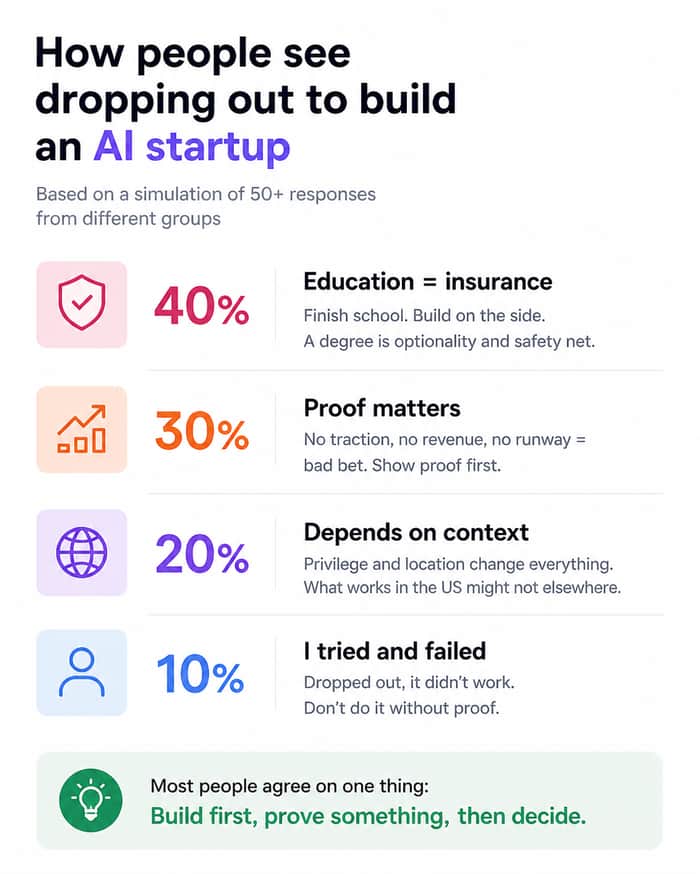
The decision to drop out of college to build an AI startup looks completely different depending on whether you have a safety net or not.
Lately I’ve been seeing more and more students seriously consider this path, and honestly, I understand why. It’s never been easier to build something real. You can go from idea to product faster than ever, often on your own, and compared to sitting through classes that feel outdated, starting now feels like the obvious move.
Still, something about this trend didn’t sit right with me, so instead of relying on my own opinion, I tried to look at it from different angles. I ran a simulation to see how people from very different backgrounds would react to that exact decision.
What I expected was strong disagreement. What I got instead was something more interesting: people coming from completely different places arriving at similar conclusions, but for very different reasons.
Investors didn’t care much about the degree itself, but they kept coming back to the same condition. If there’s no traction, no revenue, or at least some real signal that the idea works, dropping out looks less like a smart bet and more like a blind one.
People working in Big Tech focused on risk. A few of them pointed out how strong survivorship bias is in these stories. We hear about the few who made it, but not about the much larger group that burned through savings and had to start over, often without a degree and without a clear path back.
The most intense responses came from people who had actually done it and failed. They talked about debt, burnout, and how hard it is to rebuild once things don’t work out. Almost all of them said some version of the same thing: they would have waited until they had proof before taking that step.
Parents framed it differently. For many of them, education isn’t just about learning, it’s a safety net. And for a lot of people, it’s the only one they have.
Even the more optimistic voices didn’t fully disagree with any of this. They acknowledged that AI makes it easier to build, but not safer. Some were open to dropping out earlier, but only if there was already momentum behind what they were building.
That’s what stood out to me. Across very different perspectives, the same pattern kept repeating: build first, prove something, then decide. Not the other way around.
I also put the full simulation together here if anyone wants to explore it in more detail: https://viberoom.io/share/lZk1sJNL3ijETFsNqHS7DjLtHRbaZilp
Curious how others here see this. Is dropping out to build an AI startup actually a smart move, or are most people just chasing hype they don’t fully understand?

I know a few current or former founders who dropped out of college for a startup, and they would probably be willing to answer any questions you have. It's a really interesting topic and I'm sure they'd have a lot of insight to share from their own experiences.
Curious if anyone here has actually made that decision (drop out or not) and how it played out.
The biggest difference I noticed was between people who can afford to fail and those who can’t. The same decision looks completely different depending on that.
One thing that surprised me the most is how consistent the “build first, then decide” advice was across completely different perspectives.
I expected way more disagreement.