Easy marketing channels
I wrote a blog post about a hack to get started with prioritising marketing channels if you're a founder with too little time and no idea where to start.
I thought I'd share a condensed version here too
Marketing channels are the veins to your business' circulatory system. You can have the best product in the world, but if no one knows about it, it will die a lonely death of despair and neglect.
But as a maker you're keenly aware that your time is also in short supply, so how do you approach this efficiently? Which channels do you choose first? Which ones are more important?
Choose the right ones and you could kick off a reliable flywheel for growth, and get a steady, surging stream of customers your way.
Digital marketing channels include;
- Social media, like Twitter, Facebook or LinkedIn
- Paid advertising, like Google Ads
- YouTube
- Communities, like Reddit, HackerNews or ProductHunt
- Email marketing and Newsletters
- Content marketing & SEO(like your website and its blog)
The generally recommended approach is to test most of them one-by-one, keeping track of which ones work best, and then optimising the hell out of the top ones and ignoring the rest.
That would be fine in an ideal world, of course, but to me, as a solopreneur, that sounds pretty expensive and time consuming.
Like me, you probably barely have time to work on your product, never mind do lots of testing to figure out which random marketing channels to focus on first.
Marketing channel hack
If you're just starting to dip your toes into marketing or you don't have an intuitive feel for where your customers would be most receptive yet, try this quick hack to get started.
Simply spy on your competitors and other niche sites related to your product and do what they do, since what's working for them would very likely work for you too.
Don't forget though; you'd still need to record and keep track of your own results with an analytics plugin or customer surveys, so that you could later optimise and tailor fit it to your site in particular, but at least you can skip the queue and jump-start this process now with this sneaky trick.
The sneaking will be accomplished with a tool called SimilarWeb.
SimilarWeb - it's sneaky
With this tool you simply enter your competitor's URL in the search bar, hit enter, and then sit back and marvel at your ingenuity.
Let's use Indiehackers as an example, since we're all familiar with it.
Let's assume that we're also creating a makers’ community, and we're looking to compete directly with Indiehackers.com on audience and offerings. Where do they get their users from, and could we use a similar approach?
SimilarWeb offered the following set of results for Indiehackers.com;
Nationalities
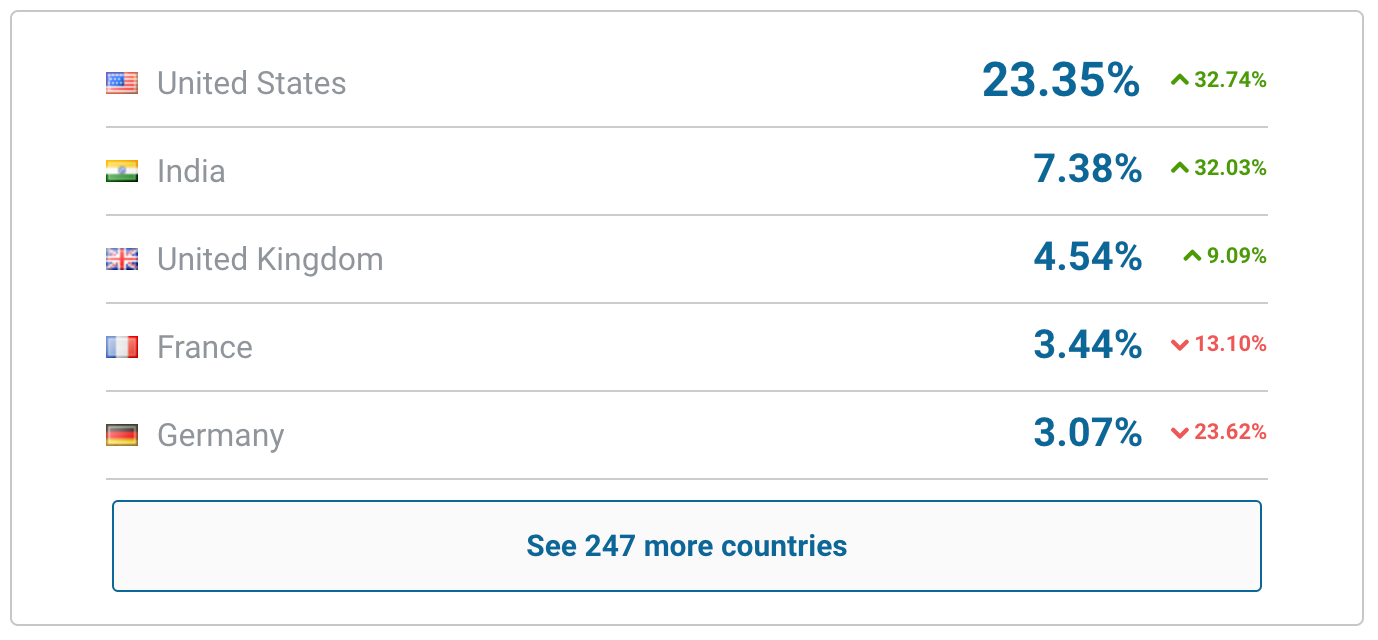
This is not really something directly related to a specific marketing channel, but it tells us a little bit about how to speak to our audience when we do reach them.
It tells us we'd need to focus our efforts on American language(english) and cultural references primarily, with a good second thought to Indian and European audiences too.
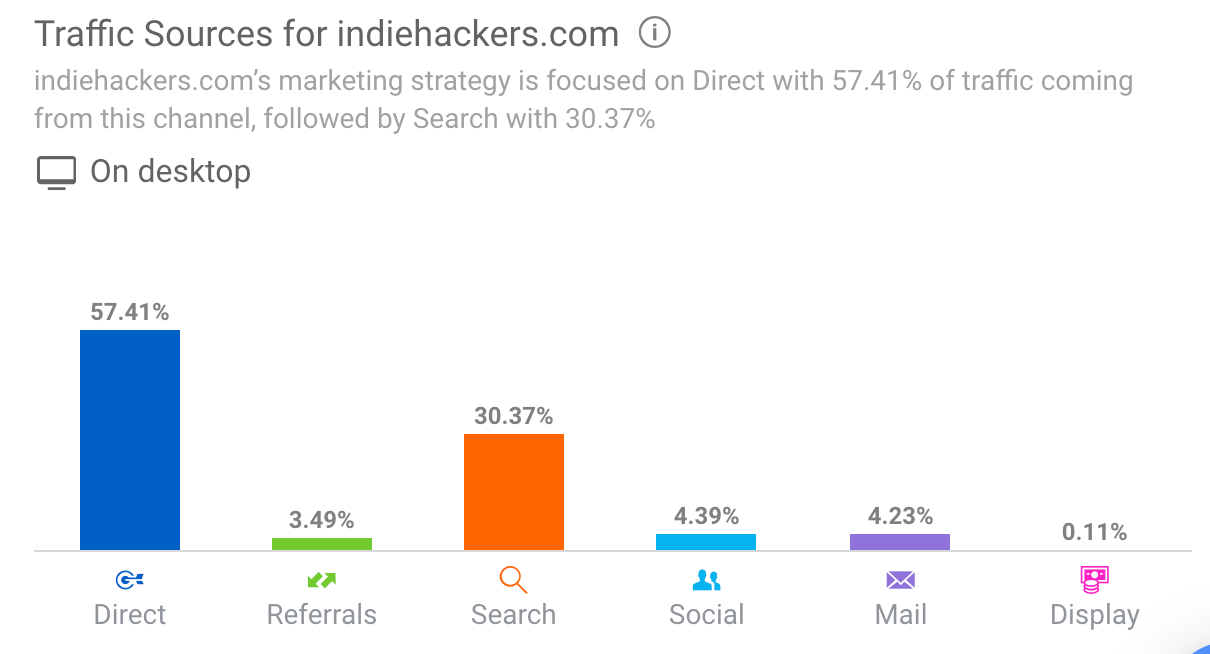
Now here we have some good and relevant marketing channel suggestions! We can see that most of their visits come from Direct and Search(SEO) sources. Then, at pretty much a tie, we have social and mail sources(presumably from links in the newsletter).
What are Direct sources? This generally means that someone entered the indiehackers.com url directly on their browser, or visited via a bookmark.
That's not the whole story though - Direct could also mean that the analytics tool used to record these visits couldn't really accurately determine what the source of traffic was, and simply recorded them as direct.
This might be the case for visits from;
- native mobile apps, like social media
- email marketing campaigns not tightly integrated with the sites analytics
- links in PDFs or other offline documents
- browsers with adblockers or other weird JS manipulator plugins
Direct source can thus be a bit vague and hard to understand. You'll have to do some guesswork to decide on how to interpret it, but in Indiehackers' case, I think it's safe to assume a good portion of Direct traffic came from people clicking their bookmark. Users like to visit the community often, because the actual value of Indiehackers.com is in its community features on site.
Since our hypothetical product is also a community and we'd want to compete with Indiehackers, we'd probably need to focus on our landing page itself too, as our primary marketing channel. We'd need to make it valuable enough that, on the very first visit, someone would want to bookmark it as well. Perhaps we could use some visual device or aid to request this?
SEO, now that's something pretty clear and standard. From the sources graph we can gleam that Indiehackers.com might get about 30% of its desktop traffic from search engines, presumably where people searched for the following terms, as per SimilarWeb.
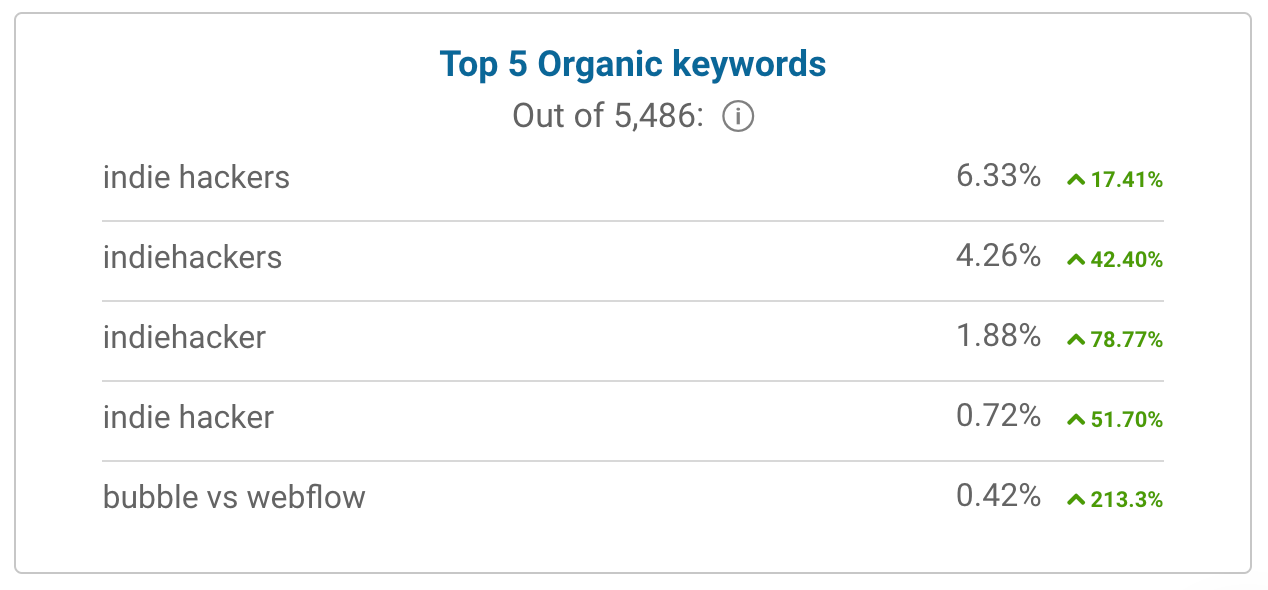
Now if you were really to compete with Indiehackers.com, this might not necessarily be very useful, since it's mostly their trade name listed as keywords. However, just by adding up the figures in that table I can see that something might be fishy. I think that this might be the limitations of SimilarWeb's free feature letting us down, and that those keywords might indeed be accurate, but not necessarily comprehensive.
Still, the idea that 30% of traffic sources came from SEO suggests to me that our secondary channel to focus on, would likely also need to be a search engine optimised website and blog.
Keep in mind though that the entire Indiehackers community is free and crawlable by search engines - paid and private communities would not be able to rely on the same mechanics, so they would need to rely more on other channels, perhaps paid ads.
Next, we'd also need to consider an email newsletter as a marketing channel(always a good idea anyway), since it seems that at the very least 4% of our competitor's traffic comes from their newsletter. But it could also very well be that a larger portion of the email figures would be hidden in Direct traffic, so let's assume that email would, in reality, be larger than social.
In which case the fourth largest source of traffic(assuming we're considering part of direct as email) would be social. Social clearly forms a relatively small part of the inbound funnel to Indiehackers.com(according to SimilarWeb, mind you), so it would not be a basket to put too many eggs in. Its effect appears to be a smidgen more than negligible on the overall inbound traffic.
But, it would still be worth it to share a link to content on your site every now and again, especially if you could automate the share of content in some way.
And there we have it!
Just like that, you now have a rough idea of how to figure out which marketing channels to focus on when getting started. Analyse your competitors on SimilarWeb!
Let's recap. As an example, if I were to try and compete with Indiehackers.com, I'd likely focus on the following marketing channels, in order;
- Primary channel - a valuable site with high bookmarking potential(good community and content)
- Secondary channel - content that's SEO optimised
- Tertiary channel - capture email addresses for a newsletter.
I wouldn't personally focus too much on social(I won't go hire a dedicated social media team, for instance), but I would certainly share some of my content automatically, if possible.
SimilarWeb offers some specific suggestions here too;
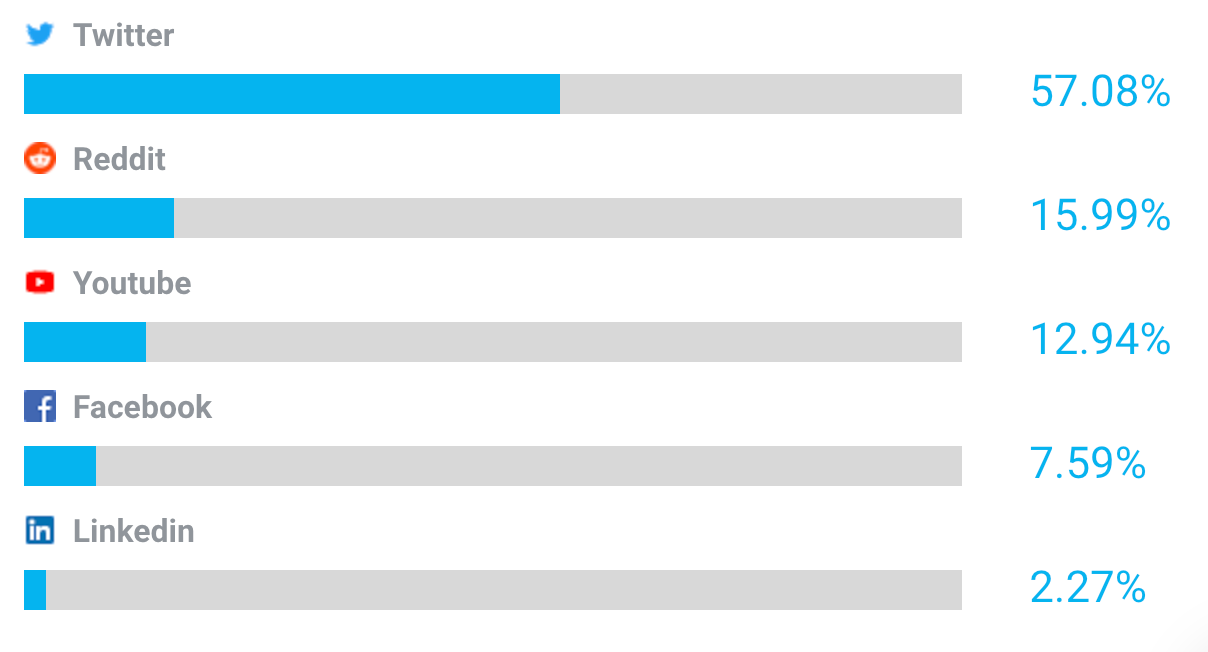
I'd share links on Twitter primarily, since that appears to be the bulk of the social traffic sources, and perhaps add a sprinkling of Reddit every once in a while too, when appropriate. I wouldn't bother with YouTube at this stage, since video can be very expensive on resources to produce.
More sites, more data
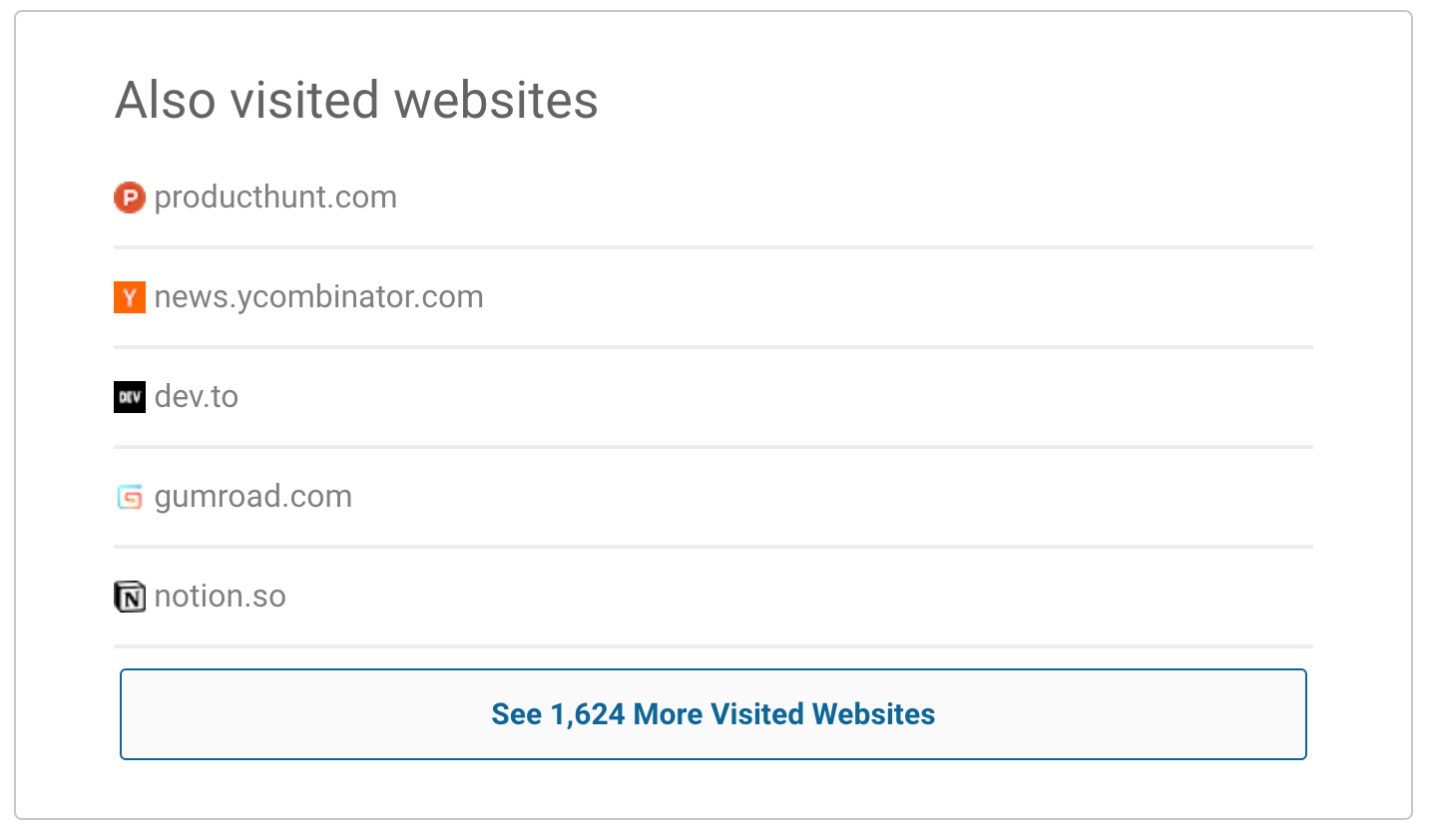
SimilarWeb offers further suggestions for you to consider too, sites that it thinks are similar, or in some other way connected with the same visitors. You could expand your dataset and include some of their breakdowns as well, as this might give you a broader view of which channels to prioritise.
Conclusion
You now know how to get started with ready-made and likely pretty accurate marketing channel strategy, based on seeing what's working for your competitors.
I hope you found this post useful. Thanks for reading.

cool. pick a few and be amazing at them, is my strategy.
Great reading, thanks.
Cheers
Andrzej
https://pagemtr.com