Every AI you use remembers a different slice of you. So I built a fix.
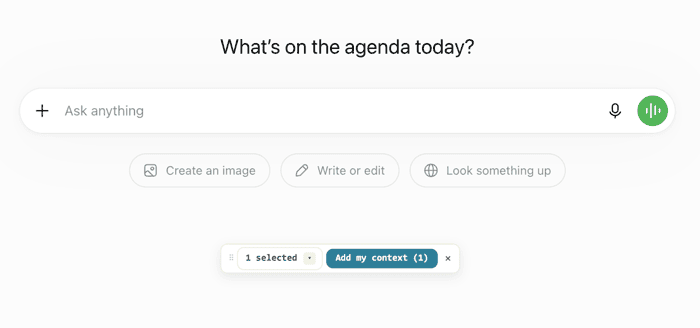
Just hit 40% weekly active users on my local-first extension. Here is the breakdown of the problem, the metrics, and the next two features I'm shipping to keep that retention up.
I use ChatGPT, Claude, Gemini, and a few others every day, and the same thing kept biting me: my context is trapped inside whichever one I happened to open.
ChatGPT knows my projects and my writing style. Claude knows a different slice. DeepSeek knows absolutely nothing about me at all. So every time I switched tools, or just hit a maxed-out thread and had to start a new one, I was re-explaining myself from scratch.
A few months ago I shipped the first version of the cure here: LLMnesia, a Chrome extension that builds a private, on-device search index of every AI conversation you have. ChatGPT, Claude, Gemini, Perplexity, Grok, Copilot, and more, all searchable from one keyboard shortcut. Nothing ever leaves your machine.
Where it stands now:
231 people have used it. 93 of them in the last week.
Roughly 40% of everyone who's ever installed it was active in the last 7 days.
They've run 6,600+ searches and pulled in 292 full conversation back-catalogues.
For a free, local-first tool with zero paid acquisition, I'll take that. Weekly return is the only number I really care about.
But the longer I used it, the more I realised search was only half the problem. The real pain was the amnesia. That's the thing I've spent the last stretch building for, and two features are landing very soon.
🧠 Portable Memory (built, in testing, landing very soon)
This one lets you carry your context to any AI.
In Settings you import what your assistants already know about you. Claude and ChatGPT can surface their memory directly. For tools that store memory but don't give you a clean export, like Gemini, there's a one-click "Copy export prompt" that makes the model list what it remembers about you. Each platform is kept as its own entry, side by side.
Then on any new chat anywhere, a small "Add my context" button sits below the message box. Tap it (or use ⌥⇧M ) and your context drops in, or open the picker and choose exactly which memory to inject so you're not pasting overlapping dumps and burning tokens.
The part I like most: open a tool with no memory of its own, like DeepSeek, paste your context in, and a blank-slate AI is suddenly as informed as your most-used assistant. Walk away from a capped-out thread, pick up somewhere else, and it already knows who you are. No vendor holds your context hostage. And like everything else, it never leaves your device.
🔍 Semantic search (also landing very soon)
Search today is fast and keyword-based, and I lean on it constantly. The upgrade is natural-language search: "that thing about postgres locking" finds the right chat even without the exact words. It runs alongside the existing keyword search rather than replacing it, so you get both signals at once.
Staying true to local-first put a fun constraint on this. The model runs entirely in your browser, no network calls, so it's a small model by necessity, not a big hosted one. It works well in my own use, but I'm genuinely curious how it holds up across bigger, messier histories than mine. When it lands I'd love to hear how the matching feels for you.
✨ Already live
Continue In: Move a live conversation from one AI to another, formatting intact. Start in ChatGPT, finish in Claude.
11 platforms: ChatGPT, Claude, Gemini, Perplexity, Grok, Copilot, DeepSeek, Mistral, Kimi, Qwen, AI Studio.
Full history import: Pull your entire back-catalogue into search, not just new chats.
🛡️ One rule
Local-first, no compromises. Your conversations, your index, and now your memory all live on your device. I don't even log what you search.
If you bounce between AI tools and you're tired of re-explaining yourself to each one, it's free and installs in a click:
One question for this crowd -
Which AI do you trust enough to let it remember you, and which would you never give that to?

The line that stuck with me was that your context ends up trapped inside whichever AI you happened to use.
It feels like we've solved portability for documents and files, but not for the understanding these tools build about us over time. That's a much more fundamental problem than just switching models.
It is frustrating how much time goes into repeating yourself to these tools. Finding a way to pass that understanding between different apps is the main thing I wanted to solve.
That's exactly what I was getting at.
I think there's one implication of your reply that's much more significant than it first appears, but it's probably too much to unpack properly in a thread.
Happy to explain what I mean if it's useful. What's the best email to reach you on?
Absolutely, you can reach me at hello@llmnesia.com - but please continue here, I think this is more interesting as a public discussion.
Just sent it over.
The reason I suggested email is that I don't think the interesting part fits into a few comments without oversimplifying it. Curious to hear where you agree or disagree after you've had a chance to read it.
Context switching is still one of the biggest productivity killers in AI workflows.
The “not pasting overlapping dumps and burning tokens” line is important. Portable memory is useful only if it also keeps context hygiene under control: what gets injected, which model receives it, how often it repeats, and whether the extra context actually improved the result.
When people move between ChatGPT, Claude, Gemini, DeepSeek, etc., the product problem is memory portability, but the operator problem becomes route and spend visibility. A context bridge can quietly turn into a cost multiplier if every workflow carries too much history into a premium model.
That is the angle we keep building around with Tokens Forge: multi-model access is powerful, but the ledger should show which workflow, route, model, fallback, context size, and balance bucket paid for each run. Memory portability and cost traceability probably need to evolve together.
The line about search being only half the problem and amnesia being the real pain is dead on. A lot of the friction with AI tools isn't model quality, it's having to rehydrate yourself every time you switch tools or start a fresh thread. I built DictaFlow for a similar reason on the input side. If capture takes too many steps, the thought is already weaker by the time it lands. Portable memory plus fast capture feels like the better direction than betting everything on one assistant getting smarter.
You nailed the core issue. Wasting time getting an AI back up to speed on a new thread is a massive momentum killer. I checked out DictaFlow and the push-to-talk approach for physical workspace privacy is a smooth workflow. It is neat to see how we are both tackling friction from different angles.
This is actually a really smart angle — you didn’t just build another AI tool, you’re fixing the fragmentation problem across them.
40% WAU on a utility extension is strong, especially with zero paid growth. That usually means it’s already part of people’s daily workflow, not just a “try once” tool.
Portable memory feels like the real unlock here. Search is useful, but removing the need to re-explain yourself every time you switch models is a much bigger painkiller.
Curious to see how the semantic search performs at scale though — local models can get tricky with messy, long histories.
If you nail that + keep the UX frictionless, this could become a “can’t use AI without it” type of tool.
Appreciate the breakdown. The 40% WAU has been a really great signal early on. Scaling local semantic search with long histories is definitely the biggest technical hurdle on the roadmap, but keeping everything on-device is worth the engineering headache.
Is this tool use API of Claude or OpenAi?
It doesn't use any APIs, it indexes your AI chats from ChatGPT, Claude, Gemini and many more locally.