Everyone thinks rocket science is hard.
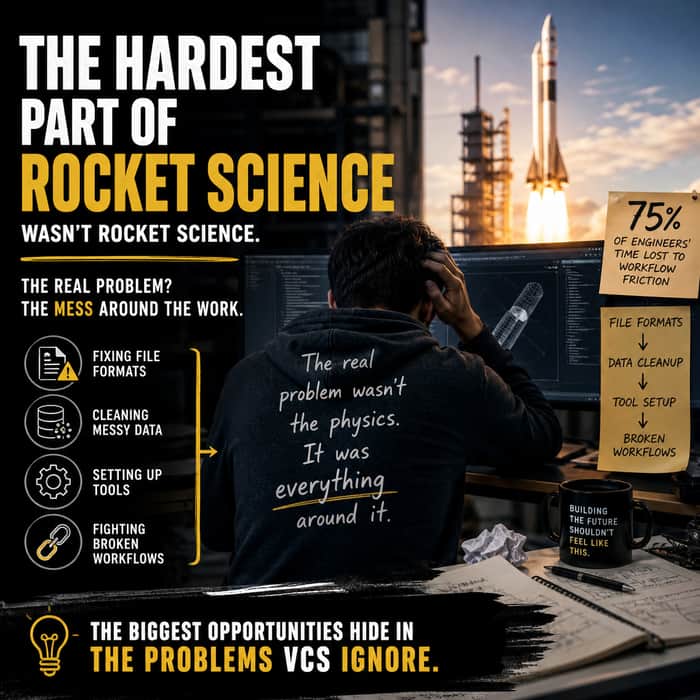
Everyone thinks rocket science is hard.
Turns out… it’s not the hardest part.
A Stanford engineer working on a team that literally reached space discovered something unexpected:
🚫 The real problem wasn’t physics
🚫 It wasn’t intelligence
🚫 It wasn’t even the math
👉 It was everything around the work
Engineers were spending 75% of their time:
- fixing file formats
- cleaning messy data
- setting up tools
- fighting broken workflows
Not building. Not thinking. Just… struggling to start.
So he quit aerospace.
Not because rockets weren’t exciting —
But because the bigger opportunity was fixing the invisible friction holding real work back.
Here’s where it gets uncomfortable 👇
We’re in an era where:
- everyone is building “AI startups”
- everything looks impressive
- funding is flowing
But most products?
They’re just polished wrappers with no real depth.
Built for:
👉 pitches
👉 hype
👉 investors
Not for actual problems
The truth most people avoid:
💡 Big companies aren’t built on what looks cool
💡 They’re built on what feels painful
- The thing wasting people’s time
- The silent revenue leak
- The boring problem nobody wants to touch
Right now, there are two types of builders:
- Chasing trends
- Fixing friction
Only one survives when the hype dies.
The smartest move?
Stop asking:
👉 “What can I build?”
Start asking:
👉 “Where are people stuck every single day?”
Because that’s where:
- money flows
- retention happens
- real businesses are born
Build for the friction.
That’s where the future is.

Honestly this hits a bit deeper than it sounds — everyone jokes about “rocket science is hard” but building anything real isn’t the problem, it’s all the invisible complexity around it. Most products don’t fail because the idea is complex, they fail because small things stack up silently — unclear assumptions, unnoticed edge cases, no feedback loops until it’s already messy. The hardest part is usually not building the thing, it’s realizing what you didn’t even think to monitor until it bites you.