eWallet App Development: From Idea to a Secure, Scalable Product
Tap. Pay. Done. That’s the promise users expect from a modern wallet. eWallet app development turns that promise into a product that moves real money, passes audits, and wins users at scale.
This guide shows what to build, how it works under the hood, and how to ship safely. No fluff. Clear steps. Buyer-focused.
Why build an eWallet now?
Consumer payments keep shifting to mobile. Merchants want faster checkout. Banks and fintechs are opening APIs. An eWallet that ships quickly, settles reliably, and meets compliance can capture this demand. The opportunity is real, but the bar is high. You need airtight security, clean UX, and integrations that don’t break during peak traffic.
Core product outcomes
Frictionless pay-in and pay-out. Cards, bank rails, QR, and P2P in one place.
Trust at first launch. Visible security cues, strong authentication, and transparent fees.
Growth loops. Rewards, referrals, bill pay, and merchant acceptance that bring users back.
Architecture at a glance
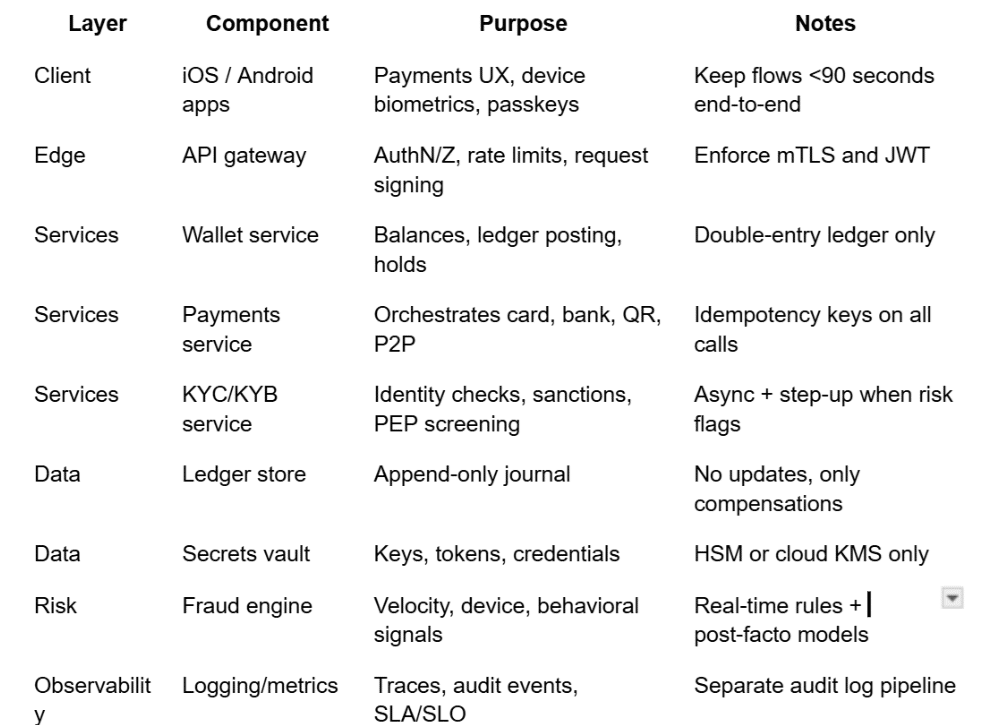
Keep components small and observable. Isolate anything that touches funds or secrets.
Table 1: Reference architecture for eWallet app development
Feature set that ships (and why)
1) Accounts and balances.
Users fund the wallet, hold value, and move it. A double-entry ledger guarantees every credit has a matching debit, which makes reconciliation predictable.
2) Pay-ins.
Cards, bank transfers, and local rails. Tokenize card data, then store only tokens. Use EMV® 3-D Secure for step-up authentication to cut fraud on risky e-commerce flows.
3) Pay-outs.
Instant to card, bank account, or agent cash-out where allowed. Queue payouts and retry idempotently to avoid duplicate disbursements.
4) P2P and requests to pay.
Phone-number or QR based. Add daily limits and velocity checks to cap loss per account.
5) Bills and merchant acceptance.
Utility payments, mobile top-ups, and online checkout. Merchant SDKs should support one-tap checkout and token reuse.
6) Security and authentication.
Adopt passkeys (FIDO) for phishing-resistant sign-in, backed by device biometrics. It’s faster than passwords and less fragile than SMS OTP.
7) Compliance by design.
For card data, align with PCI DSS v4.x. Do not store plaintext PANs. Segment the network. Monitor access. These controls reduce breach blast radius and speed up audits.
MVP vs. V1 vs. Scale
You can’t ship everything on day one. Sequence features by risk and revenue.
Table 2: Build roadmap for eWallet app development
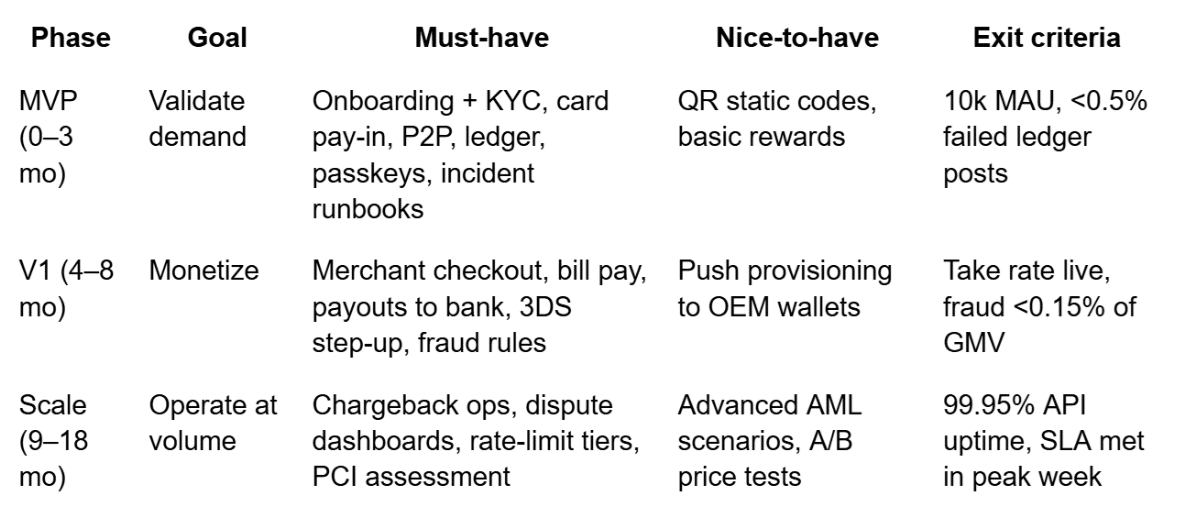
(Timelines are indicative. Use your team’s historical cycle time.)
Payments and rails: choose with intent
Cards.
Fast activation and wide acceptance. Use EMV tokenization when available and 3-D Secure challenge flows for riskier transactions.
Bank transfers.
Great for high-value and low-fee funding. Batch and reconcile daily. Offer instant rails where regulators and partners allow.
QR ecosystems.
Useful for offline and micro-merchant acceptance. Standardize payloads to avoid QR fragmentation.
Agent networks (for specific markets).
When cash-in/out is needed, track agent float and settle daily. Flag agents with abnormal success/fail ratios.
Security you can show your auditor
Users judge trust in seconds. Auditors judge evidence.
PCI DSS v4.x alignment. Encrypt at rest and in transit, segment the cardholder data environment, rotate keys, and maintain centralized logging. Build quarterly evidence packs.
Strong customer authentication. Use EMV 3DS step-up for e-commerce risk spikes and out-of-band approvals inside your app.
Passwordless by default. Passkeys bind authentication to the user’s device, reducing phishing and credential reuse. Support device-bound and synced passkeys.
Secrets management. Put API keys and tokens in a vault backed by an HSM/KMS. Never ship secrets in binaries.
Least privilege. Short-lived tokens and scoped roles for every microservice and operator.
Tamper-evident logs. Write audit events to an append-only store with immutable retention.
KYC/KYB and fraud controls that work in the real world
Onboarding.
Start with ID document + liveness + sanctions and PEP checks. Run AML scenarios asynchronously to keep signup fast. Escalate to manual review only when risk scores breach thresholds.
Device and session intelligence.
Fingerprint devices, assess emulator/root signals, and track inconsistent geolocation.
Velocity and value caps.
Limit sends per hour/day and cap total exposure per account. In a breach, this saves real money.
Chargeback and dispute workflows.
Expose dispute status in the app. Provide evidence bundles (3DS data, device signals, timestamps) to issuers.
UX principles that increase conversion
Every extra tap costs you users.
Build flows that reduce thinking and waiting.
One screen per decision. Users should know exactly what happens next.
Clear fees and limits. Surprise fees drive churn.
Default to passkeys. Faster entry means more completed payments.
Recoverable errors. Give next steps, not codes.
Local language and formats. Currency, date, and address formats must feel native.
Analytics that guide the roadmap
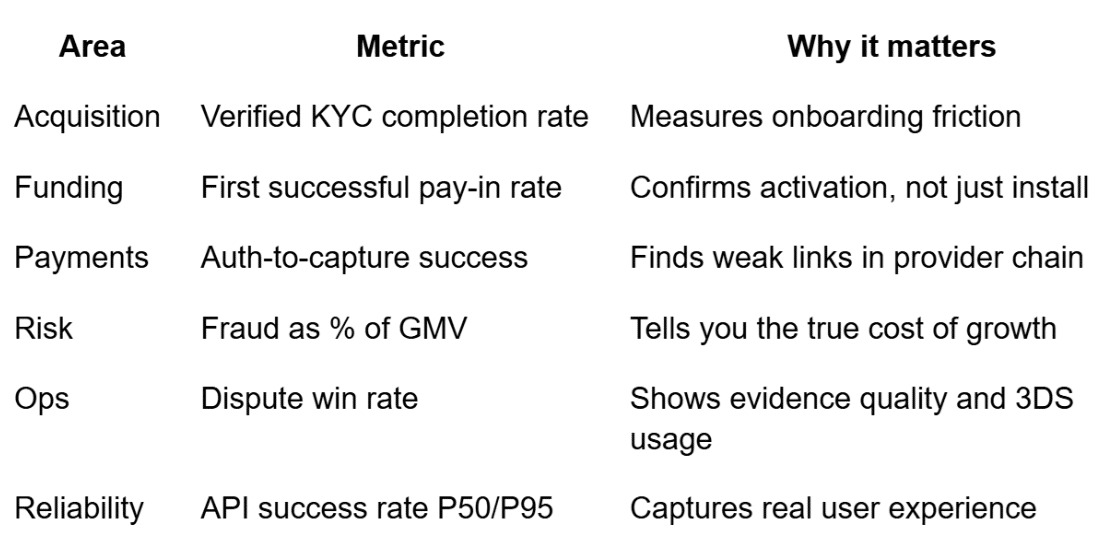
Track events tied to money and risk, not vanity metrics.
Table 3: KPIs for eWallet app development
Build vs. partner: a practical split
Build the ledger, risk rules, and user experience.
These are your core.
Partner for card processing, KYC data, transaction monitoring, and payout networks.
Replace providers behind a stable internal API to avoid vendor lock-in.
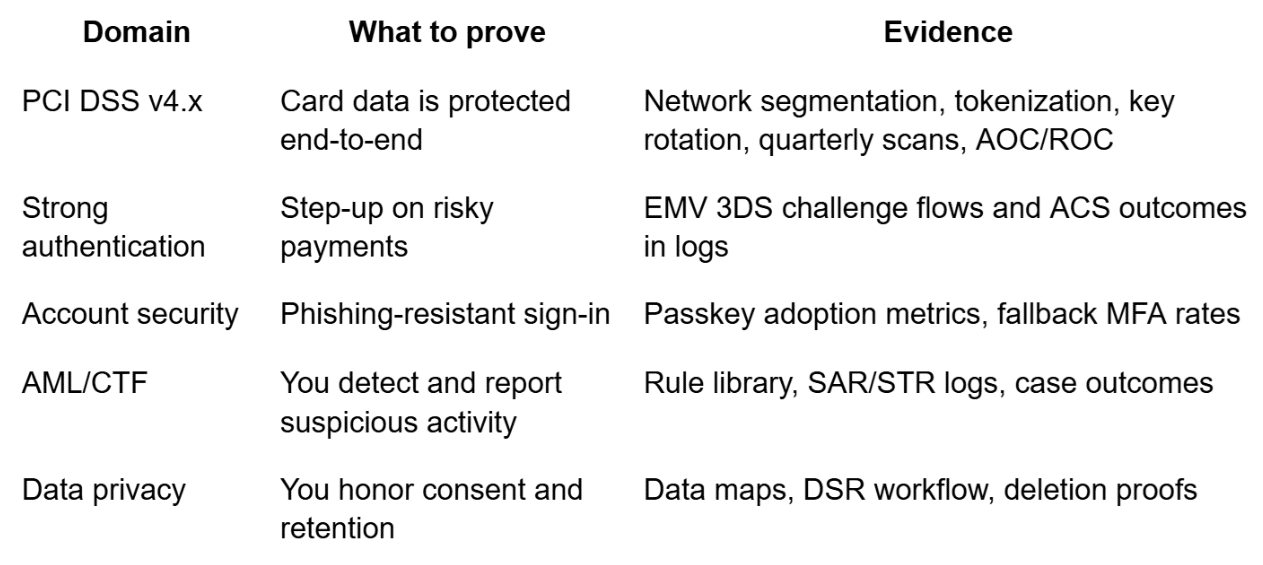
Compliance checklist you can share with stakeholders
Table 4: Compliance and assurance map
Cost drivers and planning notes
Skip guesswork. Tie effort to known variables.
Markets and rails. Each new country and rail adds contracts, compliance, and testing.
Fraud appetite. Tighter controls reduce loss but increase friction; model this trade-off early.
Operations. Disputes, refunds, and support scale with transactions; staff accordingly.
Audit cadence. PCI and financial audits require artifacts. Budget time to produce them.
Common pitfalls (and how to avoid them)
Treating the ledger like a CRUD table. Use an append-only journal. Reversals are new entries, not updates.
Saving raw PANs or CVV anywhere. Tokenize and vault. If you can read it, an attacker can too.
Relying on SMS OTP for everything. It’s phishable and fragile. Move to passkeys for account access and keep SMS as a last resort.
Ignoring idempotency. Without idempotent endpoints, retries become double charges.
Launching without 3DS. You’ll pay in fraud and chargebacks. Implement risk-based step-up from day one.
Go-to-market playbook in three moves
1) Solve a concrete payment job.
Pick a high-frequency use case: utility bills, transit, or marketplace payouts. Adoption follows habit.
2) Onboard with speed and safety.
KYC in under two minutes. Passkeys by default. Clear limits for new accounts.
3) Prove value with data.
Publish monthly uptime, dispute outcomes, and fraud rate as a share of GMV. Buyers trust numbers they can verify.
Final word
eWallet app development is a product, an audit, and an operations machine — all in one. Ship a clean MVP, authenticate with passkeys, secure cards to PCI DSS v4.x, and add EMV 3DS step-up where risk spikes.

