Farming Is Changing Fast—Here’s How Smart Farmers Are Staying Ahead of Climate Risk
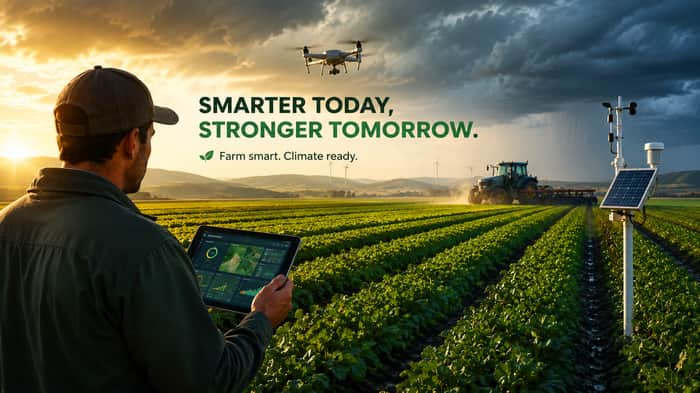
Farming has always depended on nature.
But what’s changing now is the level of unpredictability.
Rainfall patterns are shifting.
Temperatures are becoming extreme.
Seasons are no longer as reliable as they used to be.
And this creates a serious question:
How do you produce consistent food when the environment itself is inconsistent?
This is where climate-smart agriculture starts to make sense—not as a trend, but as a practical response to real problems farmers are already facing.
1. The Old Farming Model Is Under Pressure
Traditional farming methods were built around stable conditions.
You could predict:
- when to sow
- when to irrigate
- when to harvest
But now:
- rains may arrive late or too early
- heatwaves damage crops
- unexpected weather disrupts cycles
This makes farming more reactive than planned.
And when farming becomes reactive, food production becomes unstable.
That’s a risk not just for farmers—but for overall food security.
2. Climate-Smart Agriculture Is About Adaptation
At its core, climate-smart agriculture focuses on three things:
- adapting to changing conditions
- maintaining productivity
- reducing environmental impact
It’s not one single technique.
It’s a combination of practices like:
- efficient water management
- resilient crop selection
- improved soil health
- better planning using data
Instead of trying to control nature completely, it focuses on working with changing conditions more intelligently.
3. Stability Matters More Than Maximum Yield
One of the biggest mindset shifts is this:
High yield doesn’t matter if it’s not consistent.
Climate-smart practices focus on:
- reducing crop failure risk
- stabilizing output across seasons
- maintaining soil productivity
For example:
- better irrigation reduces drought impact
- soil health practices improve resilience
- diversified crops reduce dependency on a single outcome
This creates a more reliable system.
And food security depends more on reliability than occasional high production.
4. Resource Efficiency Becomes Critical
Climate change is also making resources more limited.
- Water is becoming scarce
- Soil degradation is increasing
- Input costs are rising
Climate-smart agriculture addresses this by improving efficiency:
- using less water with better systems
- reducing unnecessary chemical inputs
- improving natural soil fertility
It’s not just about producing more—it’s about producing better with fewer resources.
5. Technology and Traditional Knowledge Work Together
Another important aspect is the role of technology.
Climate-smart farming often includes:
- weather data
- soil monitoring
- remote sensing tools
- predictive insights
But this doesn’t replace experience.
Instead:
- technology provides data
- farmers provide judgment
Together, they create better decisions.
That combination is where real improvement happens.
What Changed for Me
Understanding climate-smart agriculture changed how I look at farming risks.
- I started focusing more on stability than just output
- I paid more attention to soil and water management
- I began thinking in terms of long-term resilience
- Decisions became less reactive and more structured
It made farming feel more controlled—even in uncertain conditions.
The future of agriculture will not be defined by perfect conditions.
It will be defined by how well we adapt to imperfect ones.
Climate-smart agriculture is not about eliminating risk completely.
It’s about reducing it to a level where farming—and food production—can continue sustainably.
Because in the end, food security is not just about growing crops.
It’s about ensuring that those crops can be grown consistently, year after year, no matter how conditions change.
If you want a deeper understanding of how climate-smart agriculture ensures food security, including practical strategies and real-world applications, I’ve explained it in detail here:
How Does Climate-Smart Agriculture Ensure Food Security?
This will give you both the concept and how to apply it in practice.

Climate risk is becoming a business risk, not just an environmental one. What stands out to me is that resilience rarely comes from a single technology. It comes from combining better data, local knowledge, diversified farming practices, and long-term planning. The most successful farmers will likely be those who build adaptive systems rather than optimize for a single season. I'm curious how you see regenerative farming practices fitting into this picture alongside digital tools and predictive analytics.