Festo FRL Units: Sizing, Filtration Ratings & Maintenance Guide
Published March 17, 2026 | ChillElec – Pneumatic & Fluid Control Solutions
What Is an FRL Unit?
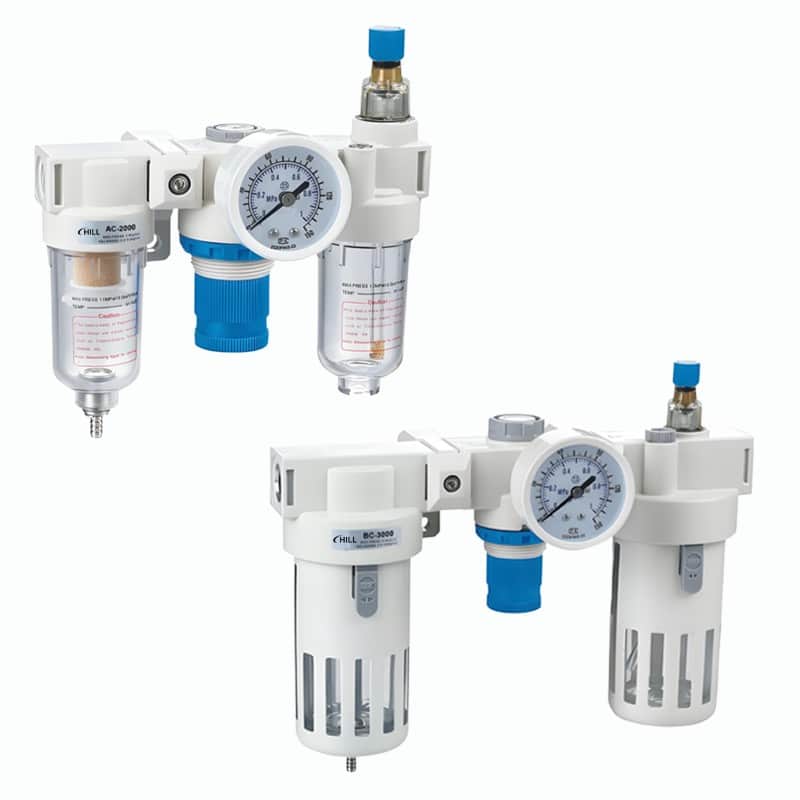
In any pneumatic system, compressed air quality and pressure stability are non-negotiable. That's where the FRL unit comes in. FRL stands for Filter – Regulator – Lubricator, a three-stage conditioning assembly that prepares compressed air before it reaches actuators, valves, and cylinders. Festo, one of the world's leading pneumatics manufacturers, produces a comprehensive range of FRL units engineered for high-cycle industrial automation environments.
Whether you're designing a new pneumatic circuit or troubleshooting premature valve wear, understanding how to correctly size and maintain your FRL unit is fundamental.
The Three Stages Explained
1. Filter (F) The filter removes solid contaminants, water droplets, and aerosol oil from the compressed air supply. Festo filters are rated by micron grade — typically 5 µm for general purpose, 0.01 µm for sterile/high-purity applications. A bowl with a manual or automatic drain collects separated condensate.
2. Regulator (R) The pressure regulator maintains a constant downstream pressure regardless of upstream fluctuations or varying flow demand. Festo regulators feature a precision spring-and-diaphragm mechanism and are available in standard and precision variants. Setting pressure is done via a locking knob with a visible gauge.
3. Lubricator (L) The lubricator injects a fine oil mist into the air stream to reduce wear in cylinders and valves with sliding seals. Note: many modern Festo components (e.g., DSBC cylinders, MFH valves) are pre-lubricated and require oil-free air — in these cases, the lubricator stage is omitted entirely.
Sizing Your FRL Unit
Incorrect sizing is the most common mistake in pneumatic system design. An undersized FRL creates pressure drop and starves downstream equipment; an oversized one wastes footprint and cost. Here's how to size correctly:
Step 1 – Determine Maximum Flow Rate Calculate or measure the total free air consumption of all downstream components operating simultaneously, expressed in l/min (ANR) or SCFM. Add a 20–30% safety margin.
Step 2 – Select Port Size Festo FRL units are available in G⅛ through G1½. As a general guide:
Port SizeTypical Flow RangeG¼Up to 1,200 l/minG⅜Up to 2,000 l/minG½Up to 4,000 l/minG¾Up to 6,500 l/minG1Up to 10,000 l/min
Always verify against Festo's official flow characteristic curves (∆p vs. Q) for the specific model — the MS series (modular) and LFR series (combined filter-regulator) are the most widely used in industrial automation.
Step 3 – Set Working Pressure Confirm your system's minimum required pressure at maximum flow. Festo regulators are available in ranges from 0.1–7 bar (low pressure) up to 0.5–16 bar for high-pressure applications.
Step 4 – Choose Filtration Grade
40 µm / 5 µm – General industrial use, pneumatic cylinders and standard valves
0.3 µm – Breathing air, food contact equipment, optical or electronics assembly
0.01 µm + activated carbon – Sterile environments, pharmaceutical, laboratory
Festo FRL Product Series Overview
MS Series (Modular Service Units) The MS series is Festo's flagship modular platform. Individual components — filters, regulators, lubricators, soft-starts, pressure switches — clip together on a common rail. This modular architecture makes system expansion and maintenance straightforward. Available in sizes MS4 (G¼), MS6 (G½), and MS9 (G1).
LFR Series (Filter Regulator Combined) A compact combined filter-regulator in a single housing, ideal for space-constrained installations. Available with manual or semi-automatic drain. Excellent for standalone machine tool and handling applications.
LFMA / LFMB (Micro Filter) For ultra-fine filtration, these coalescing microfilters achieve 0.01 µm separation efficiency with a residual oil content below 0.01 mg/m³ — suitable for instrument air and air-operated tools in cleanroom environments.
Maintenance Schedule
Neglecting FRL maintenance is one of the leading causes of pneumatic component failure. Follow this schedule:
Daily / Weekly
Check and drain filter bowl condensate (manual drain units)
Inspect oil level in lubricator bowl
Verify set pressure on regulator gauge
Monthly
Clean or replace filter element — a ∆p indicator turning red or exceeding 0.5 bar pressure drop signals replacement time
Inspect bowl seal and bowl O-ring for cracking or deformation
Check lubricator oil drip rate (typically 1 drop per 10–25 m³ of air flow)
Annually
Full disassembly and inspection of regulator diaphragm
Replace filter element regardless of ∆p indicator status
Inspect all bowl seals; replace with genuine Festo repair kit
Key Maintenance Tips:
Always depressurise the line before disassembly
Use only Festo-approved lubricator oil (e.g., OLAB oil) — incorrect viscosity disrupts drip rate calibration
Automatic drain valves should be tested monthly by briefly pressurising and observing drain function
If the system runs intermittently (e.g., production shifts), the filter bowl may accumulate more condensate than a continuously running system — increase drain check frequency accordingly
Common Problems & Troubleshooting
| Symptom | Likely Cause | Action |
|---|---|---|
| Pressure fluctuating downstream | Regulator — diaphragm worn | Replace diaphragm kit |
| Water carryover past filter | Filter — bowl overfull / drain blocked | Empty bowl; inspect drain valve |
| Valve solenoid sticking | Lubricator — oil empty or wrong grade | Refill with Festo OLAB oil |
| High pressure drop | Filter — element clogged (∆p > 0.5 bar) | Replace filter element |
| Excessive oil mist | Lubricator — drip rate too high | Reduce needle adjustment |
| Pressure creeping above set point | Regulator — seat seal worn | Clean or replace seat seal |
| Bowl cracked or leaking | Mechanical — over-pressure / UV damage | Replace bowl + O-ring |
| Air leaking at bowl joint | Mechanical — O-ring displaced | Reseat O-ring; apply silicone grease |
| No oil feed from lubricator | Lubricator — venturi blocked | Clean venturi pick-up tube |
| Filter element collapses | System — pressure surge / water hammer | Install soft-start valve upstream |
Why Choose Festo FRL Units?
At ChillElec, we supply Festo FRL units because of their proven reliability in high-cycle industrial environments. The MS series in particular offers:
IP65 rating (with appropriate enclosure)
Extensive accessory ecosystem — pressure switches, soft-start valves, manual shut-offs, all on one rail
Clear visual status indicators — filter saturation, pressure reading, oil level
Global spare parts availability — repair kits, elements, bowls, and O-rings are stocked worldwide
For custom sizing advice or to order Festo FRL units and spare parts, visit www.chillelec.com or contact our technical sales team directly.
ChillElec specialises in precision solenoid valves, pneumatic FRL assemblies, and fluid power control components for industrial automation. Designed for high-cycle reliability.


Very different from most posts here. Always interesting seeing niche products like this.