First SaaS idea as a beginner – validating a simpler Stripe metrics alternative (1-min survey)
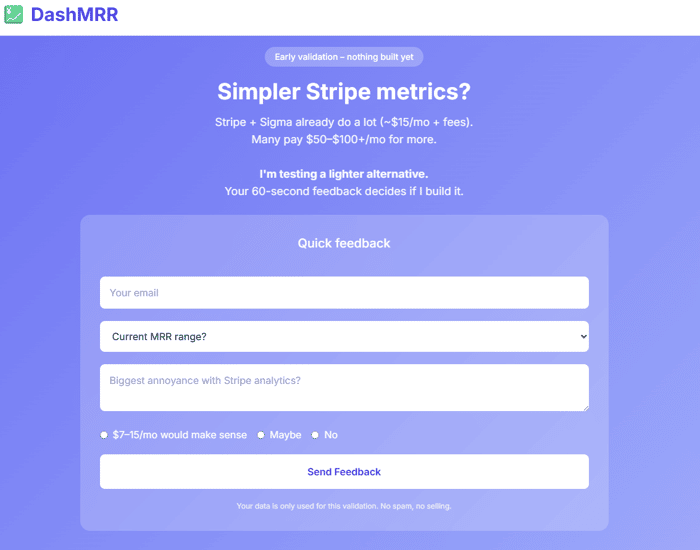
Hey everyone,
I'm completely new to SaaS – this would be my very first web app.
In my day job (DevOps / developer) I work a lot with PowerBI dashboards. Over the years I've painfully missed a really simple, clean overview of our most important numbers. Everything always felt either way too complicated or way too enterprise-heavy.
When I started researching ideas for my first SaaS product, I quickly landed on the Stripe analytics space (i assume that Stripe is one of the most used product for SaaS). Stripe already gives great basics, but tools like ChartMogul and Baremetrics often cost $50–$100+/mo – which feels disproportionate when you're just starting out with low MRR.
So my rough idea is a very minimal dashboard that focuses only on the 3–4 things most small SaaS founders actually check weekly:
- MRR / ARR / basic churn
- NRR + expansion / contraction breakdown
- Customer movements with € impact
- Maybe a super simple runway view
Planned pricing (very rough): free under ~$1K MRR, then something like $7–$9/mo.
Before I learn a bunch of new tech and build anything: I'd love to know if this solves a real pain for others or if I'm completely off track.
Takes literally 60 seconds:
https://dashmrr.netlify.app/
Brutal honesty is super welcome – if you think “nah, nobody needs that” or “Stripe already does enough”, just say it. Every single answer helps me decide whether to continue or pivot early.
Thanks a lot for reading – really appreciate it! 🙏

Love that you’re validating early — simpler Stripe metrics tools are something a lot of founders quietly wish existed.
One thing I’d test early is whether people care more about clarity of insights (easy decisions) or time saved — those two often drive adoption more than feature lists.
If you can tie survey responses to real use cases (what decisions people make after seeing the metrics), you’ll land way stronger product messaging and early growth.
So I am working on an app that tells you if your idea is worth pursuing. Should you kill it or pivot or go. I typed your idea in and this is what it came back with. If you like message me and I’ll send you the link so you can give me feedback on my idea as well. I’m new here so I can post links yet.
Next best step
Identify which part of your idea resonates most with potential users.
2.
Talk to 5 people in your target market about the problem (not your solution).
3.
Resubmit with a revised approach after gathering feedback.
This is a decision tool, not a prediction.
If you still want to proceed, test this first
Validate the problem exists before building any solution.
Verdict: PIVOT
Confidence: 85
Why this struggles (top 5)
Stripe already exposes clean, simple revenue metrics; customers mostly want more than just basics, not less.
The target market (small SaaS startups under $1K MRR) often aren’t willing or able to pay even $7/mo, especially if free Stripe dashboards exist.
The product scope is minimal and low differentiation — not enough to abandon current tools or justify ongoing costs for users.
Strong customer segmentation is missing; “anyone” means diluted focus and harder product-market fit.
Monetizing at a low price with small user base leads to slow growth; solo builders face scaling and support challenges for subscription SaaS.
Competitor context (at least 3)
Name: Stripe Dashboard
What they're built for: Basic revenue, churn, and customer analytics for users directly in Stripe’s ecosystem.
Why they're NOT a direct replacement: It’s free and integrated but less customizable; good enough for many startups early on.
The real risk (if any): If Stripe improves their dashboard UX or features, your minimal product becomes redundant fast.
Name: Baremetrics
What they're built for: Comprehensive SaaS metrics, deeper cohort analysis, forecasting, and customer insights.
Why they're NOT a direct replacement: Pricing is tiered and expensive; more features than needed by scrappy startups but valuable at scale.
The real risk (if any): Baremetrics appeals when complexity grows, not for minimal tracking needs.
Name: ChartMogul
What they're built for: Subscription analytics, segmentation, and revenue intelligence suited for small to mid-size SaaS companies.
Why they're NOT a direct replacement: Also pricier, with richer analytics. Provides staged “upgrade paths” as businesses mature.
The real risk (if any): Same as above, not competing on simplicity or price at earliest stages.
The real customer pain (truth version)
Early-stage SaaS founders want easy insight into revenue and churn without complexity or high cost — but often accept Stripe’s built-in tools until growth justifies paying for better.
A very small segment feels under-served by expensive tools but may struggle to pay anything at all.
Simplification is valued, but oversimplified dashboards may fail to provide actionable insight, causing users to jump back to more capable platforms.
Monetization reality check
Price points that could work: $0–$5/mo for <$1K MRR startups, possibly $10+ for more mature SMBs who want ease with some extras.
Why users would/wouldn't pay: Free existing tools and manual tracking compete heavily; $7/mo might feel arbitrary, especially without compelling extras.
What would have to be true for this to hit $500/mo: At $7/mo, you need ~70 paying users. They must perceive unique value enough to switch early and pay monthly; difficult without strong differentiation.
Cheapest pivot(s) with better odds (2-3)
Build a focused, free Chrome extension or web app that enhances Stripe’s dashboard with a neat “weekly snapshot” email or notification — cheap, fast, and hooks into an existing audience.
Narrow target to a very specific niche (e.g., indie SaaS with <$500 MRR + common pain like onboarding metric) and add one key insight or automation instead of a generic dashboard.
Offer an ultra-simple cashflow/runway calculator with integrations beyond Stripe — appeal to very early SaaS founders struggling with runway, not just metrics.
7-day validation plan (no-code, cheap)
Day 1-2: Identify and join relevant online groups (Indie Hackers, SaaS founders, Twitter) and post a clear question/poll on their current Stripe analytics pain points and willingness to pay for “minimal dashboard.”
Day 3-4: Build a simple landing page describing your product idea, with pricing and 2-3 benefits; include email signup for early access.
Day 5-7: Drive low-cost traffic to the page via Twitter/Tiny communities; measure signups and engagement. Conduct 5–10 user interviews to validate pain and price sensitivity.