First SaaS shipped — Pinstark. Pinterest pin packs from any product URL. What am I missing?
Solo founder here. Shipped my first SaaS last week — Pinstark.
What it does
Paste a product URL — Amazon, Etsy, Walmart, any Shopify store, most other e-commerce — and get a complete Pinterest pin pack in ~30 seconds:
- 6 editorial pin images showing your actual product
- 5 SEO-optimized titles
- 5 descriptions
- A blog blurb
- Board suggestions
- Keyword list
Built for Pinterest affiliate marketers who spend 15–30 minutes per pin in Canva writing SEO copy and hand-formatting images. Free tier: 3 credits (3 full packs, no card). Paid: $19 / $39 / $89 per month depending on how many packs and images per pack.
Why I built it
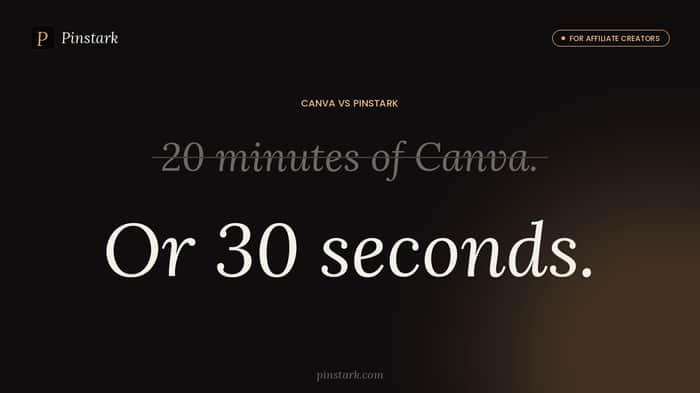
Pinterest affiliate marketing has one bottleneck almost nobody talks about: production time. Each pin needs a custom image, an SEO-optimized title (96% of top Pinterest searches are unbranded, so keywords matter more than brand), a description, board matching, and a link. Manually that's 20+ minutes per pin. Shipping 20/week eats a full workday just producing.
Differentiator
The competing tools optimize for volume and scheduling. Pinstark optimizes for image quality. Every pin shows the actual product — not an AI guess of what it might look like. Editorial compositions, not template overlays.
Honest limitations
- No direct Pinterest publishing yet. Users download the pack or use "Pin It" with their affiliate link attached. Publishing is on the roadmap.
- No bulk URL upload yet — one URL at a time.
- No analytics or performance tracking yet.
I traded features for time-to-launch. Adding these based on what actual users tell me matters most.
Where I am
- Live at pinstark.com
- $0 MRR — launched last week, no paying users yet
- A handful of signups from initial launch traffic
- Two bugs found and fixed since launch
- No newsletter, no ads, no affiliate program yet
What I probably got wrong
The tagline. I keep saying "pin packs from product URLs" and I think that abstracts the value. Something more concrete would land harder — but I don't know what yet.
Also underweight on Pinterest as a marketing channel. Ironic for a Pinterest tool. Starting a brand account there in a few weeks.
What I'd love feedback on
- Does "editorial pin quality" land for you, or does it read as marketing fluff?
- If you've done Pinterest affiliate marketing — what's the actual bottleneck you'd solve with a tool? Image production, SEO copy, both, something else?
- Anyone who tries it: what broke, what confused you?
Free Pro for 3 months for anyone who wants to break it. Drop your email in a reply, tell me a product URL you'd test with, and I'll spin up an account.

What you might be missing is the failure a stranger can hit in two minutes. The free tier says try it; it does not say what breaks. Pick one ugly product URL (a listing with three variant images and a title that is mostly brand name), run it, and put that exact case on the page: the pack it produced, what it got wrong, and what the tool does not do (stock photos, non-English listings, pages behind a login, whatever your real limits are). Publishing the constraint in the same place as the launch cuts the bad-fit sign-ups who burn the three credits, get a weak pack, and leave as a churned trial you never learn from.
On the three paid tiers: which one did the first stranger actually pay for, and what did they say on the way in? That answer is worth more than the pricing table.
Congrats on shipping your first SaaS! I like the simplicity of the workflow here — turning an existing product URL into Pinterest content removes a lot of the friction that store owners usually face when they know they should be creating pins but don’t have the time.
One thing I’d explore is making the target customer sharper on the homepage. The value is probably very different for a Shopify store owner, Etsy seller, affiliate marketer, or small brand, and choosing the strongest first audience could make the message land faster.
I’d also emphasize the outcome more than the generated assets. Users don’t really want “pin packs” — they want more product discovery, traffic, and sales from Pinterest without spending hours designing content.
The idea is clear, but I suspect there are a few positioning opportunities that could help visitors immediately understand why this is worth using.
If useful, I do a $10 homepage audit where I document conversion friction points and practical copy improvements.
haven’t used Pinterest for affiliate marketing, so this is purely messaging feedback: “editorial pin quality” feels a little vague to me.
Your concrete promise is stronger: “Turn one product URL into 6 Pinterest-ready pins in 30 seconds.” I’d lead with that, then explain the differentiator as: “Every pin uses the actual product image, not an AI-generated approximation.”
The honest limitations also made the product feel more trustworthy. I’d love to see one complete 6-pin pack side by side, because that would show how varied the layouts and compositions really are.
yeah you're right on the tagline. "editorial pin quality" is what i'd say pitching a design agency. "6 pinterest-ready pins in 30 seconds from a product URL" is closer to what someone actually googling for this would type. rewriting the hero this week around that line + your "actual product image, not an AI-generated approximation" framing - both are better than what's up.
on the 6-pack side by side, fair ask, haven't put one up. drop a product URL you'd want to test with and i'll spin up a free pack and post the images back in this thread so anyone reading can see the actual output.
Three free packs can measure generation, but not value. Track pack generated, downloaded, actually published, and second pack within seven days. If people generate once and never publish, quality or fit failed; if they publish but never return, production time was not a recurring bottleneck.
the 4-step funnel is exactly the diagnostic i've been missing. generate and download i can pull from logs. actually-published is the hard one, no publishing integration yet so it's self-report or nothing. pack-2-in-7-days i can start this week. if that's near zero, quality or fit failed regardless of step 3.
when you've run this before, is the "generate but never publish" drop usually quality, or workflow friction (export format, clunky download)?
I haven't run this exact Pinterest funnel, so I wouldn't pretend there's a usual cause. I'd add one tiny prompt after download: “What stopped you publishing?” with quality, dimensions/file format, and “publishing later” as options. Then compare that with pack 2 in 7 days. Quality should suppress repeat generation too; workflow friction can leave repeat generation healthy while publishing stalls.
the intercept survey is the exact shape i needed and it's small enough to ship this week. three predefined options + free-text on the download modal, then cross-check against pack-2-in-7-days. if quality-flagged users also don't come back, that's two independent signals pointing the same way.
your "friction leaves repeat generation healthy while publishing stalls" line is the testable prediction. if pack-2 rate is fine but the intercept skews to file-format complaints, the fix is on export, not the pin.
What stood out to me is that you're optimizing for production time rather than Pinterest itself. I'd keep validating whether users are buying faster pin creation or the ability to publish consistently without burning an entire day on content production.
honestly you're right and it's the thing i keep going back and forth on. current bet is production time is the actual bottleneck for pinterest affiliate folks specifically — they burn hours in canva per pin and never get out of that treadmill. but yeah, saving production time doesn't automatically mean the pins perform on pinterest. give me a couple months and i'll actually know instead of guessing. thanks for pushing on it.
I'm glad it resonated.
Reading your reply gave me one thought about the assumption underneath that bet. I don't think I could explain the reasoning properly in a thread because it really depends on how you're thinking about the product rather than Pinterest itself.
If you're interested, what's the best email to reach you on?
ha, appreciate that. i'd rather keep it in the thread if that's ok. whole point of posting on ih is that other people building similar things get to read the pushback too, and my inbox eats that anyway. fwiw i learn more from being wrong in public than being right in private lol.
if there's a specific assumption you'd poke at, drop it here and i'll engage with it properly. worst case i say "yeah that's the thing i'm most nervous about" and someone else in the thread has an angle we both missed.
Fair enough—I respect that, and I also like the idea of people learning in public.
The assumption I'm thinking about only really becomes useful when it's applied to a specific product rather than as a general principle. I'd rather not oversimplify it into a thread or pretend there's a universal answer.
I'll leave it there, but I appreciate the discussion—it definitely gave me something to think about as well.