Five Questions Vimeo Users Should Ask Bending Spoons (Before It’s Too Late)

Five Questions Vimeo Users Should Ask Bending Spoons (Before It’s Too Late)
If you’re a startup using Vimeo for customer onboarding, product videos, or content marketing — you need to read this before your next billing cycle.
When a platform you rely on changes hands, it’s not the press release that matters, it’s the fine print you’ll never see until it’s too late.
Vimeo’s acquisition by Bending Spoons is one of those moments where every business, creator, and developer using Vimeo should pause and ask hard questions (not out of panic, but out of prudence). Ownership changes always come wrapped in optimism, but history says the details that follow decide who wins and who gets blindsided.
The truth is simple: If you’re hosting mission-critical videos on Vimeo, you now owe yourself a due diligence sprint. Pricing, data ownership, SLAs, and security policies can shift faster than your next billing cycle. AI features and product direction might evolve in ways that don’t align with your workflow, or your compliance needs.
This article is not about fear. It’s about control. You’ll learn five questions every Vimeo customer should ask Bending Spoons right now—before contracts renew, before APIs change, and before performance or access starts to drift. Each question is backed by the same criteria used by teams that can’t afford downtime, broken analytics, or lost visibility.
Because if you can’t verify how your platform will evolve, you’re not a customer… you’re collateral.
1. Will your pricing, contract terms, and SLAs change in the next 12 months?
An acquisition always begins with promises of “business as usual.” But ask anyone who’s lived through one — pricing and support are usually the first things to shift.
When Vimeo becomes part of Bending Spoons, there’s a good chance new cost structures, bundling, or enterprise tiers will emerge. That’s not inherently bad. The danger lies in not knowing when or how those shifts hit you.
What to Ask
-
Will existing contracts be honored under the same terms until expiry?
-
Are there caps on renewal price increases (percentage or absolute)?
-
Will the SLA uptime guarantees (e.g., 99.9% delivery) remain enforceable?
-
Are support tiers—especially enterprise escalation paths—unchanged post-acquisition?
-
How long will legacy billing models or feature sets be maintained before mandatory migration?
Why It Matters
For teams using Vimeo as a delivery backbone, predictability is oxygen. If your marketing automation, LMS, or product tutorials run on Vimeo embeds, a 15% price swing or throttled API quota can blow through quarterly budgets and create unplanned technical debt.
Post-acquisition, internal cost structures get optimized. “Enterprise” might get repackaged, or features like private embedding, custom analytics, or DRM may get locked behind new tiers. Once that happens, switching costs multiply and you’ll be negotiating from a place of dependency, not leverage.
How to Verify
-
Ask for documentation, not assurances. Written communication from account managers or legal teams about term continuity and SLA commitments is what holds weight.
-
Pull your current contract and highlight renewal clauses. Note any section that allows the vendor to “adjust fees” or “modify feature availability.”
-
Benchmark support response times. If average response time or uptime changes after the handover, you’ll have an objective baseline.
-
Set calendar reminders for renewal milestones. You need lead time to re-evaluate if pricing changes coincide with new ownership cycles.
Red Flags
-
Promises like “no immediate changes planned” (“immediate” is not a timeframe.)
-
Lack of written confirmation on price caps.
-
Reduced transparency around support escalation or SLA dashboards.
-
Consolidation of existing plans into new “bundles” that charge for features you already use.
Founder Takeaway
Your pricing stability determines your margin predictability. If you don’t have written clarity on renewal and SLAs, you’re financing someone else’s experiment.
Before the next invoice lands, lock your numbers down in writing or prepare a secondary hosting pipeline, so you can negotiate from power, not panic.
2. Do you fully own your data and have a guaranteed, fast export path?
A video platform isn’t just where your files live, it’s where your customer history, engagement data, and metadata are trapped. And when ownership changes, the rules around that data can change too.
When Vimeo shifts to Bending Spoons, it’s reasonable to expect new infrastructure, different API limits, or migrated storage contracts. That can quietly impact how (and whether) you can extract your content and analytics without breakage.
What to Ask
-
Can we export original files + all renditions (including metadata, captions, and analytics events)?
-
Will current APIs and webhooks for export remain stable through the transition?
-
Are there rate limits or throttles on bulk downloads (especially above 1 TB)?
-
How long will our data be retained if we choose to migrate off the platform?
-
Is there a formal data-portability SLA documented in the contract?
Why It Matters
Your videos aren’t just assets, they’re distribution channels, SEO surfaces, and training data for your own AI workflows. If export speed drops or metadata is lost, you lose discoverability and attribution history. Worse, broken embed links or renamed URLs can kill search equity overnight.
In a world where AI models increasingly crawl and cite structured metadata, your ability to retrieve complete records (heatmaps, engagement, schema, titles, tags) is a visibility issue, not a storage one.
How to Verify
-
Run an export rehearsal this week—pull a few hundred GB of mixed content and note completion time, error logs, and API fail rates.
-
Use network logs to measure throughput and parallel request handling.
-
Cross-check exported metadata against original values (titles, tags, captions, analytics IDs).
-
Document any fields missing from API responses — these often signal future deprecations.
-
Request a written timeline for API and storage changes post-acquisition.
Red Flags
-
Vague phrases like “Data export is available on request.”
-
Throttled downloads (especially under enterprise plans).
-
Analytics exports limited to aggregate dashboards instead of event-level data.
-
API docs disappearing from public access or replaced by SDK-only models.
Founder Takeaway
If you can’t leave, you can’t safely stay. Your first audit after an acquisition should be a data-portability rehearsal. Export originals, renditions, and analytics in parallel and time the process. If it takes days or breaks permissions, you know what kind of future you’re signing up for.
In contrast, modern platforms like Gumlet treat data ownership as a feature, not a favor—providing upload/replace APIs, metadata search endpoints, and JSON exports that preserve titles, tags, and event triggers across CRM systems.
3. What is your current and future security posture?
After an acquisition, data rarely moves silently. Infrastructure changes, CDNs get swapped, and sometimes, access rules loosen in favor of cost or convenience. That’s when leaks happen.
If your videos carry IP, paid lessons, or internal communications, your security stack is your moat. You need proof, not promises, of how your content will be protected once Vimeo becomes part of Bending Spoons.
What to Ask
-
What DRM and encryption standards does Vimeo currently enforce and will those remain under Bending Spoons’ infrastructure?
-
Are tokenized URLs (unique, time-limited, or viewer-specific) available for private or paid content?
-
Does the player support domain, IP, and geo restrictions to control where videos can be embedded or viewed?
-
Is dynamic watermarking supported at the session level (so leaks are traceable)?
-
What audit logs or access reports can admins export for compliance checks?
Why It Matters
Enterprise video isn’t about views, it’s about control. If you can’t define who sees what, where, and when, your content is one leak away from becoming public property. DRM and tokenization aren’t “nice-to-haves”; they’re mandatory for regulated industries, e-learning, and premium creators.
Without session-level watermarking and audit trails, piracy becomes invisible. Without geo/domain restrictions, your content can be embedded anywhere, diluting brand control. And once data is mirrored across new storage nodes post-acquisition, permissions can slip through cracks faster than anyone admits.
How to Verify
-
Request a security architecture diagram showing encryption layers, DRM vendors, and CDN access policies.
-
Confirm access rules (token expiry, playback authorization flow, referrer whitelists) with your account rep.
-
Audit a few internal videos by attempting unauthorized embeds or regional playback to see what actually blocks.
-
Demand a sample watermarking demo—session identifiers should be dynamic and unique per viewer.
-
Ask for audit logs that include access source, timestamp, and IP to test compliance readiness.
Red Flags
-
“We’re exploring DRM in future updates.” That means they don’t have it now.
-
Only static watermarking (same overlay for all viewers).
-
Playback restrictions limited to passwords instead of tokenized sessions.
-
No logging or user-level access trails.
Founder Takeaway
Security is not an add-on, it’s a posture. If your platform’s protection depends on “security by obscurity,” you’re already compromised. Teams that handle paid, private, or proprietary content should verify that DRM, tokenized URLs, and watermarking aren’t just mentioned in sales calls—they’re enforced in production.
Best Vimeo alternative like Gumlet treat these as built-ins: DRM-first delivery, tokenized access tied to user sessions, domain/IP/geo fencing, and dynamic watermarking that connects every playback to a traceable identity.
4. What’s the delivery architecture, and how do you handle performance at scale?
When everything’s running fine, delivery seems invisible, until latency spikes, streams buffer, and your global audience starts dropping off. For video platforms, infrastructure is the invisible differentiator. It’s also where most post-acquisition disruptions quietly begin.
Bending Spoons has a solid reputation for app engineering, but large-scale video delivery isn’t just software—it’s a global logistics problem. Vimeo users need to understand exactly how their videos will be delivered, cached, transcoded, and optimized once new infrastructure and cost centers come into play.
What to Ask
-
Which CDNs currently serve your video traffic, and will that multi-CDN setup remain after the acquisition?
-
Are you using adaptive bitrate (ABR) streaming (HLS/DASH) to adjust quality by network and device?
-
What’s your average time-to-first-frame (TTFF) across regions?
-
Is transcoding handled via GPU or parallel pipelines for faster readiness and lower buffering?
-
Are regional PoPs (Points of Presence) expanding or consolidating post-acquisition?
-
How do you monitor and report uptime, rebuffering ratio, and QoS (Quality of Service) metrics to clients?
Why It Matters
Your customer doesn’t care where your video is hosted. They care that it loads instantly. Slow playback kills engagement, increases bounce rate, and lowers conversion, especially for global users.
Acquisitions often introduce cost optimizations: consolidating CDNs, throttling low-traffic regions, or delaying transcoding jobs. The result? Slower first frames, delayed availability, and inconsistent quality across geographies.
If you run video on product pages, onboarding flows, or gated learning content, every second of latency compounds into lost revenue and churn.
How to Verify
-
Run regional tests using tools like WebPageTest or Catchpoint to compare load times before and after the acquisition.
-
Ask Vimeo for their PoP map and whether they maintain redundancy across CDNs.
-
Request transcoding pipeline documentation—CPU vs GPU, batch vs parallel, and SLA for video readiness.
-
Measure TTFF, rebuffering ratio, and bitrate switching frequency using your player logs.
-
Ask for QoS dashboards or uptime reports (ideally 12-month lookback).
Red Flags
-
Vague language like “optimized delivery network” without named CDNs or maps.
-
Lack of transparency around transcode time to readiness.
-
No GPU or parallel transcoding. This means longer “processing” delays before playback.
-
Single-CDN dependency or regional limitations masked as “cost optimization.”
Founder Takeaway
Performance isn’t an add-on metric; it’s your brand’s first impression. If your videos buffer or delay loading in global markets, no feature or rebrand will fix that perception.
Forward-thinking companies benchmark their delivery stack on time-to-first-frame, rebuffering ratio, and global consistency, not just uptime.
Platforms like Gumlet are built exactly for that: GPU/parallel transcoding, multi-CDN routing, adaptive bitrate streaming, and real-time monitoring that keeps first-frame speed and delivery reliability measurable, not mystical.
When ownership changes, demand these metrics upfront—or risk paying for performance you no longer get.
5. How will the new roadmap handle AI features and analytics for enterprises?
Bending Spoons has built its reputation on design, apps, and consumer-grade UX. But enterprise video infrastructure lives and dies by data depth—the difference between “views” and actual impact.
For Vimeo users, this acquisition raises a crucial question: Will the new owners prioritize creative features and automation, or will they double down on enterprise analytics, attribution, and CRM alignment?
What to Ask
-
What’s the AI roadmap? (Automatic captions, scene detection, thumbnailing, recommendations, personalization)
-
Will those features integrate into enterprise analytics, or stay as consumer add-ons?
-
How will video events (plays, watch time, CTAs) connect to CRMs or ad platforms?
-
Are there plans for in-player CTAs, lead forms, or retargeting pixels?
-
How will Vimeo ensure attribution transparency when embedding across channels (web, email, apps)?
-
Is there a unified analytics dashboard or API that can export engagement data programmatically?
Why It Matters
The future of video isn’t just watched—it’s measured, segmented, and personalized. When AI starts generating chapters, thumbnails, or titles, ownership and analytics pipelines must evolve too. If Vimeo shifts toward closed-loop AI experiences, you could lose granular data access and CRM syncing that drive your marketing ROI.
Enterprise teams rely on:
-
Heatmaps to identify drop-off points.
-
Event streaming to map video engagement to pipeline influence.
-
Attribution data to prove ROI.
When those vanish or get throttled, your video becomes a black box again.
How to Verify
-
Ask for the public AI roadmap or upcoming feature set and see how many items connect directly to analytics or CRM.
-
Request a demo showing event streaming to HubSpot, Salesforce, or Segment.
-
Test whether in-player CTAs actually send data downstream (not just to Vimeo’s dashboard).
-
Verify whether you can still query raw session-level data (not just aggregates).
-
Check if Vimeo’s SDK or API has AI-powered metadata endpoints—these indicate maturity.
Red Flags
-
AI features limited to aesthetic or consumer-facing functions (thumbnails, filters).
-
Event exports capped or available only as paid enterprise add-ons.
-
No webhook support for engagement data.
-
Analytics locked inside dashboards with no external integration.
Founder Takeaway
Visibility without attribution is vanity. If Vimeo’s roadmap drifts toward “AI magic” instead of CRM-grade analytics, teams will lose the only thing that proves ROI: traceable data.
Modern infrastructure platforms (like Gumlet) already bake AI, analytics, and attribution into one stack. You get in-player lead capture, event-based triggers (50% watched, CTA clicked → CRM), cross-channel analytics, and heatmaps that roll up to a unified dashboard.
In other words: measurable revenue, not just engagement.
A Zero-BS Hedge Plan (Even If You Stay on Vimeo)
Not every team needs to jump ship overnight. But every smart team needs a hedge. The goal isn’t to abandon Vimeo, it’s to make sure you never wake up dependent on a black box. Even if the acquisition plays out smoothly, you should treat this as a systems audit—testing whether your stack is exportable, measurable, and secure under pressure.
Here’s the five-step hedge every Vimeo user should implement this month:
1. Run an Export Rehearsal
Pull 10–20% of your library (including captions, metadata, and analytics events). Measure download speed, API error rates, and data completeness.
If you hit throttles, rate limits, or missing fields, you’ve identified your first risk surface. If you can’t leave cleanly, you can’t safely stay.
2. Mirror Critical Content
Duplicate essential assets like product demos, onboarding videos, gated lessons, etc. to an alternate host or local storage. This isn’t overkill; it’s operational continuity. If downtime or policy changes hit, your customer-facing assets stay live.
3. Normalize Metadata for Portability
Standardize titles, tags, schema, and captions in JSON or CSV. Use consistent field naming across all platforms so future imports don’t scramble SEO or analytics history. Think of metadata as the passport your videos carry when crossing platforms.
4. Audit Security Controls
Test tokenized URLs, geo/IP restrictions, and playback authorization. If your videos can be embedded anywhere or shared without expiry, fix that now. Run a “piracy simulation”: leak a link intentionally and track where it surfaces. If you can’t trace it, you’ve got a visibility problem.
5. Instrument Analytics → CRM Now
Don’t wait for roadmap promises. Start streaming video events (plays, watch-throughs, CTA clicks) directly into HubSpot, Salesforce, or Segment via existing webhooks or scripts. That way, even if platform analytics get restructured, your revenue attribution remains intact.
The Backup Plan You’ll Thank Yourself For
You don’t need to leave Vimeo to regain control. You just need proof that you can leave, cleanly and quickly, if conditions change. That’s what separates scalable teams from captive ones.
Platforms like Gumlet make that proof default—offering upload/replace APIs, DRM-first delivery, in-player CRM events, and unified dashboards for teams that treat video as infrastructure, not just media.
If Vimeo is your current stack, treat this hedge plan as your insurance policy.
Decision Checklist: Can You Still Trust Your Video Platform?
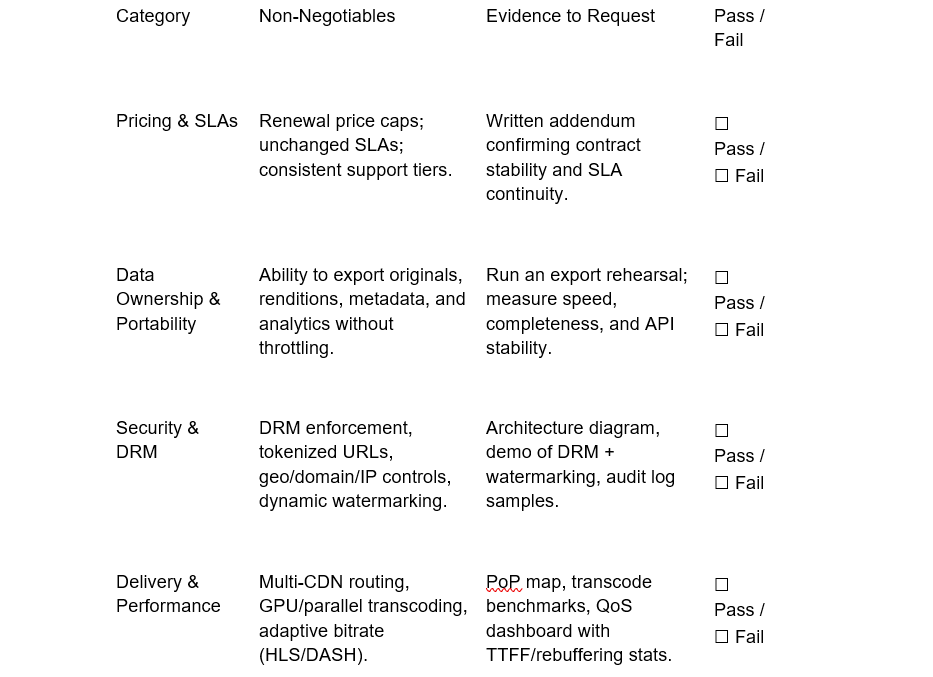
Platforms that consistently Pass all seven categories aren’t just vendors, they’re partners. Platforms that Fail even one critical row (especially Data Portability or Security) turn from partners into risks.
And that’s why teams using Vimeo today should run this checklist now, while the ink on the acquisition is still drying.
If You Need a Vimeo-Class Alternative (Without the Guesswork)
If you’re reading this, it’s probably not because you want to move, it’s because you don’t want to get trapped. And that’s the right mindset. The best founders and marketing leads don’t switch platforms impulsively, they test leverage.
If you’re evaluating alternatives, benchmark Vimeo not against lookalikes, but against the next class of infrastructure—platforms that give you:
-
Control (your player, your domain, your data).
-
Speed (GPU/parallel transcoding, multi-CDN routing, and adaptive streaming).
-
Proof (heatmaps → event streaming → pipeline attribution).
-
Personalization (segment-wise intros, CTAs, and captions tied to CRM behavior).
-
Security (DRM, tokenized links, geo/domain/IP control, dynamic watermarking).
That’s where Gumlet fits in. It’s not a “video host.” It’s a video infrastructure platform built for companies that treat video as a revenue engine, not a file folder.
Why It Exists
Vimeo and YouTube were built for publishing. Gumlet was built for performance, attribution, and protection.It helps SaaS, EdTech, and media companies host, optimize, personalize, and analyze videos across every touchpoint—with built-in compliance, security, and CRM-grade analytics.
What That Looks Like
-
Marketing teams get branded embeds, in-player lead capture, and analytics that sync directly into HubSpot or Salesforce.
-
Product teams get adaptive playback, multi-CDN speed, and APIs to automate metadata, ingestion, and personalization.
-
Security teams get DRM, watermarking, and domain/IP controls that block piracy before it happens.
-
Leadership gets proof—dashboards that show how each video contributes to pipeline and retention.
Final Thought
You don’t need to predict what Bending Spoons will do with Vimeo. You just need to make sure that your infrastructure choices keep leverage on your side.
So before the next product update or policy shift drops, ask the five questions, fill the checklist, and hedge smart. And if you’re exploring next-gen infrastructure for secure, high-performance, measurable video—
start where the future’s already built: Gumlet.
FAQ: What Vimeo Users Are Asking Right Now
1. Will Vimeo prices change after the Bending Spoons acquisition?
There’s no confirmed pricing revision yet, but ownership transitions often trigger restructuring. The safest move is to get written clarity on renewal terms, price caps, and SLA continuity. Don’t rely on “no immediate changes planned”—that phrase has sunk more budgets than competitors ever did.
2. How do I export all my Vimeo videos and analytics safely?
Use Vimeo’s export API or dashboard to pull originals, renditions, captions, and analytics data. Run a test export with both small and large files to see where throttles or missing fields appear. If your analytics exports lack event-level data, back them up now.
3. What security controls should I confirm with Vimeo?
Ask about DRM enforcement, tokenized URLs, geo/domain/IP restrictions, and session-level watermarking. These are non-negotiable for paid or internal content. Without them, you lose content protection and compliance visibility overnight.
4. How can I validate Vimeo’s delivery performance?
Request their CDN map, average time-to-first-frame (TTFF), and GPU/parallel transcoding documentation. Run real-user playback tests from multiple geographies to verify speed and consistency—don’t trust uptime percentages alone.
5. How do I ensure Vimeo’s AI and analytics features still work with my CRM?
Confirm whether new AI tools connect to enterprise analytics or remain siloed. Test event streaming from player → CRM. If data stops flowing downstream, build your own webhook integration before it’s too late.
Curious to hear from others. Are you planning to stay with Vimeo or looking for alternatives? What’s your migration plan?
