Flux Krea: A Solo Developer’s Journey Through Technical Challenges and Growth
In today’s AI landscape, image generation technology is becoming increasingly essential, especially in creative work and content creation. As a solo developer, I built Flux Krea from the ground up, overcoming numerous technical hurdles and operational challenges. In this article, I’ll share my journey, offering practical advice and insights that could be helpful to other solo developers.
1. Starting from Scratch: Technical Architecture and Challenges
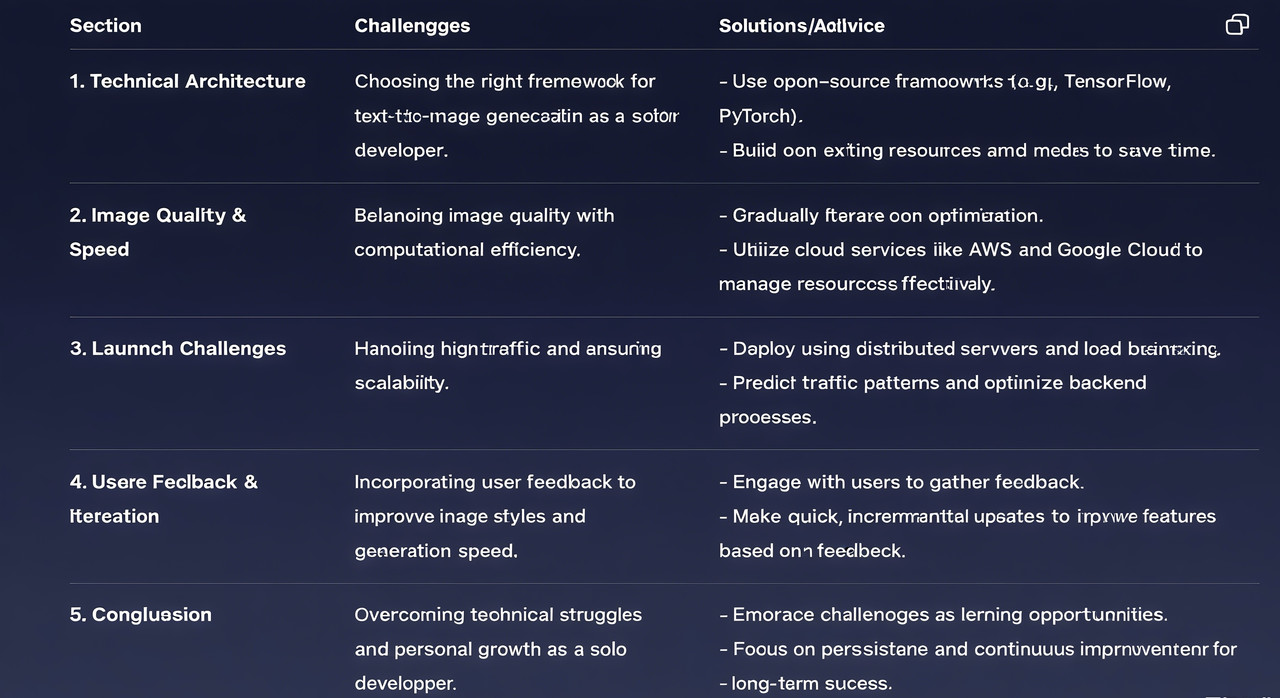
Flux Krea is built on a next-gen text-to-image model, which generates images based on textual descriptions. As a solo developer with no team, one of my first challenges was choosing the right technology that could meet both performance and resource efficiency. After experimenting with various frameworks, I opted for an open-source framework based on generative adversarial networks (GANs), refining the architecture through multiple iterations to strike the right balance between quality and speed.
💡 Practical Advice:
- Choose the Right Open-Source Framework: For solo developers, leveraging established open-source frameworks is a huge time-saver. Platforms like TensorFlow, PyTorch, and Hugging Face offer excellent community support and pre-trained models that can accelerate your development process.
- Utilize Existing Resources: Don’t reinvent the wheel. Many AI technologies, such as image generation and NLP models, already have mature solutions and APIs. Building on these existing tools can save you a lot of time and effort.
2. Optimizing Image Quality: Technical Hurdles and Solutions
The quality of generated images directly correlates with the computational resources required. During the development of Flux Krea, I encountered two major challenges:
- Balancing Image Quality and Processing Speed: High-quality images often require substantial computational power, which can be costly for a solo developer. To address this, I optimized the image generation process, from noise reduction to fine-tuning the network parameters, to improve both quality and efficiency.
- Diversity and Personalization in Generated Images: The more complex the text input, the harder it is to generate accurate images. I had to make sure that Flux Krea could handle a wide range of textual inputs while still producing high-quality and relevant images.
💡 Practical Advice:
- Iterate Gradually: Optimization doesn’t happen overnight. Start with a functional version of your model and improve it over time, focusing on one aspect at a time. Through incremental adjustments and testing, you can achieve significant improvements.
- Use Cloud Services: I leveraged cloud computing services to overcome computational resource limitations, avoiding the need for expensive hardware investments. Services like AWS and Google Cloud offer flexible, on-demand compute resources that scale with your needs.
3. Launch Challenges and Solutions
As a solo developer, one of the biggest hurdles was ensuring that Flux Krea could handle a high volume of traffic without crashing. During the initial launch, the platform faced server downtime, and users experienced delays in image generation, which negatively impacted the user experience.
To solve this, I took the following steps:
- Distributed Deployment: To ensure scalability, I deployed Flux Krea across multiple server nodes, utilizing load balancing to distribute traffic evenly and reduce strain on individual servers.
- Traffic Prediction: By analyzing usage data and forecasting traffic patterns, I was able to prepare for high-demand periods and optimize backend processes to reduce latency.
💡 Practical Advice:
- Plan for Traffic Load Early: As a solo developer, predicting traffic spikes and load distribution is essential. Be proactive about scaling your infrastructure, especially as your platform grows and attracts more users.
- Use Monitoring Tools: Tools like Google Analytics and Datadog can help you track performance in real time, monitor server health, and gather valuable insights into how users interact with your platform. These can help you identify bottlenecks and optimize the system.
4. From User Feedback to Product Improvement
After launching, I received valuable feedback from users, which pointed out areas for improvement in both the image generation process and platform speed. As a solo developer, I don’t have the resources for extensive market research, so user feedback became my most important data source.
I used this feedback to enhance Flux Krea, including:
- Expanding Image Style Options: I introduced additional style choices so that users could generate images that better matched their personal preferences.
- Improving Generation Speed: By optimizing the backend and refining algorithms, I reduced wait times and improved overall user experience.
💡 Practical Advice:
- Stay Close to Your Users: User feedback is crucial. Whether your platform is large or small, actively engaging with users and gathering their feedback will help you identify pain points and areas for improvement.
- Quick Iterations: Continuously iterate and improve your platform. Focus on making incremental updates that enhance functionality or user experience without overwhelming yourself with too many changes at once.
5. Conclusion: A Solo Developer’s Path to Growth
The successful launch of Flux Krea didn’t happen overnight. It was the result of overcoming numerous technical challenges and operational struggles. But each challenge presented an opportunity to grow, and the satisfaction of building something from scratch as a solo developer is incredibly rewarding.
Looking ahead, I plan to continue improving Flux Krea, adding more features to meet user demands, and expanding the range of image styles and generation capabilities. For other solo developers, remember that every challenge is an opportunity to learn and improve, and every milestone is a testament to your persistence and hard work.
Through this article, I hope to provide valuable insights to other solo developers, offering both technical advice and practical solutions based on my experience. The journey of developing Flux Krea has been full of challenges, but it’s also been one of immense growth. If you’re starting your own project, stay persistent, iterate, and keep improving—it’ll be worth it in the end!

Inspiring stuff for indie devs...
Your insights on "solo dev resource allocation" hit home! We faced identical dual challenges building Accio:
Technically: Just like you balanced "generation speed vs image quality" in GANs,
procurement AI must trade off "real-time quote accuracy" and "compute costs"
User-wise: Your "simple prompts vs complex art demands" tiers mirror SMB procurement needs exactly—some want basic price checks, others need full supplier negotiations
We're implementing all three of your core strategies:
✅ Rapid iteration: Like your weekly style optimizations, we refine Agent Mode's pricing granularity through user feedback
✅ Elastic scaling: Following your cloud scaling playbook, our engine auto-deprioritizes non-critical tasks (e.g. historical analysis) to protect core quoting
✅ Trust-first: Echoing your no-preset-pricing approach, we let companies test basic features before recommending plans based on actual procurement volume
Would love to hear more about your multi-style generation roadmap—it could inspire our "industry-tailored procurement packages"!
Thanks for sharing the hurdles and the highs. Inspiring grind.
Great post! The best takeaways for me are staying close to your users, being persistent, and keep improving and iterating.
Impressive work — it’s inspiring to see you take this from idea to launch solo. Just curious, how long did it take you to get it to this point?
Great work, really inspiring to see you build and launch this entirely on your own. I’m curious, how long did it take you to bring it to this stage?
I really enjoyed reading this! It's inspiring to see someone tackle the ups and downs of solo development head-on. The way you shared both the struggles and the breakthroughs made it feel so real and relatable. I can really feel the passion and dedication you’ve poured into Flux Krea. Your journey of learning and growing through feedback resonated with me—it’s not easy, but it’s what makes the success that much more meaningful.
By the way, I’m also working on a solo project called Textideo, which is a platform for AI-powered video creation. It's been quite a ride, and I can relate to the challenges and excitement you mentioned! Wishing you continued growth and success with Flux Krea! with Flux Krea!
Awesome write-up. Mad respect for building this solo.
The part about user feedback being your main data source really hit home. I'm in the same boat right now trying to validate my own tool (Cortexa).
What was the best way you found to get those first few users to actually try the app and give you that initial feedback?
Congrats on the success!
Thanks so much! 🙏 I totally get the struggle—getting those first users can feel like the hardest part. For me, it was all about reaching out to communities where people were already interested in the problem I was solving . I started by offering free trials or early access in exchange for honest feedback. That initial feedback loop really helped refine the product. Good luck with Cortexa—hope it takes off! 🚀
The details are insane. I typed a short sentence and got an image that looked like a professional photo shoot.
Yeah, the AI is pretty amazing at turning even the simplest ideas into something professional! It’s like magic, right?
This comment was deleted a year ago