For years, I was terrible at estimating projects. Here’s what changed.
For years, I was terrible at estimating projects.
I’d tell a client it would take 40 hours, and somehow it always turned into 60.
Every time, I had to choose between explaining myself or eating the extra time.
At first, I thought I just sucked at planning.
But it wasn’t my hours — it was my structure.
My proposals looked clean and professional,
but they didn’t show what was behind the numbers.
One day I’d had enough, I decided to break a project down properly.
No more “Phase 1: Design” or “Phase 2: Development.”
Instead, I listed everything, step by step:
One-time costs — design, development, integrations and more
Recurring costs — hosting, domains, maintenance, everything that client needs to know about future costs after the project is done
Milestones — grouping all one-time work into clear stages with pre-payment, description and deliverables
It wasn’t fancy, but it worked.
For the first time, clients could see the moving parts — and finally understand the price.
That changed everything.
After doing this manually a few times, I noticed I was rebuilding the same Notion template over and over — just changing numbers, checking formulas, updating dates.
So I built a small internal tool to make it faster.
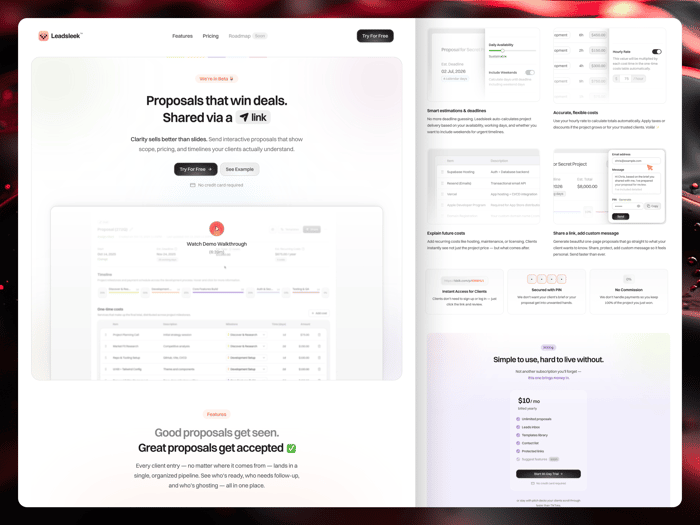
In Leadsleek.com, every proposal is built around real structure, not slides.
You add milestones, one-time and recurring costs, and the app:
Auto-calculates total and recurring costs
Estimates deadlines automatically based on many customization options
Adjusts timelines dynamically when you change scope
Ties payments to milestones so clients see exactly what they’re paying for and when.
Lets you share via a single link — no PDFs, no decks
That’s how Leadsleek was born — a small SaaS for freelancers and small teams who want to stop guessing and start quoting with clarity.
Project estimating isn’t about getting the math perfect.
It’s about showing your work.
When clients see what’s behind the price, they stop questioning it —
and you stop doubting yourself.
Leadsleek just makes that process faster, clearer, and easier to repeat.
🧠 Try it free for 30 days — no credit card required.
👉 leadsleek.com
(It’s still in Beta — if you find bugs, you can report them inside the app or email hello@leadsleek.com)

This hits home, Alan — so many founders underestimate how much “showing the work” builds client trust. The transparency you’ve baked into Leadsleek isn’t just smart for quoting ,it’s a growth strategy too. Clarity like this makes word-of-mouth and referrals so much easier to scale. Excited to see where you take it. 👏
appreciate it!
Anytime, Alan! 🙌 Your approach with Leadsleek actually aligns perfectly with what I help founders do , turning clarity into organic traction. Tools that show their value naturally perform better on platforms like Reddit and Indie Hackers.
Would love to see how Leadsleek resonates when you start sharing those use cases it’s the kind of story that gets real attention. 🚀
Love how you turned a personal pain point into a solution! The shift from vague phases to detailed breakdowns is so crucial for setting proper expectations. Auto-calculating costs and timelines based on scope changes sounds like a huge time-saver for freelancers.
thank you!
Breaking projects down into real comonents definitely improves trust. I've found the tricky part is pricing uncertainty and negotiation pressure explicitly - that's usually where estimates drift.
Structure + risk awareness seems to be the winning combo.
This is a great reflection — estimating well is one of those skills that feels obvious after you learn it, but until then it quietly erodes profitability and relationships. One thing that helped me move from guesses to realistic estimates was breaking work into micro-tasks with independent time buffers. Instead of “Project X = 30 hours,” I’d estimate:
• Feature A = 4–6 hours
• Feature B = 8–12 hours
• QA + fix cycles = 15–25% on top
That way, the estimate wasn’t a single “big number,” it was a set of buckets with built-in cushions for discovery and feedback — and clients got much clearer expectation alignment.
For others here: what’s one estimation habit or template that helped you go from underestimating to estimating like you actually get paid for your time?
This is exactly why proposals fail or succeed: transparency. Step-by-step cost breakdowns + milestone-linked payments = no guessing, no friction
Such a smart approach ... transparency over perfection
Really insightful breakdown! Seeing the value behind numbers is key, and while streamlining work like this, I’ve also found a reliable new earning app helpful for keeping side income organized and growing alongside client projects.
Estimating projects accurately is all about transparency and structure, which helps build trust and avoids misunderstandings. Speaking of clarity, I recently looked into patrick cutler net worth 2025, and having a clear breakdown of his ventures and assets really shows how deliberate planning and diversified projects can lead to substantial growth—similar to how detailed proposals prevent surprises in client work.
Breaking down complex projects into clear steps changed how I handle estimates, and the same principle applies to ordering or exploring options from something like a funke menu. When everything is laid out clearly—ingredients, portion sizes, and pricing—it’s easier to make choices and understand what you’re getting. Just like in project planning, clarity reduces surprises and helps you feel confident about your selection.
This is a great idea! I love any tool that helps with estimating.
To share an example of my own estimation adventure, when I was working for a big media company several years ago, we were all scratching out heads wondering why we could never get our estimates right. I did a deep-dive analysis of a couple of years worth of sprints, and noticed that one thing kept coming up in projects where estimates were especially problematic: context switching. Any time our team had to move off of a project for "a quick thing", it would be hours, even days before things got back on track. If someone is doing a "6 hour task", and somebody pulls them off for even a 20 minute favor, that task became 8 hours, or worse.
Anyway, I'll check out LeadSleek. It looks fantastic!