Founder Burnout Is Pushing Indie Hackers Toward Contemplative Practice, and It's Reshaping How Products Get Built
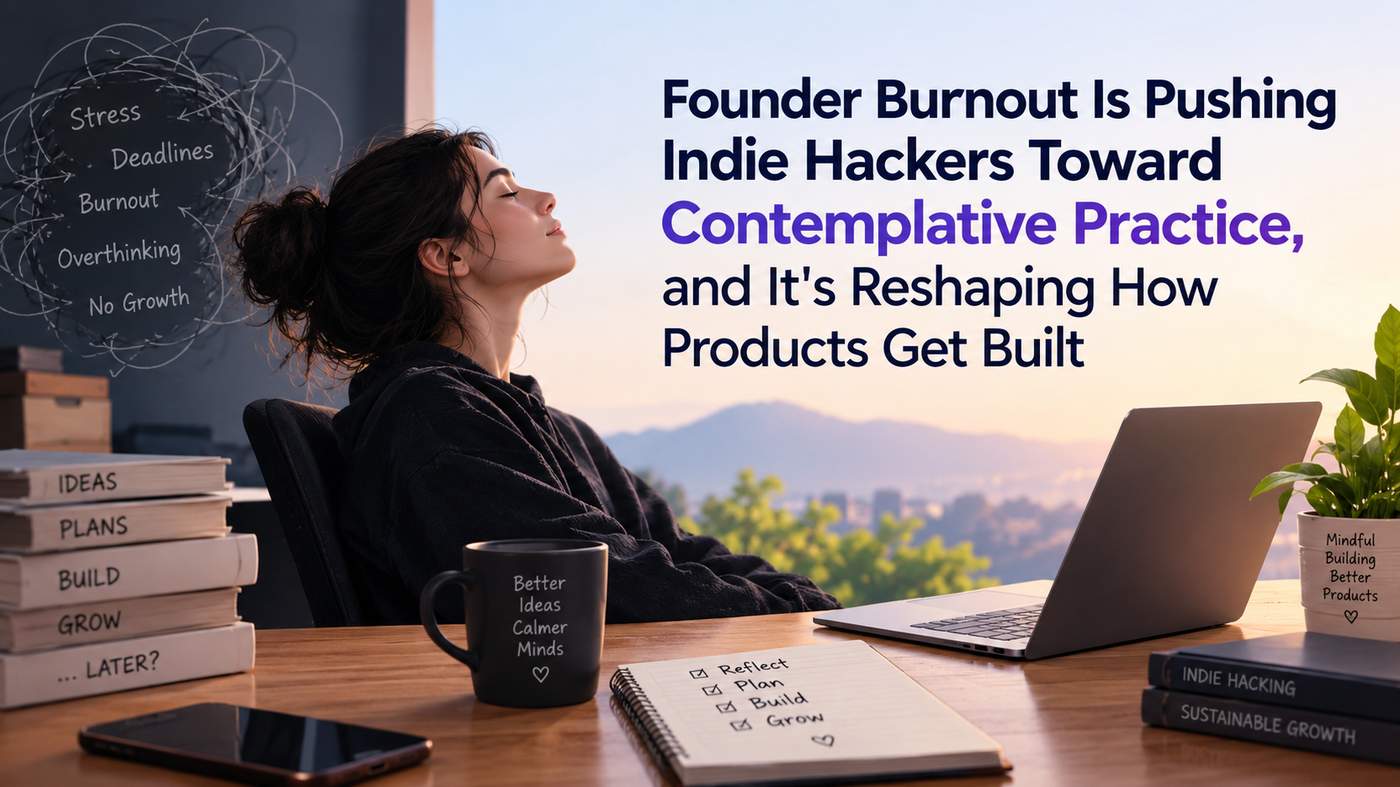
The real cost of burnout for a solo founder isn't a bad quarter. It's the six months of flat shipping after you stopped being able to think clearly, the churned users you didn't notice, the roadmap you rewrote three times because you couldn't hold a decision long enough to commit. It's the thing you built for four years, sold for a fraction of what it was worth, and told yourself you were fine with.
According to the World Health Organization, burnout is an occupational phenomenon with three specific dimensions: exhaustion, cynicism about the work, and a drop in professional effectiveness. Every indie hacker who has shipped past year two knows all three from the inside.
What's less obvious is why the fixes most founders reach for don't work, and why more are ending up in meditation halls, breathwork sessions, and plant-medicine retreats instead.
The Problem Is Bigger Than the Hustle Discourse Admits
Founder burnout is not a vibe. It shows up as a measurable pattern across almost every serious survey of the population.
The indie hacker context makes it worse. You don't have a co-founder to trade the psychological load with. You don't have a board that will notice you're eroding. Your revenue is real and the pressure is real, but the support structure is whatever you cobbled together for yourself between shipping cycles.
The Obvious Fixes Keep Missing the Point
The default founder response to burnout is to optimize around it. Better sleep tracker. Cold plunge. A stricter 6pm shutdown ritual. None of it is wrong, and most of it helps at the margins. But it frames burnout as a resource-management problem, which is where the intuitive fix falls short.
Burnout, as clinicians describe it, isn't a battery you refill. It's a signal from your nervous system that the relationship between you and the work has gone sideways. The American Medical Association's read on the WHO's classification is worth sitting with: the AMA argues that the real intervention is fixing the workplace, not fixing the worker.
For an indie hacker, you are the workplace. Productivity hacks alone can't do the job. You can't out-tool a structural problem with your own operating conditions.
Why Contemplative Practice Keeps Showing Up in Founder Circles
The shift over the past few years is how many indie hackers have moved from productivity tools to contemplative ones as triage rather than lifestyle. Meditation, breathwork, somatic therapy, silent retreats, and plant-medicine ceremonies inside recognized traditions have stopped being fringe among people running SaaS businesses on their own.
Part of the reason is that these practices target the layer productivity hacks can't reach. They work on the underlying relationship: with the work, with uncertainty, with the identity you've built around the product. Founders who do them consistently tend to describe a similar pattern. The workload doesn't shrink, but the grip loosens, and decisions come faster because fewer of them feel existential.
The other reason is that clinical research is finally catching up to what practitioners have said for a long time. A UCSF trial of a workplace digital mindfulness intervention showed meaningful improvements in global stress, job strain, burnout, and depression and anxiety symptoms immediately post-treatment. That's a modest, everyday intervention producing measurable change on the exact metrics that eat founders alive.
What Works Looks Less Like a Hack and More Like a Practice
Strip away the aesthetics and the founders getting durable results tend to do a few consistent things. None of them are complicated. All of them require the one thing indie hackers protect worst: repeated, unmonetized time.
A daily contemplative anchor.Twenty to forty minutes of sitting practice, breathwork, or something equivalent. The point isn't calm. It's building the muscle that notices when you're fused with a thought and gently unfusing, so you can look at churn data without spiraling.
Longer immersions once or twice a year.A silent retreat, an extended fast, or a guided ceremony inside a legitimate tradition. Founders who commit to something like a guided spiritual ayahuasca retreat tend to talk about the integration weeks afterward, the follow-up work with a facilitator, as where the actual change lands.
A real relationship with a practitioner.Therapist, teacher, coach with clinical training. Someone whose job is to notice what you can't see about yourself. This is where solo founders lose the most ground, and where the fewest of them invest.
Community that isn't your customers.A small group of people you can be honest with about the work without performing for them. Founders often think their peer group is this. It usually isn't, because everyone in the room is subtly recruiting everyone else.

