Founders: if you could permanently delete ONE repetitive task from your business, what would it be?
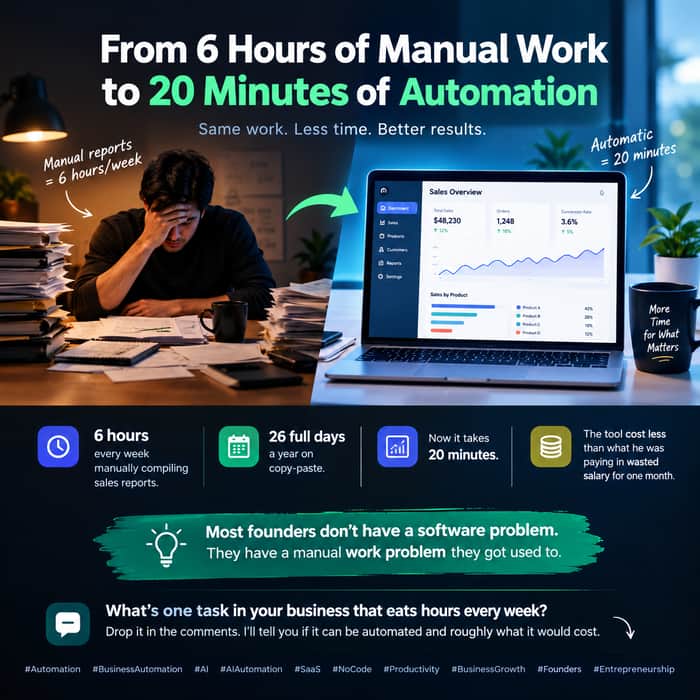
Context from my side (I'm a developer working with small businesses): the answers I get in real life are almost never what founders expect. They say 'email' or 'meetings' — but when I actually watch their week, it's usually things like:
- Re-entering the same data into multiple tools
- Manually building reports nobody reads
- Chasing payments
- Copy-pasting between systems that 'should just connect'
The gap between what founders THINK wastes their time vs what ACTUALLY wastes their time is where most automation money is spent wrong.
So I'm asking honestly — what's the task? And have you ever calculated how many hours/week it actually eats?
I'll reply to every answer with my honest take on whether it's automatable (and roughly what it would take). No pitch — I genuinely want to see if the pattern I see in my clients holds here too."

For me it's the quiet re-explain work.
Not "email" as a category — the specific job of taking a workflow that already works for one person and restating the stop conditions, blanks, and failure points so the next person doesn't invent a different job with the same prompt.
I timed it for a few weeks: about 3–5 hours a week when things are calm, more when something drifts. Founders usually budget time for the first version and almost none for keeping the instructions honest after the third handoff.
You can automate pieces of it (checklists, forced blanks, a re-run date). Deciding whether the output is still the same kind of work still needs a human. Curious if that matches what you see on the client side, or if chasing payments still eats more hours.
That’s a really good point. I think the hidden cost isn’t just creating the workflow, but keeping the logic consistent as more people use and hand it off. Checklists and required inputs can reduce a lot of the repetition, but knowing whether the output still matches the original intent is where human judgment matters. I’ve seen the same pattern with clients too — the manual work often hides in the handoffs rather than the obvious tasks.
Yeah — the handoff is where the job quietly changes shape.
What keeps biting me: after the second or third person uses the same instructions, someone fills a blank differently and the output still looks "fine," so nobody notices the work drifted until a week later.
Forced blanks and a re-run date catch some of it. The part I still can't automate is the five-minute check: is this still the same deliverable, or a cousin wearing the same label?
Curious whether your clients notice the drift themselves or only when something breaks downstream.