From 0 to 30,000 visits/mo in 6 months (3 steps)
SEO is hard and complex.
But sometimes we over-think it.
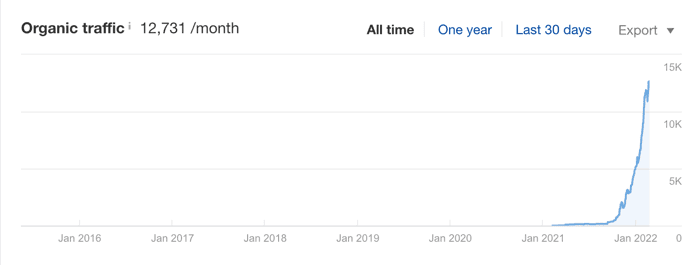
In this case study, I'll show you how we grew traffic on our client's website like this... 🤯

Specifically, I show you how we used keyword clustering to become a topical authority in the niche.
And, I'll also share how content written at scale and published at a fast velocity, can generate results like this.
From here...

to here...

in just 6 months.
A little context
This client is called PerkUp. They approached us in September 2021 to help them grow from near zero traffic to winning in the SERPs!
Challenge accepted.
We started work in mid September and as of February 2022, the site is now doing 30k monthly sessions.

How did we achieve this? 🧐
The truth is, there's been a lot of work to generate these results.
To simplify everything into a single strategy would disingenuous and misleading.
But if I had to distill the three most important components, they would be:
1. Keyword Clustering -> Topical Authority
We used a keyword clustering process that helped us formulate a topical authority content strategy.
Google rewards sites that create deep and insightful content that covers a topic in its entirety.
Look at any site that is dominating in a niche. I guarantee you they have 100s of articles that cover their niche.
For example, look at the accounting software company Freshbooks. They have over 292 articles on the topic of "invoices".

You can be pretty certain they've covered the invoicing topic, and indeed they are dominating. These articles alone generate over 146,000 monthly visitors for them.
For PerkUp, we used KeyClusters to generate 100s of article ideas across 6 main silos.
For example, one of the main silos for PerkUp is "Work Anniversaries". Running this keyword through Ahrefs and looking at the matching terms report, you can see there are 7,118 keywords related to Work Anniversaries.

Refining this list to remove low volume keywords (i.e. those with less than 20 searches a month), left about 700 keywords to analyse.
We uploaded this list to KeyClusters, and in 1 minute it grouped all these keywords into distinct clusters that require individual articles.
Below you can see the cluster analysis, each row represents one potential article for the silo "Work Anniversary".

We followed this process for 6 silos, and created a detailed content strategy
that prioritised 150 articles based on keyword volume, difficulty and relevance.

2. Bulk Content Creation -> Publishing Velocity
Once we had our strategy in place, we ran every article through Frase to calculate the word count.

This gave us a total required word count of 200k words for 150 articles.

Our team at Contentellect create 1+ million words of content a month, so we have the in-house systems for bulk content creation.
We then deployed our publishing system to drive fast indexation.

Drip feeding a few articles every month will take years to see results, especially if your site is new.
To illustrate, it can take 2-3 months for a new article on a newish website to index, and then another 6-12 months to rank.
If you publish just a handful of articles every month, you may take years to see results!
The faster you publish the quicker you'll rank.
This rings true for PerkUp. See how fast their pages start to rank due to our fast publishing efforts.

3. On-page SEO -> Silo'ed Interlinking
Publishing fast means removing all friction - i.e. no bureaucracy in article sign-off and no complex templates for articles.

We used a streamlined on-page SEO process that prioritised silo'ed interlinking. We focussed on the 80:20 of on-page SEO.
Specifically, the following:
- URL slug -> targeting primary keyword
- Header Title and Meta Title -> targeting primary keyword
- Headers (H2, H3) -> hierarchical and targeting keyword variations
- Images -> every 250-350 words with keyword variation alt tags
- External links -> to authoritative (non-competitive) sources
- Internal links -> to other articles in the same silo on exact or close match anchors
I can't stress enough the importance of internal linking within a silo. The idea here is to connect up your articles on anchor texts that signal to Google what each article is about.
Here's a snapshot from one PerkUp article. Notice the three internal links and relevant anchors.

Not only does internal linking help with indexation, but when you start scoring backlinks, these authority signals will flow throughout your site and help other pages rank.
So that's it in a nutshell!
Any questions, just ask in the comments. 🙋♂️

Impressive!
Thanks!
For those interested in the keyword clustering methodology see this video: https://youtu.be/ePmRbwp4Abk