From $1 to $1k MRR -- my journey
Timeline: 12 months (2019-2020)
For my first year, about 3 months of that timeline was part-time, so progress was minimal, and I also took several weeks off during the summer to enjoy life (and hedge against an early death, if you know what I mean). I had several road trips, staycations, and travelled large parts of the US with my girlfriend and family during that time, but I digress. 🤣
I remember being a bit ticked off getting customer support emails during that time, but eventually the churns caught up to me, and so I decided to get serious again.
What worked for me
I think the most important thing in my $1 to $1k MRR journey, as a solo founder, was to focus 80-90% of my time/effort on getting the product right, transforming a wonky MVP to a passable/good-enough product that can compete in the marketplace.
Here are some specific things I've done:
- I filled in feature gaps so that my product is state-of-the-art for my product category, using customer feedback as my guide -- I worked on the most-requested features first.
- I fixed every bug reported, even if I considered it edge-case (nothing is "edge-case" if a customer encountered it).
- I sped up the site as much as I could, rewriting/refactoring tons of my code to utilize more efficient database queries for instance, adding more RAM/processing power to my server, caching generously, enabling gzip, minification, etc. etc.
- I continually updated the UI/UX if I had a customer emailing me about something that was unintuitive or confusing.
All the while I was also facilitating my users to spread the word easier on my behalf, thus in essence outsourcing the bulk of my marketing.
I created a generous affiliate program, and I paid a fat 50% recurring monthly commission to incentivize my users, provided double-sided incentive (every referred user gets 60-day free trial right off the bat), and soon enough there were users who tweeted constantly, wrote blog reviews, created YouTube reviews, and even ran paid ads to drive traffic to my site.
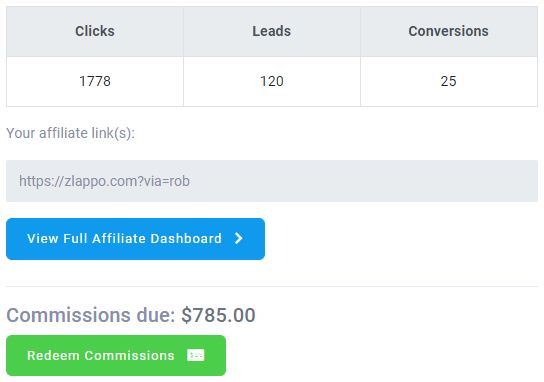
I assisted them by providing graphics, screenshots, copy, and also creating a simple affiliate dashboard where they can view their affiliate stats and redeem their commissions at any time using a one-click interface:
In the earlier stages, early adopter feedback should be more than enough to carry you to an MRR in the thousands, assuming your product is "good enough" and comparable to others in the marketplace with no glaring critical feature gaps.
All you need to do is to help them help you.
Some people think that 50% commissions are too high, but truthfully it's better to be at $1k MRR with 50% margins than to be at, say, $500 MRR with 100% margins (some people will debate this, but the former at least shows you've discovered a repeatable lever of growth where you can invest X dollars and get back 1.5X dollars, so theoretically you should be able to scale this up indefinitely).
Oh, I also ran an AppSumo Marketplace deal which accounts for 50% of my monthly revenue now. I can obviously sell lifetime deals on my own too (I do), but AppSumo legitimizes my nascent app, helps me garner 5-star reviews/testimonials, gets affiliates to link back to my site and thus drive traffic, and also they increase the visibility for my brand by running paid ads on my behalf. Absolutely worth it.
Ah yes, one last thing: email marketing turned out to be massively valuable. As my user base grew into the thousands, I now have thousands of email addresses to leverage on, to whom I can blast offers or update emails. I wrote a custom script to send emails to my user base who have trialed but not upgraded, or churned, and I periodically send out offers, discounts, product updates, etc. to get them to re-engage with my product. Mailgun is such a godsend for this. I'm still too cheap to use an email marketing software. 🤐
What I haven't tried
Between working on the product and other competing commitments in my life, I haven't been able to invest too much time and effort into these long-term marketing channels:
- Blogging/Content creation/SEO
- Tweeting/Audience-building/Building in public
- Paid ads/Sponsorships
- Cold outreach
- PR/Podcasts, etc.
I'm sure those channels work for many founders, it's just not part of my experience building Zlappo from $1 to $1k.
I hope someone finds this useful! 🚀

Great work man, definitely interested in how you continue to scale!
keep us updated!
Really cool. The affiliate idea is something that has piqued my interest too.
I've been doing a lot of thinking about what makes users more willing to open up their wallets, specifically with SaaS.
And the more I think about it, when they view the product as an asset, instead of a good, they're much more willing to spend on it.
An asset is something that appreciates in value over time (e.g. company shares, bonds, art, etc) vs a good, which generally depreciates in value over time. A lot of apps, especially in B2C I've noticed, seem to eventually hit a wall with the amount of value users get from it over time. They're considered a good instead of an asset.
A solid affiliate program combined with an already great product can elevate a product to asset status because it really engages your community. It gets them even more invested, and builds the community even further. A strong community that actively promotes the product is one of the biggest things IMO that gives it asset level status: see products like Airtable or Integromat.
Anyway, congrats on your success!
You're right.
Logically a customer must see that he's getting a positive ROI with your product to continue paying for it.
It can be in terms of how your product helps them to close more sales/make more money, save some money, or save some time, but for B2B it's quite clear-cut.
It doesn't even need to be real either, only perceived.
Good read. Thank you for sharing!
I am stealing the phrase, "hedge against an early death."
Thanks for sharing.
Great read, thanks for that.
How did you actually market your affiliate program? Were you using one of the affiliate platforms? Or direct outreach to potential affiliate partners?
Thanks for the info and congrats on the successful journey so far! The detail that appealed most to me was the 'affiliate program', definitely going to use this advice with future projects. All the best
what a journey. love it. thanks for sharing
This is well written. Congrats on your success so far! I will keep this advice in mind as I build out some ideas.
thanks for sharing - I think paid ads could help. I had a good experience with Quora so far. Let me know how it goes!
Love the write up! Thanks for sharing. I think you captured marketing channels better than anyone I’ve ever read.
Keep it up!
Well written, very nice read. Great experience to share. Thank you!
I have a question. The site says Zlappo is trusted by 2000 users but your MRR is $1000, is that because you have lots of free users?
Also why haven't you used paid ads? Now that you have some traction, do you think it is a good idea to use them?
Zlappo is past $1k MRR now.
I'm recounting my experience in the early days of Zlappo from 2019-2020, responding to this post:
https://www.indiehackers.com/post/how-long-did-it-take-you-to-go-from-1-mrr-to-1000-mrr-569e25d85a
I currently have 300+ subscription/MRR customers.
If I include lifetime customers, it's well over 1k paying customers.
nice, interesting story, I do have the main question ... how exactly have you acquired the first paying users? the LTD on Appsumo was your first/only acquisition channel so far?
First 10+ paying customers were from Twitter DMs.
Wrote about it here:
https://zlappo.com/blog/4-powerful-ways-grow-and-market-your-saas-business-using-twitter-examples-given/
how do you create blog inside you domain (app) like that, want to create blog like that too? it is wordpress?
WordPress is PHP-based.
I use Wagtail, which is Python-based.
so it's CMS under the hood. thank you for sharing simplisticallysimple
niiiice, I love the walk-the-talk-SaaS-growth stories :-)
I was about to post a similar question! +1
Love the review! A debt of gratitude is in order for sharing. I think you caught showcasing channels better compared to anybody I've at any point perused Physik Nachhilfe Online.
This comment has been voted down. Click to show.