From a Side Project to a Community: How the I Ching gave me Confidence as an Indie Developer
Hi everyone,
I am an indie developer. Like many of you, I love building small tools.
A few months ago, I started a new side project. It was a simple website called Cast I Ching.
My goal was small: I wanted to use modern tech (Next.js) to recreate the ancient "Yarrow Stalk" divination method.
I saw that many existing I Ching sites were very old, slow, or full of ads. I wanted to make something clean and respectful.
At that time, I thought this was just about coding.
I was wrong. It became a journey about connection.
- The Discovery
To build a good tool, I needed good content. I started reading deep into the I Ching community.
That is when I found Bradford Hatcher.
He was a scholar who spent decades translating the I Ching. What shocked me was his spirit: he released his life's work for free (Creative Commons license). He wanted everyone to have access to it.
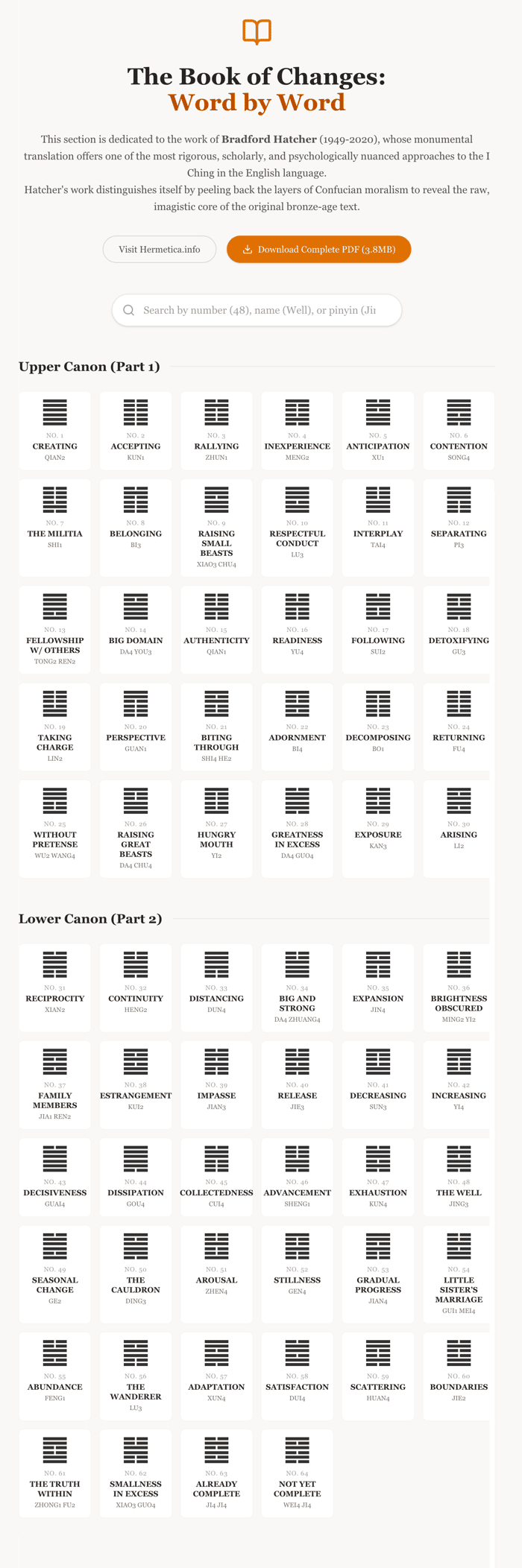
But there was a problem. His work was locked inside massive PDF files. It was very hard to read on a mobile phone or to search for specific lines.
This was my "Aha Moment."
As a developer, I knew I could fix this.
I decided to digitize his work. My rule was strict: "Structure, not Interpretation." I would not change his words; I would just make them accessible.
- Stepping Out of the Cave
This was the scary part for me.
Usually, I just write code. I don't like to talk to people. I am an introvert.
But I needed to respect the legacy. I needed to make sure the "Buy Book" links went to the right place.
So, I gathered my courage and emailed Luis, the person who manages Bradford’s estate.
I was afraid he would ignore me or say "no."
Instead, he replied. He was incredibly kind. He loved the design. We exchanged emails about the project, about shipping costs to Europe, and even about different divination algorithms (the Nanjing Method).
I realized I was no longer just "coding alone." I was connecting with a real person.
- The Community Feedback
With this new confidence, I shared my project on Reddit and the OnlineClarity forum.
I did not try to "sell" anything. I just told my story: "I found this great book, but the PDF was hard to use, so I built a website for it."
The response was amazing.
People thanked me for preserving the work.
Strangers offered to help me find typos (OCR errors).
Serious students shared their feedback on the layout.
- The Real Reward
As indie hackers, we often look at numbers: MRR (Revenue), Daily Active Users, or Clicks.
But this project taught me that the best reward is Confidence.
- Confidence that comes from building something useful.
- Confidence that comes from connecting with a legacy.
- Confidence that comes from real human feedback.
I started with a small script for Yarrow Stalks. I ended up as a part of a passionate community.
If you are a solo developer working on a niche tool, don't be afraid to reach out. Don't be afraid to email the author. Don't be afraid to share your work.
Code is just a tool. The real magic happens when it connects people.
Thanks for reading.
Please check my work here: Browse Hatcher's Translation

This really resonated with me. What started as a “small tool” turned into preserving and making accessible someone’s life’s work. The part about reaching out to the author’s estate hit hard, most of us stay in our code cave and forget there are real people behind the work.
Also love the idea of “structure, not interpretation.” That mindset is underrated. Great reminder that the real payoff in indie hacking is not always MRR, but confidence, trust, and community.
Thanks comment.
I used to chase quick wins, only to find that you can't cheat the process. Zero value means zero returns.
Now I realized that even helping a small group of users is a form of success. Financial return is just a byproduct of helping others solve problems.
It all comes down to one question: Is this creating genuine value?
This was beautiful to read.
What stood out to me is how the project stopped being about shipping code and started being about stewardship, preserving something with care rather than “optimizing” it.
It’s a good reminder that sometimes the confidence we’re looking for doesn’t come from traction, but from knowing we did right by the work and the people behind it.
You completely nailed it with the word "Stewardship."
To be honest, I started this journey with a typical developer mindset—looking for "keywords," "SEO gaps," and "traffic." I was trying to optimize a product.
But as I dug deeper into Hatcher's work, the goal shifted. I realized that if I could build a bridge between this profound content and the real people who need it, that value would be far greater than any SEO trick.
As you said, the confidence that comes from "doing right by the work" feels much more solid than just watching a traffic chart go up.
Thank you for this beautiful reflection!
That shift you described is rare, and I think people can feel it immediately when they land on the project.
Optimization usually asks, “How do I extract more value from this?”
Stewardship asks, “How do I not damage what already has value?”
When builders make that transition, the work tends to outlive metrics. It earns trust quietly.
Really glad you shared the story it’s the kind of reminder a lot of us need more often.
The hardest thing about B2B is that you're often selling to someone who didn't budget for your category. They need the result you provide but never planned to pay for it.
The products that win here usually create a new budget line (by being categorically new) or steal from existing budget by making the ROI comparison obvious. Which of those are you trying to do?