From AI Detection Problems to SaaS Solution: The Story Behind UndetectedGPT
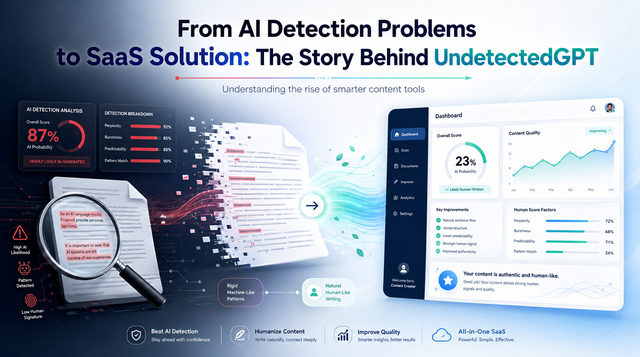
Generative writing tools changed how people draft articles, emails, reports, landing pages, and learning material. They created uncertainty. A piece of writing may be clear, useful, and carefully edited, yet still be questioned because an automated detector gives it a suspicious score.
That tension is the starting point for the story behind UndetectedGPT. It grew from a practical problem faced by writers, students, agencies, publishers, and business owners who needed better ways to understand how their content might be judged by readers and software.
The Problem That Created the Demand
AI detection tools became popular because organizations wanted a quick answer to a difficult question: was this text written by a person, a machine, or both? On the surface, the process seemed simple. Paste in text, scan it, and review the score.
In practice, the results were often confusing. A detector might flag a polished human essay because it is too clean. It might miss machine-written text after light editing. It might struggle with technical, legal, academic, or formal writing because those styles naturally use predictable sentence patterns.
This created pressure for honest writers. Freelancers worried about losing clients. Students feared unfair accusations. Brands questioned whether supported drafts would harm credibility. The problem was not detection itself. The problem was overconfidence in detection. Many people treated probability as proof, and that opened the door for better tools and better education.
How AI Detectors Read Writing
To understand why UndetectedGPT became relevant, it helps to know how detection systems usually work. Most detectors study patterns in language. They may look at predictability, repetition, sentence rhythm, vocabulary range, transitions, and the smoothness of a passage.
A detector may ask whether the text sounds too uniform, whether sentence lengths vary enough, whether ideas develop with specific detail, and whether the wording resembles common machine-generated output.
That is why the phrase UndetectedGPT, how AI detectors work, belongs naturally in this discussion. The value is not just in naming a tool. It is in understanding the system that created the need for that tool.
Good writing is not simply writing that avoids a bad score. Good writing has intention. It includes context, examples, judgment, and a clear reason for every section.
Why Scores Can Be Unfair
A detection score is not a final verdict. It is an estimate produced by a model. That estimate can be influenced by topic, length, writing style, and the detector’s own training data.
Short passages can be unreliable because there is not enough language to analyze. Formal writing may appear suspicious because it avoids slang and emotional phrasing. Non-native English writers may use clean structures that look patterned. Heavily edited work may lose the natural texture that once made it feel personal.
For businesses, the issue became practical. A team could not pause every campaign because a detector produced a confusing result. They needed a smarter workflow that reviewed content for quality, originality, clarity, and natural flow.
The SaaS Opportunity Behind the Friction
Every useful software product begins with friction. In this case, the friction was simple: people wanted confidence before sharing their writing. They wanted to know whether a draft sounded natural, carried enough originality, and might raise questions during automated review.
UndetectedGPT stepped into that gap as a SaaS solution shaped by a specific market need. Its broader appeal comes from helping users think beyond the scan. Instead of treating detection as the whole problem, the platform points toward stronger writing.
A valuable writing tool should help improve:
• Clarity of ideas
• Sentence flow
• Specific examples
• Tone consistency
• Natural phrasing
• Reader engagement
Those improvements matter because content is judged by humans first. A visitor, editor, teacher, or client cares whether the page makes sense, answers the question, and feels worth reading.
From Rewriting Tool to Writing Support System
The simplest tools in this category focus on rewriting. A user pastes text, clicks a button, and receives a new version. That can be useful, but it is not enough for long-term trust.
A stronger platform helps users understand why a draft feels weak. Maybe the introduction is too generic. Maybe the paragraphs repeat the same point. Maybe the tone shifts without reason. Maybe the content lacks examples that prove experience.
This is where UndetectedGPT can be seen as part of a broader movement in writing technology. The best tools are moving from output to guidance. They do not just replace words. They help shape stronger communication.
For example, a weak sentence might say, “AI tools are changing content.” A stronger version explains who is affected, what changed, and why the reader should care.
Building Trust in a Crowded Market
The writing software space is crowded. New products appear constantly, each promising faster drafts, cleaner wording, or smarter editing. For UndetectedGPT, the challenge is not only to offer useful features. It is to communicate a responsible promise.
Users need to know what the tool does, what it improves, and what it should not replace. It should not replace original thinking, fact-checking, or the writer’s responsibility to follow rules and disclosure requirements.
Trust grows when a platform explains its role clearly. The strongest message is not “hide everything.” The stronger message is “make your writing clearer, more original, and more natural.”
That distinction matters for agencies and brands. They do not need empty content that slips through a scanner.
Ethical Use Should Stay at the Center
Any discussion about AI detection must include ethics. Tools should not be used to misrepresent authorship, avoid academic rules, or hide work where disclosure is required.
The better use case is improvement. A business owner may refine a product description. A creator may make a draft sound less generic. A student may use feedback to understand why wording feels repetitive, while still doing the real thinking. A freelancer may review a client article before delivery.
The difference is intent. Responsible users are not trying to replace honesty. They are trying to improve communication. Readers reward content that feels useful and specific. Editors reward work that shows care. Brands win when their material sounds knowledgeable rather than mechanical.
What Users Really Want
Most users are not interested in detection algorithms for their own sake. They care about outcomes. They want a draft approved. They want readers to stay. They want a manager, client, or reviewer to focus on the message instead of questioning the process.
That means a successful SaaS product must solve emotional problems as well as technical ones. Users want confidence before publishing, clear feedback, faster revision, natural but professional tone, and better control over structure.
The Product Story Behind UndetectedGPT
The story behind UndetectedGPT is really the story of a market adapting to a new reality. At first, AI writing and AI detection seemed like opposing forces. One created text, the other judged it. Over time, users realized the real challenge was not beating a detector. It was creating better communication in a world where trust is harder to earn.
A useful SaaS platform reduces uncertainty. It gives users a way to review text before someone else does. It helps them notice weak patterns, improve readability, and make the message sound more intentional.
The Next Chapter for Smarter Writing
The future of content will not belong to the people who publish the fastest. It will belong to those who communicate with clarity, usefulness, and credibility.
Tools like UndetectedGPT will need to keep evolving from simple rewriting utilities into thoughtful writing assistants that educate users while improving drafts.
That is the real story behind UndetectedGPT. It began with AI detection problems, but its lasting value depends on something bigger: helping people write with confidence, originality, and purpose.
