"From Electrical Tech to Solo Founder: How I'm building a disaster management SaaS in an underserved niche"
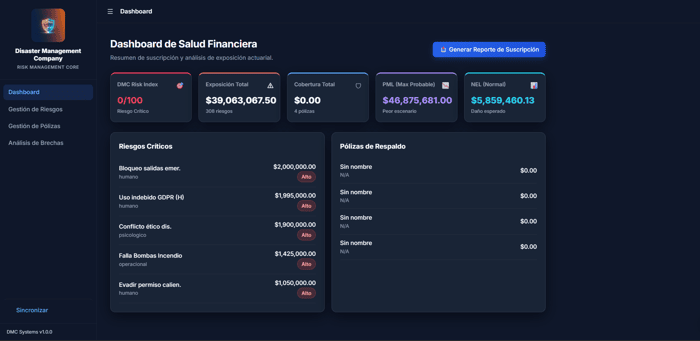
I wanted to share my journey of building a SaaS in a niche that most developers completely overlook: Disaster Management and Industrial Risk Assessment.
For years, I’ve worked as an electrical technician. I love hands-on technical work, but over time, I noticed a huge, recurring problem in the industry: most companies manage their risk assessments, safety compliance, and disaster protocols using outdated tools—mostly messy Excel sheets, paper forms, or fragmented software that doesn’t follow international standards.
Coming from a background in Disaster Management myself, I knew there had to be a better way. So, I decided to build it.
🚀 The Product: Disaster Management Company (DMC)
I built Disaster Management Company to automate risk management and ensure compliance with international regulations like ISO 31000, ISO 27001, and NFPA frameworks.
The goal is simple: allow organizations to predict, manage, and mitigate risks in a structured, modern web platform.
🛠️ The Tech Stack (As a Solo Founder)
Since I’m building this entirely on my own while working my day job, I needed a stack that allowed me to move fast without losing scalability. I went with:
Backend: Python & Flask (reliable, clean, and perfect for handling complex risk calculation logic).
Database & Auth: Firebase (allowed me to set up secure user authentication and real-time data handling quickly).
Frontend & Hosting: Clean web architecture deployed on Firebase/Netlify to keep loading speeds fast and server costs at zero while validating.
📉 The Challenge of an "Invisible" Niche
The hardest part isn’t the code—it’s marketing to a highly specific B2B audience. Disaster management isn’t a trendy AI wrapper or a social media scheduler. It’s boring corporate safety, but it's a critical infrastructure requirement for thousands of companies worldwide.
Right now, I am focusing on refining the user experience and getting the platform in front of risk professionals and safety managers.
💬 I'd Love Your Feedback!
As a solo founder wearing all the hats (coding, UI/UX, database architecture, and marketing), I would appreciate the community’s eye on a few things:
Landing Page & Positioning: Does the value proposition on the landing page click immediately?
B2B Outreach: If you have experience selling software to traditional industries (like industrial safety, construction, or corporate compliance), what strategies worked best for you early on?
Check out the platform here: disastermanagermentcompany.com
Thanks for reading! I’m happy to answer any questions about the stack, the regulatory frameworks, or what it's like building this from scratch.

Impressive work. Well done.
Hello, greetings, thank you very much.
The founder-market fit here is real — you lived the problem (electrical tech + disaster management background), and the niche genuinely is underserved. Messy Excel + paper + fragmented tools for ISO/NFPA compliance is a real gap. That's the strong part.
Two things working against you though.
The name and domain. "Disaster Management Company" sounds like a services firm that responds to disasters, not a SaaS for risk assessment. And the domain has a typo — "disastermanagermentcompany." For a B2B compliance buyer, who is risk-averse by definition, a typo'd URL on risk-management software is an instant credibility hit. They won't trust risk software that can't spell its own address. Fix that before any outreach.
On B2B outreach — traditional industrial/safety buyers don't buy from landing pages or build-in-public. They buy through compliance consultants who recommend tools, safety conferences (ASSP, NFPA events), referrals from other safety managers, and the auditors who check their ISO compliance. The motion is relationship and credential-driven, not product-led. Get in front of safety managers through their existing trusted channels, not IH or Twitter.
And go narrower. "Disaster management" is too broad to win against Intelex, Cority, VelocityEHS. The wedge is your exact background — "ISO 31000 risk assessment for mid-size electrical contractors" beats "disaster management for everyone." Own the niche you actually came from, then expand.
Hello, greetings, thank you very much. This is a project I'm starting and I'd like to receive more feedback, comments from people with much more experience in marketing. You're right about the domain name.
Since you asked for more — three concrete things to do this week before any more building.
Get on the phone with 5 actual safety managers before refining the product more. Not email, not survey — actual conversations. Find them on LinkedIn (search "Safety Manager" at electrical contractor companies), DM 30, get 5 on calls. Ask how they currently track ISO compliance, what tools they tried and abandoned, what their auditor specifically checks. Real customer research, not abstract.
Pick ONE certification standard as the wedge. ISO 31000, ISO 27001, NFPA — you listed all three, but compliance buyers care about the ONE specific standard their auditor checks. "Software for ISO 31000 risk assessments" is sellable. "Software for disaster management" is not. Pick the one closest to your electrical contractor background and lead with it everywhere. Other standards become "we also support" later.
Find the auditor referral channel. Auditors who certify ISO 31000 recommend tools to the companies they audit. Find 10 ISO 31000 lead auditors on LinkedIn, send each a free trial with no obligation, ask them to review and give feedback. Auditors are the gatekeepers in this niche — they control which tools become "the standard" within an industry. Get one auditor to recommend you and your pipeline opens.
For pressure-testing the positioning and outreach messaging itself, we build HiveMind (myosin.xyz/hivemind, code HivemindIH123) — AI strategy copilot trained on operator frameworks rather than generic prompts. Useful for "is my positioning right for ISO 31000 buyers" or "is this outreach DM going to land with safety managers" type questions. It won't replace the real safety-manager phone calls — those are essential and irreplaceable — but for the messaging and positioning layer specifically it's the right kind of pressure-test.