From Idea Graveyard to Data-Driven Validation
Hey fellow Indie Hackers,
I've been in the indie game for a while, and if I had a dollar for every time I spent months building something nobody wanted... well, let's just say I'd have more runway.
You know the cycle:
-
Get excited about an idea
-
Build it in isolation
-
Launch to crickets
-
Repeat
After my third "build it and they will come" failure, I decided to flip the script. Instead of starting with solutions, I started looking for quantified problems. (Take note of that)
The StackExchange Goldmine!
Here's what most people miss: StackExchange has 180+ communities with millions of unanswered questions. That's not just noise - that's a map of exact problems people are having right now.
But who has time to read through 3 million questions? Not me. So I built AI agents that do it instead. (Hold on, I am not selling you anything, the project is going opensource, completely free and you could deploy it yourself)
My Current Validation Stack:
Problem Frequency Scoring - How often does this specific issue appear?
Solution Gap Analysis - Are existing answers outdated or incomplete?
Monetization Signals - Are people already paying for subpar solutions?
Technical Feasibility Check - Can one person realistically build this?
Inteterest Signals - How many people viewed and upvoted the problem?
The surprising insight? The best opportunities are often the most boring. Think: database migration tools, specific API wrappers, niche dashboard templates.
From Data to MVP
Here's my current process:
Pull top 10 validated problems from the AI analysis
Build a single-page MVP for the top 3 (just landing pages)
Run micro-campaigns to each audience
Build the one with highest interest-to-effort ratio
It's not perfect, but it's better than guessing. Last month this method helped me identify a Docker monitoring tool that's now at $289 MRR.
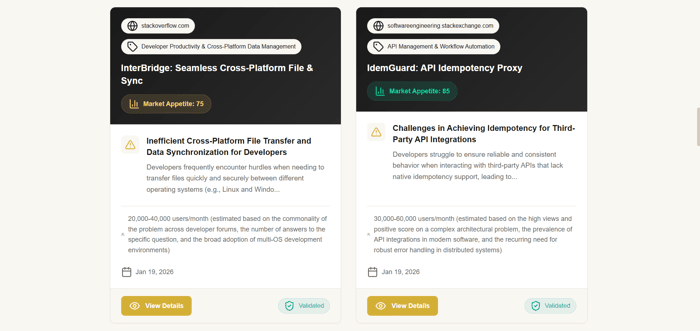
Here’s What a Validated Opportunity Looks Like in the Dashboard
Each idea is broken down with a consistent, data-driven framework. For example, our system recently analyzed discussions around a specific Google development framework and surfaced this:
Pain Point Analysis
Developers are facing critical instability with a key Google framework, encountering frequent model loading failures and sudden application crashes that halt their work and waste hours.
Product Solution
A micro-SaaS stability monitor that provides real-time diagnostics, proactive alerts, and guided fixes specifically for that framework's common failure points.
Suggested Features
Real-time service status dashboard
Intelligent error diagnostics for crashes and load failures
Proactive alerts for stability risks
Automated script suggestions for common recoveries
IDE plugin for in-context troubleshooting
Complete AI Analysis
Problem Description: The analysis drills into specific error threads—like "Agent terminated due to error" causing login failures—to map the exact workflow blocks and frustration points developers describe.
Target Audience: Software engineers, DevOps specialists, and development leads in teams that rely on this framework for building applications.
Current Solutions (and their Gaps): It identifies that developers currently rely on restarting apps, scanning cryptic logs, or searching forums. The gap is the lack of a dedicated, actionable tool that consolidates diagnostics and solutions.
Market Opportunity: The rationale is validated by metrics from source discussions: high Stack Overflow scores (117) and thousands of views on related questions signal an active, sizable audience seeking solutions right now.
SEO-Friendly Keywords: The engine compiles a targeted list like "framework stability tool," "model loading errors fix," and "developer productivity SaaS" to guide content and marketing.
This is the template for every opportunity. The dashboard applies this same analytical lens to dozens of niches, turning scattered complaints into structured, actionable product briefs.
See the live dashboard and today's top opportunities: https://roipad.com/product_trends/trends/ideation.php
The goal is to give you a quantified starting point, so you spend your time building what already has proven demand.

This is solid especially the emphasis on boring, frequent problems.
One thing I’ve noticed when mining StackOverflow/SE is that frequency alone can be misleading unless paired with who feels the pain most acutely. A problem asked 50 times by solo devs behaves very differently from one asked 10 times by teams under deadline pressure.
Curious if your stack weights questions by role/seniority or context (prod vs side project). That layer has helped me filter “interesting” problems from “people will pay to make this go away” problems.
I am inviting you to join the indiehackers group where we intend to discuss things like this. We still need a few more members to go live. https://www.indiehackers.com/group/saas-onboarding-workflows
Appreciate the invite, sounds like exactly the kind of discussion I enjoy.
Happy to join and contribute where I can.
Looking forward to it 👍
That's a very interesting take on this, the way I approached this is to give more weights to questions asked by users with high reputations, then only mine those questions with lots of upvotes and views. We also filter questions based on urgency and 'pain intencity' (we you a sort of sentiment agent to determine this.) all these makes it possible to extract only the most valuable data most of the times. Once I have shipped the whole code to a github repo, I will make another post about it, this way, perhaps developers can even help make it smarter, add more data sources and solve SaaS validation problem once and for all #winks
That makes a lot of sense, high-rep + upvotes/views is a solid proxy for “this problem actually matters,” and layering sentiment/urgency on top is smart.
One interesting edge case I’ve seen is when high-rep answers sometimes solve the problem too well which can mask downstream willingness to pay. Pairing that with signals like “team context,” “prod incident,” or deadline pressure might surface a different class of problems altogether.
Love the idea of open-sourcing it and curious to see what patterns emerge once more data sources get pulled in. Looking forward to that post.
That’s a thoughtful stack already weighting by rep + upvotes + urgency is a solid way to avoid noise, and the sentiment layer is especially smart.
One nuance I’d add (and this is where things usually get interesting):
reputation and upvotes often correlate with correctness, not cost of failure.
High-rep users are great at surfacing cleanly articulated problems, but the problems teams will actually pay to remove are often:
under-upvoted (because they’re specific or unglamorous)
posted by mid-level devs under delivery pressure
framed as “why is prod on fire” rather than “what’s the elegant solution”
A lightweight way to capture that without overcomplicating things:
Look for language markers of external pressure (“deadline”, “client”, “prod”, “on-call”, “blocked deploy”)
Weight threads where the asker stops replying once a workaround is found (signal of “good enough, ship it”)
Cross-reference tags that skew toward operational pain (infra, CI, auth, migrations, payments)
Those tend to map closer to “someone will pay to make this disappear” than pure intellectual difficulty.
Also love the idea of open-sourcing it and if you frame it as “help us separate interesting problems from expensive problems”, you’ll attract exactly the right contributors.
If you ever want to sanity-check a few extracted problem clusters from a buyer’s POV, happy to look this is a genuinely interesting direction.
"Idea Graveyard", man, that phrase hits home. I’ve spent 15 years mentoring founders and I’ve seen more 'Frankenstein' startups die in that graveyard than I care to count.
Your approach to mining StackExchange for "Solution Gaps" is pure gold. It’s exactly how you avoid the Circle of Lust (falling in love with your own solution instead of the user's pain).
I actually codified this whole 'descent into chaos' into 9 circles in my ebook, Startup Inferno. What you're building here is essentially the 'Escape Map' for Circle 1 (Limbo) and Circle 6 (Heresy/Bad Unit Economics).
One thing I'd add from my experience: even with great data, founders often fail because they lack a Clean Structure to execute on those insights. They get the data right, but the execution becomes a mess.
Would love to see how your AI agents weight "structural complexity" in those problems. Some problems are expensive to solve because the solution itself is a maintenance nightmare.
Keep it up, Angel! I'm definitely joining the group to see that GitHub repo when it drops.
"Idea Graveyard", I felt that in my soul. I used to waste 6 months per idea before learning to validate first.
What data points are you tracking? I built an web specifically to check ideas against real market data, competition density, search trends, monetization paths, then give a GO/ITERATE/KILL verdict in 3 minutes.
Saved me from building 3 bad ideas last year. Happy to validate your current idea with it if you want a second opinion on the data?
Free, just need 3 mins.
I am inviting you to join the indiehackers group where we intend to discuss things like this. We still need a few more members to go live. https://www.indiehackers.com/group/saas-onboarding-workflows
Here is my reply to a similar question; "The way I approached this is to give more weights to questions asked by users with high reputations, then only mine those questions with lots of upvotes and views. We also filter questions based on urgency and 'pain intencity' (we use a sort of sentiment agent to determine this.) all these makes it possible to extract only the most valuable data most of the times. Once I have shipped the whole code to a github repo, I will make another post about it, this way, perhaps developers can even help make it smarter, add more data sources and solve SaaS validation problem once and for all #winks"
This is smart methodology weighting by reputation + urgency + pain intensity.
We're solving the same problem (validation) but different approaches:
I'd love to join your SaaS onboarding group. Also happy to trade beta access. I could validate your onboarding idea with FounderOS, you could test my market validation approach.
DM me on Twitter @FoundersOS and let's compare notes. It's always good to meet another founder trying to kill bad ideas before they get built. 😅
Thank you, I will check out FounderOS and reach out to you