From laser physics to indie Mac dev: I built a meeting recorder that never touches a server
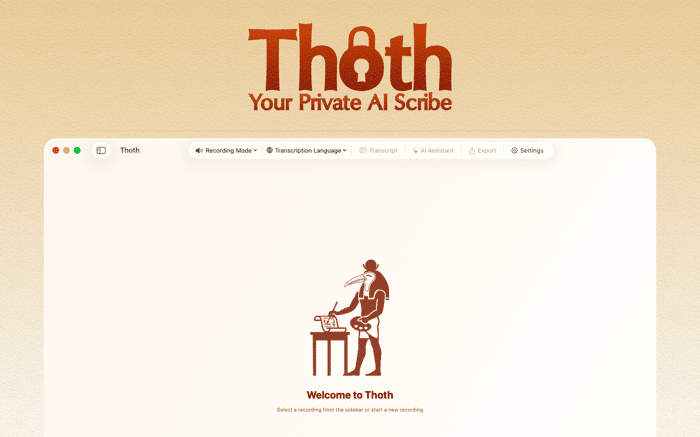
My day job is laser physicist. I work on high-power optical systems, coherent beam combining, femtosecond lasers. Software has always been part of it (instrumentation, data pipelines) but as a means to an end, not the product itself.
Late 2024 I needed to transcribe meetings. Every app I tried had the same architecture: your audio goes to a server, gets processed, comes back as text. Otter, Fireflies, Granola. All of them. For some of my conversations that wasn't acceptable.
I knew on-device transcription was possible. WhisperKit had just matured on Apple Silicon. So I spent evenings and weekends building what I wanted: a native macOS app that records both sides of any meeting and transcribes everything locally. No server. No account. No network calls for core functionality.
Thoth launched on the Mac App Store six months later. First paying subscribers came in organically. One article in MacGeneration (main French Apple press) drove a 700% download spike in 24 hours.
The technical part was straightforward compared to distribution. As a physicist-turned-dev with no audience, getting anyone to notice the app is a different kind of problem. One I'm still solving.
If you're navigating the same thing, quality product and zero distribution, I'd like to hear how you're approaching it.
thoth-app.com

laser physicist to indie mac dev is a wild pivot tbh, i love it. the never-touches-a-server angle is smart, privacy is the one thing people genuinely care about with meeting recorders. did the physics background change how you approached the build, or is it a totally separate brain?
Thanks :-)
On the physics background, not really, but it came quite handy when optimizing audio capture, audio waves and light waves share the same post processing.
the on-device privacy thing is the whole moat for a meeting recorder, lean on it hard, it's the one piece the big players cant copy without rebuilding their stack. random ask since you obviously think about trust and architecture, i'm building a thing for founders raising from their first users (trust is the whole game there too) and would love a sharp builder's eye groundwork. did the physics background push you toward over-engineering the audio, or the opposite?
Really impressive transition from laser physics into indie product development. I especially liked the privacy-first approach of keeping recordings fully local instead of relying on external servers, because data privacy and trust are becoming much bigger concerns for users today.
The combination of technical depth and clear product thinking here is very inspiring. It’s also interesting how lightweight, focused tools often solve real workflow problems better than overly complex platforms.
Curious to know what the biggest challenge was while balancing local processing performance with a smooth user experience on macOS.
Thanks for the comment !
The biggest challenge was Core Audio. Capturing system audio and mic simultaneously on two separate tracks, without a virtual driver, took months to get right. Everything else was straightforward by comparison. Local models do strain processing, but Thoth monitors memory pressure and warns users before things get out of hand.
I actually did some benchmarks on the blog:
https://thoth-app.com/blog/2026-05-13-local-vs-cloud-ai-summaries/
https://thoth-app.com/blog/2026-05-10-how-we-benchmark-transcription/
This is a strong product because the privacy promise is not cosmetic. “Never touches a server” is the whole wedge. For meeting recorders, that matters immediately because the category is full of tools asking users to upload sensitive calls, team discussions, client conversations, and internal decisions into someone else’s cloud.
The distribution angle should probably lean harder into that trust contrast: not “another meeting recorder,” but “local-first meeting memory for people who cannot send audio to a server.” That gives you a sharper buyer profile too: consultants, founders, lawyers, researchers, doctors, operators, and anyone recording sensitive conversations.
The naming is the part I’d watch carefully. Thoth is meaningful, but it may not instantly communicate privacy, local-first, or serious professional trust. If this becomes a broader private meeting intelligence product, Vroth .com would carry a harder, more secure, infrastructure-grade feel than a mythological name most users may need explained.
The trust contrast point is well taken. I've been saying 'private AI scribe' but 'local-first meeting memory' is sharper for the consultants/lawyers/researchers segment. I'll test it.
I did go deep on this angle recently: use cases, comparisons with cloud tools, and since day one the website has proof, a video with Wi-Fi off showing the full record, transcribe, summarize workflow.
https://thoth-app.com/blog/2026-05-13-why-your-meeting-recorder-shouldnt-upload-your-audio/
https://thoth-app.com/alternatives/
https://thoth-app.com/use-cases/
On the name: Thoth is the Egyptian god of writing and knowledge. Seemed a natural fit for an AI note taker. Nike stuck and they never had to explain it's the goddess of victory ;)
That is a fair distinction, and I would not dismiss Thoth. It has a real meaning behind it, and for an AI note-taking product, writing/knowledge does fit.
The question I would test is narrower:
Does Thoth create enough trust before the mythology is explained?
For the privacy-first segment you are aiming at, the first impression matters a lot because the buyer is already sensitive about audio, meetings, and where data goes. So the name test is not just memorability. It is whether consultants, lawyers, researchers, doctors, and operators instantly feel “private professional tool” or need extra context first.
If useful, I can do a focused naming/positioning audit on this: Thoth’s first-perception risk, the local-first trust frame, whether the current domain/name can hold the higher-trust segment, and what direction would make the product feel more secure without losing the meeting-memory angle.
Not a long consulting thing. Just a sharp written breakdown you can use before more SEO pages, use cases, docs, and customer memory build around the current name.
I’m doing a few of these at $99 while refining the format. If useful, connect here and I can put together a clear outside read:
https://www.linkedin.com/in/aryan-y-0163b0278/
That makes sense, and Thoth is not a random name. The writing and knowledge reference does fit an AI note-taking product.
The only distinction I’d pressure-test is meaning versus first impression.
Nike works because the product did not need the name to carry trust, privacy, or data-sensitivity on day one. In your category, the first question a serious buyer asks is not “does this understand my meeting?” It is “where does my audio go?”
That is why I’d keep testing the name against the higher-trust segment you mentioned: consultants, lawyers, researchers, doctors, operators. If Thoth feels memorable and credible to them without explanation, keep it. If they need the mythology explained before the product feels serious, the name may be adding friction.
Vroth.com is the opposite direction: less poetic, more secure and infrastructure-grade. Not better for every version of the product, but stronger if the long-term position is private meeting intelligence rather than AI note-taking.
I’d test both frames before more SEO, docs, use cases, and customer memory build around the current name.