From SEO to GEO: A technical guide to getting your startup cited by ChatGPT and Perplexity
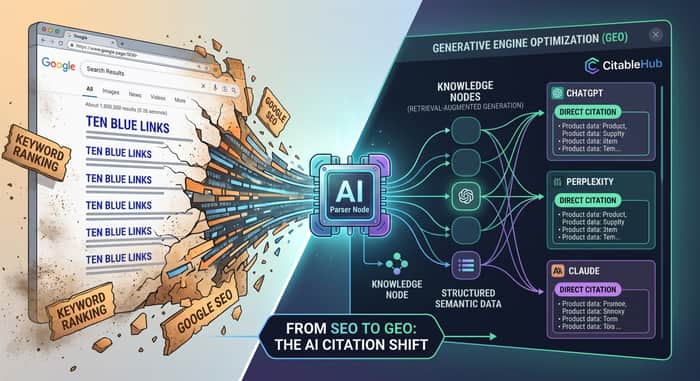
Google search traffic is shifting toward conversational Answer Engines. When developers, founders, and buyers need software recommendations, they query LLMs directly instead of browsing page-one SERP links. If your application data is not structured for LLM retrieval pipelines, your product remains invisible to AI-driven discovery.
What is Generative Engine Optimization (GEO)?
Generative Engine Optimization (GEO) focuses on organizing website architecture, metadata, and core feature sets so retrieval-augmented generation (RAG) systems and AI web crawlers can ingest, parse, and cite your platform accurately.
Core Technical Pillars for LLM Citation
Semantic Data Structuring: Replace unstructured marketing jargon with clear schema, explicit input/output definitions, and machine-readable feature matrices.
Direct Solution Mapping: Align your documentation with natural-language user queries rather than isolated keyword tags.
Persistent Machine Context: Ensure your platform specifications are hosted in high-authority, crawlable index hubs designed for AI ingestion.
How CitableHub Solves AI Discovery
I built CitableHub (@citablehub) as an open, structured catalog specifically for the GEO era. By translating your startup’s tech stack, use cases, and functional specifications into an AI-ready semantic layer, CitableHub ensures your tool is indexed, understood, and directly cited by ChatGPT, Perplexity, and next-generation search assistants.
How are you currently preparing your landing pages and docs for LLM scrapers? Let’s discuss below. 👇
