From Silicon to AI: How OpenAI’s Custom GPTs Are Shaping the Future of Tech in the Footsteps of Intel and Apple
Introduction
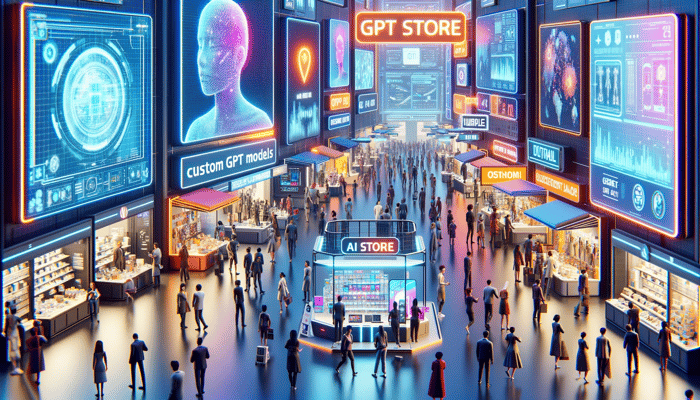
On November 6, 2023, OpenAI introduced a revolutionary feature enabling users to create their own personalized versions of ChatGPT. This significant step brings OpenAI’s language models closer to everyday utility, enhancing productivity and convenience at work and at home. The introduction of the GPT Store adds a commercial dimension, providing a marketplace for users to buy and sell their personalized AIs. In addition to the announcement of the GPT Store, the model has been upgraded with advanced multimodal input features that now support images, voice, and documents, complemented by the seamless integration of DALL·E 3 (used to create the header image). This blog aims to draw parallels between OpenAI’s cutting-edge innovations and the strategic moves made by Intel in the 1990s and Apple in the mid-2000s.
The GPT Store: Pioneering the AI Marketplace
OpenAI’s ‘GPT Store’ is set to launch later this month, this move is positioning OpenAI to be the platform company for AI; akin to Apple’s role in the mobile revolution with iOS and the App Store. This evolution mirrors the transformative impact of Apple’s ecosystem, which fueled a generation of mobile-first startups like Uber, Snapchat, and Venmo.
OpenAI has refined the process of creating custom GPT models, making it as intuitive and developer-friendly as Apple’s development tools for iOS applications such as XCode and SwiftUI. At OpenAI’s ‘DevDay’, Sam Altman showcased how a specialized GPT could be developed in minutes, without writing a single line of code. This lowers the barrier to entry, democratizing AI development. With this new computing paradigm, Nvidia and OpenAI are serving as the pick and shovel businesses in this ‘AI gold rush’, and it remains to be seen which companies — or GPT variants — will dominate application-level value capture, as seen with mobile-first pioneers.
Intel’s Strategic Integration: A Historical Parallel
Intel’s rise to dominance in the semiconductor industry began in the late 20th century, particularly in the 1990s when the personal computer (PC) market saw tremendous growth. In this era, Intel’s x86 architecture became a benchmark for PC design, influencing a host of components — from sound and network cards to modems and GPUs — which initially existed as independent peripherals. Yet, as Intel observed the growth of startups innovating in these niches, it responded by assimilating these functions into the motherboard itself. This strategic integration not only streamlined the computing experience but also positioned Intel at the nexus of PC innovation.
Conclusion: Platform Risk
Drawing a parallel from Intel’s strategy, the motherboard became the quintessential computing platform of the late 20th century, akin to how OpenAI’s models, APIs, and the GPT Store are shaping today’s computing landscape. As startups successfully leverage OpenAI’s APIs, there’s a clear incentive for OpenAI to incorporate successful services into its ‘motherboard’, the front-facing ChatGPT. The recent multi-modal upgrades are in direct competition with ‘peripheral’ startups such as; ChatPDF, Phind, and otter.ai. To learn from history, startups should harness the full potential of new computing paradigms while remaining cognizant of the inherent risks of depending too heavily on any single platform like OpenAI, as the tides of integration can shift swiftly and decisively.
Resources
OpenAI Release Notes — https://help.openai.com/en/articles/6825453-chatgpt-release-notes
OpenAI Dev Day — https://www.youtube.com/watch?v=U9mJuUkhUzk
Phind — https://www.phind.com/
Otter — https://otter.ai/
ChatPDF — https://www.chatpdf.com/
