From single experiment to portfolio of templates bringing in
$9k/mo

Kazi Mohammed Erfan saw that design templates for Framer and Webflow were lacking real-world efficacy, so he learned the platforms and submitted his first template. Today, Pentaclay has 45+ templates bringing in $9k/mo, plus services bringing in another $6k/mo.
Here's Kazi on how he did it. 👇
From civil engineering to template design
I’ve always wanted to build something of my own — a brand where I could bring together great talent, apply everything I’ve learned from my client work, and create products that scale globally. That mix of creative freedom and real impact is what pushed me to start Pentaclay.
I graduated with a degree in Civil and Environmental Engineering, but during my studies in 2013, I became deeply drawn to design. What started as a side interest quickly became a genuine passion.
Since then, I’ve worked in the design field — collaborating with various clients and gaining experience through two on-site roles and three remote positions. Over the years, I’ve developed a strong understanding of both UI/UX design and product thinking, which helped shape my professional direction.
During that time, I noticed a real gap. Many templates in the market looked good but lacked usability, structure, and conversion focus. I wanted to change that by creating templates that not only look great but also perform well in real projects.
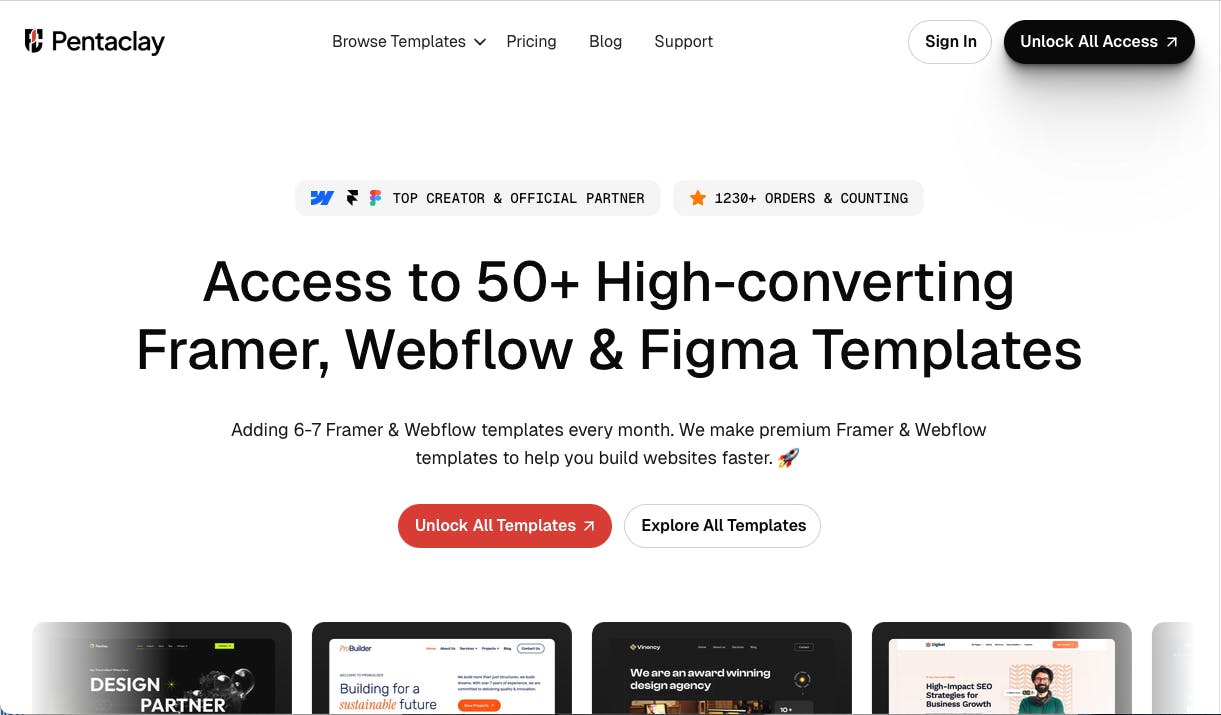
At Pentaclay we create premium Framer and Webflow templates and sell them either individually or through an All-Access pass giving users access to our full library. Alongside that, we also run a design and development agency under the same brand, working with clients to deliver high-quality, conversion-focused websites and digital products.
We’ve been consistently growing and have crossed $9k/mo in template sales, and if we include client projects, we’re now over $15k in monthly revenue.
Learning from scratch
When I started, there was a lot of hype around Framer on X, so I decided to give it a try. While exploring, I came across the Framer Template Marketplace, and that really caught my attention.
I started learning Framer from scratch and challenged myself to get one template approved in the marketplace — just to test my skills and understand the process. That first approval was a big motivation boost. One template quickly became two, two became ten, and now, combining Framer and Webflow, we’ve built over 45+ templates.
So the initial product really came from curiosity and experimentation, but as it gained traction, it evolved into a structured, research-driven process — focusing on design quality, performance, and niche relevance. That first step of challenging myself to build one template basically laid the foundation for everything we’re building today with Pentaclay.
Constant, interactive submissions
One of the biggest challenges I faced early on was figuring out how to scale template submissions effectively. After my first template, I paused to see how it would perform and, back then, I had to wait 14–15 days after submitting each template to see if it got approved. That slowed down learning and momentum quite a bit.
If I had to start over, I would focus on consistent, iterative submissions from the start. Today, we submit six templates per month on Webflow and seven or eight on Framer, which allows us to test, learn, and improve continuously. That approach has made a huge difference in speed, quality, and market understanding.
A design- and conversion-focused stack
For our templates and agency projects, we mainly work with Framer and Webflow as the core platforms. On the design side, I use Figma for UI/UX, prototyping, and collaborative design work.
For development and interactions, Framer covers most of our needs with its visual code capabilities. And Webflow handles CMS-driven and scalable websites. We also use analytics and tracking tools like Copilot and Google Analytics to monitor user behavior and optimize templates.
For project management and collaboration, we rely on Notion and Slack to keep the team aligned.
And we sell our templates with LemonSqueezy.
Finding niche opportunities
I identify niche opportunities through a combination of market research, competitor analysis, and real-world observation. For each niche, I study top-performing companies and websites, see what features and layouts they use, and identify gaps that aren’t addressed in existing templates.
We don’t just focus on high-demand niches — we also explore low-demand categories, which often have less competition but still real potential. This approach helps us create templates that are practical, relevant, and tailored to the needs of each niche.
Tracking users to improve quality
We track user behavior extensively — from traffic sources and heatmaps to sales performance, bounce rates, and conversion metrics. This data-driven process helps us understand what really works and continuously improve both our design and user experience.
For example, I initially assumed users didn’t really pay much attention to the FAQ section, so I just added a few basic ones based on competitors.
But when I started analyzing heatmaps and user behavior data, I was surprised to see that users were actually spending a significant amount of time on the FAQ section. That insight completely changed my perspective.
I realized that FAQs play a big role in building trust and improving conversions, especially for digital products. So, I revisited all the FAQs across our templates, rewrote them to address specific user concerns, and began tracking engagement regularly.
That small, data-driven change had a noticeable impact — users stayed longer, and our conversion rates improved as well.
Growth via strategic engagement
We’ve grown Pentaclay through a combination of product quality, niche research, and strategic outreach.
Every template is research-driven and high-quality, which naturally encourages users to trust our products and share them. Iterative feedback and analytics, mentioned earlier, play key roles in that.
We also focus on targeted visibility — sharing our work in design communities on X and Reddit, marketplaces like Framer and Webflow, and social platforms where creators and businesses look for templates. Engaging with these communities, providing helpful content, and showing real examples of how our templates perform has been a major factor in attracting users. Collaborating with other creators in these communities has helped too.
This engagement has led to direct inquiries from potential clients and collaborations, and some posts have reached 20,000–30,000 views, driving traffic to our templates.
Leaning on community
One thing I’ve found particularly helpful is the creator community itself. The Framer and Webflow communities are incredibly friendly and supportive — we share revenue insights, exchange ideas, and motivate each other.
Being part of this network has not only helped me learn faster but also stay inspired and make better decisions for Pentaclay.
Seeing how others solve design challenges keeps me motivated to push my own work further.
Growing the team
Until October, I was working solo, with the help of a few contractors. But last month, I began building a full-time team, and now we’re a team of eight talented people.
The focus right now is on laying strong foundations — building processes, improving product quality, and setting up a sustainable workflow. I believe once everyone’s operating at full potential, hitting $20k in revenue will be very achievable.
I’m aware the next couple of months might be a bit slower, but I see it as bending down before a big jump — we’re setting things up now to scale much faster in the coming quarters.
Start small and build in public
My advice for indie hackers would be to start small, iterate fast, and stay curious. Don’t wait for perfection — launch your first product or prototype, gather real user feedback, and improve continuously.
Focus on niche opportunities where you can stand out. For example, with Pentaclay, we started with SaaS templates to tap into the market, and then expanded into local services, portfolios, eCommerce, and more than ten other niches. Each niche allowed us to understand real user needs and create templates that solve specific problems.
Finally, build in public and engage with communities — sharing your process, challenges, and wins keeps you motivated and helps you connect with potential users or collaborators.
What's next?
My main goal for the future is to scale Pentaclay into one of the top digital design brands, recognized for both premium templates and high-quality client work. In the next 6–12 months, we’re focusing on expanding our template library, enhancing our All-Access offering, and reaching a consistent $30k+ monthly revenue.
We also plan to launch new products, plugins, and libraries over the coming months, targeting niches that complement our existing offerings. To achieve this, we’re building a full-time team, streamlining our production workflow, and using data-driven research to prioritize the most impactful products.
Long term, within the next 2–3 years, the goal is to grow Pentaclay into a full ecosystem for creators, offering templates, tools, and resources that help designers and businesses build and launch faster while maintaining top-tier design standards.
You can learn more about Pentaclay by visiting our website at pentaclay.com, where you can explore our premium Framer and Webflow templates, the All-Access pass, and our agency services. Or follow us on social platforms like X and Facebook, where we share updates, design insights, and tips for creators and businesses.

Leave a Comment
Thanks for covering my story.
This comment was deleted 6 months ago
“Great insight, thanks for sharing!”
“Great insight, thanks for sharing!”
The FAQ heatmap insight is gold. Most builders obsess over hero sections, but you let data reveal where trust actually forms. That's the learning you only get from consistent shipping.
One question: submitting 6-8 templates monthly across platforms—how do you balance originality vs market demand? Are certain interaction patterns universal converters, or does each niche need genuinely custom thinking?
The "bending down before the jump" approach to team-building shows rare discipline. Rooting for that $30k milestone.
Inspiring
Love the journey from engineering to design! Your approach of focusing on niche opportunities and consistently iterating on templates is impressive. The emphasis on data-driven design and community engagement is a great blueprint for growth. Excited to see Pentaclay reach new heights!
Love this transition story. Moving from civil engineering into design and then product thinking is a great example of how skills compound over time. You can really feel how client work + hands-on experience shaped a clear vision for Pentaclay, rather than just jumping into templates for the sake of it.
Noticing gaps in the market while actually doing the work is usually where the strongest products come from. Really inspiring path — especially the mix of creative freedom and building something scalable. Thanks for sharing this journey
Congrats, that's awesome. I just built a platform for creators to have a place to sell digital products that is half the price of Gumroad, I would love feedback, get cocoonly is the domain. Thank you
🤖 An automation tool to build apps / tools / websites like Google’s AI Studio — but lighter, faster, and more cost-efficient.
⚡ Runs on Cursor and leverages AI to generate code, build logic, optimize workflows, and dramatically shorten development time.
🧩 Supports the whole journey: idea → MVP → production-ready product. Easy to customize and scale as your needs grow.
💰 Operating cost is only ~500,000 VND/month (≈ $20), ideal for individuals, indie hackers, small startups, or teams that need to experiment fast.
—
(Available on GitHub for download, testing, and demo.)
🤖 An automation tool to build apps / tools / websites like Google’s AI Studio — but lighter, faster, and more cost-efficient.
⚡ Runs on Cursor and leverages AI to generate code, build logic, optimize workflows, and dramatically shorten development time.
🧩 Supports the whole journey: idea → MVP → production-ready product. Easy to customize and scale as your needs grow.
💰 Operating cost is only ~500,000 VND/month (≈ $20), ideal for individuals, indie hackers, small startups, or teams that need to experiment fast.
—
(Available on GitHub for download, testing, and demo.)
github. /onmou/runner
that's amazing
I’m happy for you, and I can see myself in this position too.
Great
Nice journey..
Love the transparency in your write-up. How long did it take from idea to first version?
I completely agree the right community makes all the difference. In my niche, where I cover the I’ve noticed the same thing. Other food-review creators often share insights on trending items, regional price changes, and what customers are loving lately.
Just like your experience with design communities, staying connected with other Dunkin-focused creators keeps me inspired and helps me make better, more accurate content. Seeing how others break down new menu launches or seasonal specials constantly pushes me to improve my own reviews.
Community really is a game-changer no matter the niche.
Congrats on the progress — love seeing honest, steady wins like this. It’s encouraging as someone building something lightweight on the side. What ended up being your most effective early-traction channel?
YOU CAN RECOVER YOUR STOLEN FUNDS WITH THE HELP OF // THE HACK ANGELS RECOVERY EXPERT
The most reputable and trustworthy recovery experts available today. THE HACK ANGELS RECOVERY EXPERT. They can help you retrieve your stolen crypto funds. They have technical expertise resources to track down and recover lost crypto. I had lost £973,000 to fraud and at first I thought it was gone for good. I went online to search for recovery, I saw numerous testimonies regarding THE HACK ANGELS RECOVERY EXPERT and how they had assisted other people in getting their money back. I didn't hesitate to contact them, in just a few days the experts returned all my money. They said that they did an investigation and returned my money immediately. They can never ask you for any upfront payment. They can help you track your funds. They are cyber security experts doing great jobs out there. Be wise and do your research to avoid being scammed again. For anyone in a similar situation seeking to recover funds lost to online scams, contact THE HACK ANGELS RECOVERY EXPERT through
WhatsApp +1520200-2320
Love this direction — especially the dual focus on productized templates + premium client execution. That combo scales well if the decision-making load doesn’t crush you as you grow.
One thing that helped me massively while scaling my own companies: using an AI operating system (the SoloCEO Board Engine) to pressure-test decisions across strategy, finance, ops, and capacity before committing. It cut a lot of rework and made monthly targets more predictable.
If you ever want to stress-test your revenue plan or roadmap for Pentaclay, this kind of system is a surprisingly good co-pilot. Scaling becomes a lot cleaner when you’ve got something acting like a board helping you think through the moves.
Either way — rooting for the $30k+ months. You’re building in a strong lane.
wow
I'm genuinely impressed by how a collection of templates grew into a real, sustainable business. It's a solid reminder of how far you can go by paying close attention to user needs and letting actual demand guide what you build.
Really inspiring journey! I love how you leveraged curiosity and experimentation to turn Pentaclay from a side project into a structured, research-driven design brand. The way you combine niche research, data-driven insights, and community engagement to iterate on templates is a textbook example of thoughtful product development. It’s also impressive how you’re scaling strategically with a full-time team while keeping quality and process at the forefront. Your approach to starting small, learning fast, and building in public is exactly what indie hackers should take note of. Excited to see Pentaclay hit $30k+ monthly and continue growing as a top digital design brand.
This is super inspiring!
This is super inspiring! I've been in a similar situation, trying to turn a small idea into something profitable. It gives me the push to keep going.
Transforming a single experiment into a $9k/month template portfolio demonstrates creativity, scalability, and smart execution.
Such an inspiring journey, moving from civil engineering to template design, shows how skills can evolve in unexpected and creative ways. If you’re exploring tools that help improve your workflow and system performance while designing, you can read more.
the part where you mention about keeping consistent and sharing your work in communities is right on... with build in public you create trust, authenticity and keep yourself accountable by showing up and doing the work.
reading through your journey, I couldn't help noticing that design is such an important part of any business. these days, if you see a good design, you're by default attracted to the product.
so, a niche well-picked.
good luck to you mate.
Incredible growth!
This is incredibly inspiring! The transition from curiosity to 45+ templates shows what's possible with consistent iteration.
What stands out to me is your shift from "see what sticks" to data-driven development. That FAQ insight is gold — it's amazing how often we assume what users want instead of actually watching what they do.
We've been taking a similar approach with AI-powered business systems, and that same principle of "build → measure → learn" has been transformative.
Thanks for sharing your stack and process — definitely taking notes! 🚀
“Incredible growth! Turning a single experiment into a $9k/month template portfolio shows smart product strategy.”
Do you have a question? Need advice? Tarot can help you weigh the pros and cons of a situation, give you another perspective, and provide intuitive support. Think of a yes or no question and then click on the tarot email below for insight and direction.
WhatsApp : +2348159250336
Really inspiring journey. The way curiosity turned into a real system and now a growing team is impressive. The part about learning from heatmaps and FAQs especially stood out to me. Curious which niche performed the best early on in terms of conversions.
Starting with a single experiment, test an idea or product with a small audience to gauge interest and revenue potential. Analyze results, optimize what works, and create repeatable templates or frameworks from successful experiments. Expand into a portfolio of products or services using these templates to reach different audiences. Gradually scale each stream, turning small wins into consistent income, ultimately generating around $9k per month through a systematic, repeatable approach.
nice insights.
Amazing work, Kazi — I’ve been on a similar path, and this really inspired me!
Over the past 15 years, I worked in ops and marketing across various startups. After exiting a tiny consulting agency I built (SupportOps) and then getting laid off from the company that acquired it, I decided to step away from tech and finally pursue design - something I’ve been passionate about my entire life.
Now I build (and occasionally sell) tiny projects, a few of which focus on web design:
FounderSites — a web agency creating websites for one-person business owners
FreeWebsiteThemes — 2,375+ free website templates from Webflow, Framer, and more
ServiceThemes — a collection of affordable Carrd templates for service-based business owners
Thanks for sharing and best of luck!
Kazi Mohammed Erfan grew Pentaclay from a single Framer/Webflow template into a $15K/mo business by focusing on real-world usability, niche research, iterative submissions, data-driven improvements, and community engagement—turning small experiments into a scalable, sustainable digital product brand.
wow, honestly super inspiring stuff the whole journey from civil engineering to building a full-on design brand is kinda wild in the best way. love how he didn’t just jump in with some “perfect plan” he literally learned from scratch, shipped, improved, and just kept going. the focus on usability + conversion instead of just “pretty templates” is such a smart move too
Awesome journey!
Really impressive breakdown, Kazi. Your shift from civil engineering to building a successful digital product brand shows how far consistency and clear thinking can take you. The point about submitting continuously instead of waiting for perfect timing is a valuable reminder for anyone building in public. I also appreciate your focus on data, niche research, and community engagement. It is clear that Pentaclay’s growth comes from a well-structured process rather than shortcuts.
Nice growth, that's the way to do it
This is such an inspiring journey — I love how you combined curiosity, experimentation, and data-driven iteration to build Pentaclay. Starting from one template and scaling to 45+ across Framer and Webflow while keeping usability and conversion in mind is no small feat.
What stands out most to me is how much attention you’ve given to understanding real user behavior — like discovering the impact of FAQs through heatmaps and engagement tracking. That kind of insight is what separates a “good-looking template” from a product that actually performs and builds trust.
I also appreciate your focus on niche opportunities and community engagement. Iterative submissions, strategic visibility, and leaning on the Framer/Webflow creator communities are smart ways to grow without relying solely on ads.
It’s exciting to see you scaling to a full-time team while keeping processes, product quality, and workflow sustainable. Your approach of starting small, iterating fast, and building in public is such a valuable lesson for anyone trying to create something that scales globally.
Really looking forward to seeing Pentaclay hit $30k+ monthly revenue and evolve into a full ecosystem for creators. Amazing work!
I tried Saatosa template before, and it's just awesome. You are doing good work.
Congratulations ! Good luck to grow your Pentaclay into a full ecosystem for creators.
“Congrats! Turning a single experiment into a $9k/month portfolio is inspiring—amazing example of creativity, dedication, and smart execution.”
Good luck for your new product
Impressive growth! Turning one experiment into $9k/month with templates shows smart strategy and execution.
“Great insight, thanks for sharing!”
“Great insight, thanks for sharing!”
“Great insight, thanks for sharing!”
“Great insight, thanks for sharing!”
From a single experiment to a portfolio of templates generating $9k per month reflects how small creative ideas can scale into a powerful digital business. Many creators start by testing one template on platforms like Etsy, Gumroad, or Notion Marketplace. When demand grows, they expand into multiple niches, improve quality, and optimize listings. Over time, a strong portfolio creates consistent passive income, strong customer trust, and recurring sales with minimal ongoing effort.
“Great insight, thanks for sharing!”
From a single experiment to a full portfolio of templates generating $9K/month — proof that smart experimentation and scaling can turn ideas into real, sustainable revenue.
Nice growth! Turning one experiment into a $9k/month template portfolio shows smart iteration and productization of ideas.
This is solid execution.
I’ve been working in the .NET world for years and now moving into modern JS to build products like this.
Always great to see what consistency can create.
nice
IF YOU WANT TO RECOVER YOUR STOLEN BTC CONTACT GEO COORDINATES RECOVERY HACKER FOR ALL KINDS OF HACKING JOBS
The internet today is full of scammers. But here is some good news to everyone who has been a victim of internet scammers. You can get your money back from the scammers. If you have been a victim to internet scammers, then you should contact GEO COORDINATES RECOVERY HACKER. I have been a victim of online scams. I lost $723,000 worth of BTC. I saw where so many people recommended GEO COORDINATES RECOVERY HACKER. Hackers who have dedicated time to helping individuals to get back their money from internet scammers. Recovering lost Bitcoin can require unique hacking skills and expertise that are possessed by only a handful of professional hackers, it’s best to seek out a trusted hacker like GEO COORDINATES RECOVERY HACKER who can help you recover your funds. Am here to give glory to GEO COORDINATES RECOVERY HACKER. You guys did a great job for me. And all of this was done at an affordable price. Thanks a lot. To get in touch with the recovery hacker, you can contact them via
Telegram; @Geocoordinateshacker
“Great insight, thanks for sharing!”
Truth. Start small, ship fast, and let the niche teach you.
I tried the BYO platform and it is pretty cool
Has anyone else here used it
Surprised there is no article about it yet
“Love this breakdown. What stood out most is how you focused on real usability instead of just pretty designs. The iterative submissions, niche research, and heavy use of data (especially the FAQ insight) are gold. Amazing to see how starting with one approved template turned into a full team and a $15k/mo operation. Super inspiring — thanks for sharing your journey.”
Love how you approached template design by focusing on real-world usability instead of just aesthetics. A lot of templates look beautiful but fall apart when someone actually needs to publish real content or run a business on top of them. Your decision to deeply learn Framer/Webflow before shipping anything definitely shows in the results.
I’ve been working through a similar problem in my own projects. With Cizeex Listings, I noticed people often struggle not with design, but with getting a usable page online fast, especially for small experiments or niche needs. That’s why I recently built Upsyte, a feature that lets users spin up tiny, focused mini-sites really quickly. It came from watching users who don’t want a full website yet , they just need something simple, clear, and functional.
It’s always interesting to see how builders in different spaces end up solving the same core issue: helping people get from idea → working page as quickly as possible.
Curious, how do you decide which new template ideas to build now? Are you looking at user feedback, gaps in existing marketplaces, or something else? Would love to hear how your process evolved as Pentaclay grew.
This is inspiring
A well-structured and insightful breakdown of how real market research shapes effective niche templates.
This is an inspiring story 👏
Really love how this started as a single experiment and evolved into a template portfolio that’s the part many builders overlook.
Small, validated wins compound faster than big unproven ideas.
Your post also highlights something important:
Templates are not just products, they’re “leverage engines.”
Once they work, they scale without additional effort, and the learnings from one template feed into the next.
I’m currently building something for creators where we’re going through the same loop — ship one small piece, validate it with real users, refine, then scale.
Your path reinforces that this iterative template approach is one of the strongest ways to build SaaS without burning out.
Congrats on hitting 9k/mo would love to see a deep dive on which template unexpectedly took off.
This is interesting, and a very cool business model. I am curious, where does majority of the traffic come from thus far? - Cheers.
Impressive journey! Turning a side interest into a scalable business is inspiring. It reminds me of how simple yet effective platforms like Real Earning App let people start earning in practical ways without overcomplicating the process.