From TikTok Downloader to Creator Toolkit: How to Find a Stronger SaaS Positioning
A practical look at why single-purpose download tools struggle and how adjacent value can reshape the product story
Moving beyond “save the video” toward a positioning that creators actually pay for
Most TikTok download tools start the same way: a simple page, a paste box, and a promise of watermark-free files. That model works for traffic. It rarely works for durable SaaS revenue. The reason is structural. Saving a video is a one-time job. Once the file is on the device, the tool has finished its useful life for that user.
Creators, agencies, and small media teams need the download step, but they need it inside a larger workflow. They want to collect references, organize examples, pull audio, compare versions, and keep material that may disappear from the platform. A pure downloader solves only the first minute of that process.
This article is for builders who already operate a TikTok downloader or are considering one as a starting point. The goal is not to abandon the core function. It is to locate the adjacent jobs that turn a free utility into a product someone will pay to keep using.
THE CORE PROBLEM WITH SINGLE-PURPOSE POSITIONING
A tool that only downloads videos competes on speed, quality, and lack of watermarks. Those are table stakes. Every competent competitor can match them within a few weeks. The result is a race toward free usage, ad-supported pages, or thin affiliate models that rarely support serious product development.
Users who arrive through search for “download TikTok without watermark” have low switching costs and low loyalty. They leave the moment another page loads faster or feels cleaner. That traffic is useful for testing, but it is a weak foundation for a subscription business.
The stronger path is to keep the download capability and expand the definition of the job being done. Instead of “get this video onto my phone,” the job becomes “build and maintain a private reference library of short-form content that I can actually use later.”
THE SHIFT: FROM FILE TO WORKFLOW
Creators already perform several related tasks around TikTok content:
Collecting examples of hooks, transitions, and formats that perform
Saving audio tracks or original sound for later use or analysis
Archiving their own posts before platform changes or account issues
Gathering competitor or inspiration clips for mood boards and briefs
Keeping material that may be removed or restricted later
Each of those tasks begins with a download, but none of them ends there. The product opportunity sits in the steps that follow: organization, tagging, search, export packs, and lightweight collaboration.
A POSITIONING LADDER THAT ACTUALLY SCALES
Move through these layers deliberately rather than adding features at random.
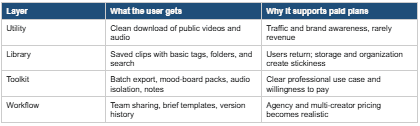
Most teams that stay stuck at the Utility layer eventually face declining margins or pure ad dependency. Climbing one or two layers changes the conversation from “another free downloader” to “the place I keep my short-form references.”
WHAT TO KEEP AND WHAT TO AVOID
Keep the simple download experience as the front door. New users should still be able to paste a link and leave with a file in under a minute. That low-friction entry remains the acquisition engine.
Avoid turning the product into a full video editor or a social media management suite. Those categories are crowded and capital-intensive. The opportunity is narrower: reliable capture plus intelligent organization of short-form material.
A tool such as TikTokio already demonstrates the clean capture side. The strategic question for any similar product is how far to extend the post-download experience without diluting the original simplicity.
MESSAGING THAT REFLECTS THE NEW JOB
Language matters. “Download TikTok videos without watermark” attracts one-time users. “Build a private library of short-form references you can actually find later” attracts people who will return and eventually pay.
Test messaging that emphasizes permanence, organization, and professional use. Creators who treat TikTok as a research and inspiration source respond more strongly to library and toolkit language than to pure speed claims.
THE HONESTY SECTION: WHEN THE OLD POSITIONING IS ENOUGH
Not every downloader needs to become a SaaS product. Some operators are content with high-volume free traffic and advertising. Others use the tool as a lead generator for adjacent services. In those cases the single-purpose positioning remains rational.
The shift described here is only necessary when the goal is recurring revenue and lower dependence on search ranking volatility. If that is not the goal, the simpler model can still be viable.
A PRACTICAL NEXT STEP FOR BUILDERS
List the three most common actions users take after they download a video.
Identify which of those actions currently require leaving your product.
Design the smallest possible feature that keeps one of those actions inside your product.
Rewrite the homepage headline to describe the larger job, not only the download step.
That sequence usually reveals whether the product can climb the positioning ladder without a complete rebuild.
THE STRONGER STORY IS ABOUT WHAT HAPPENS AFTER THE FILE IS SAVED
Download capability remains necessary. It is no longer sufficient as a complete product story. Creators and small teams need the file, but they also need a place to keep it useful.
Moving from a pure TikTok downloader toward a lightweight creator toolkit does not require abandoning the original strength. It requires recognizing that the real job starts the moment the video lands on the device—and building just enough product to stay relevant after that moment.
Disclaimer: Product strategy depends on audience, existing traffic, and competitive landscape. The framework above is a starting point for teams evaluating whether to expand beyond single-purpose download positioning. Results vary with execution quality and market timing.


-
1It sounds like you’re tapping into a crucial pain point for creators and agencies who juggle various tasks across platforms. The need for a streamlined workflow can’t be understated, especially when it comes to managing content creation efficiently. In my experience, one of the biggest challenges when scaling content is the aggregation and organization of resources. For example, I found that using a centralized system for storing videos, audio clips, and inspirations vastly improved efficiency in my own projects. Instead of scrolling through countless files or platforms, we implemented a simple tagging system to categorize content types, which sped up our retrieval process by 40%. Additionally, I noticed that comparing examples side-by-side can be messy if not properly structured. We started using shared boards where team members could drop in links and notes, allowing for an easy way to visualize and compare different pieces of content. This led to more informed creative discussions and faster decision-making. It’s also worth considering tools or processes that simplify the download step itself. For instance, when we moved to incorporate more automated content sourcing, it dramatically cut down the time spent on gathering materials, allowing our team to focus more on creative development rather than administrative tasks. Integrating a seamless process for collecting and comparing content could provide significant value to both individual creators and media teams alike. If you decide to build on this, focus on aspects like ease of use, flexibility, and perhaps even elements of performance tracking to see which types of content resonate most.9 days ago Reply
