From Wild Idea to Paying Customers: 6 Tools That Cover the Entire Startup Journey
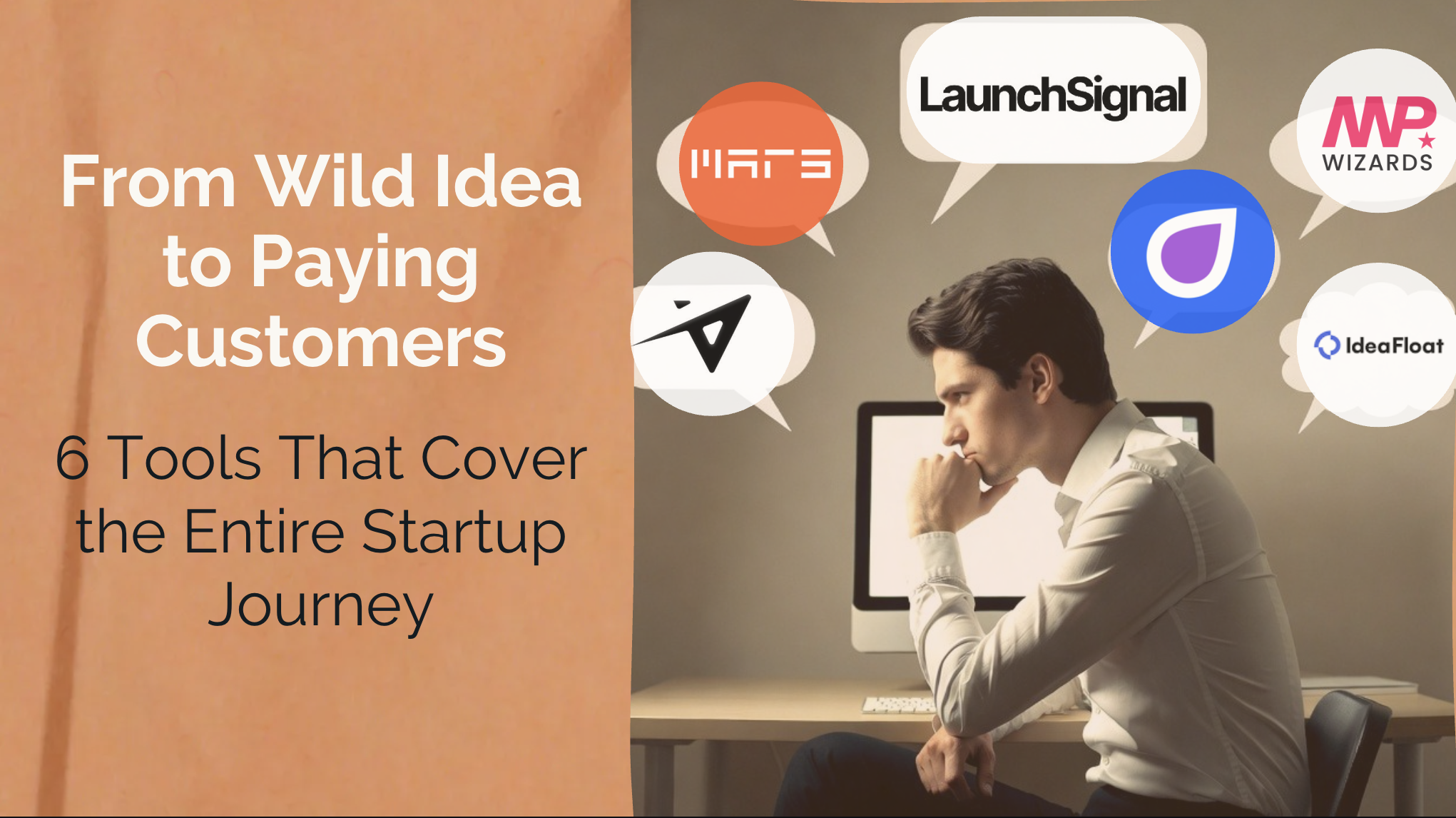
A few years ago, launching a product meant months of planning, hiring, and burning cash before a single user ever signed up. Today, a solo founder with a half-baked idea on a Sunday afternoon can have a landing page live, emails collecting, and payments running by Monday morning.
But the tool landscape is noisy. There are hundreds of "no-code" platforms, "AI builders," and "launch accelerators" claiming to do everything. Most do one thing well and fumble the rest.
I've pulled together seven tools that actually cover the real stages of bringing a product to life — from validating whether your idea is worth pursuing, to building the thing, to getting customers on board. I've ordered them by the logical sequence a founder goes through, because the order matters.
Stage 1 — Validate before you build
Most founders skip this stage entirely. They fall in love with an idea, start developing it, and three months later discover no one wants it. These two tools exist specifically to prevent that.
-
IdeaFloat
Most founders waste weeks doing "market research" that amounts to googling competitors and convincing themselves the idea is good. IdeaFloat takes a different approach: drop in your idea — anything from a SaaS app to a coffee shop concept — and the platform runs real data analysis to produce a validation score, pricing guidance, revenue potential estimate, and a step-by-step launch roadmap.
The appeal isn't that it's clever AI magic. It's that it forces you to confront the data quickly. Live market demand, customer insights, and competitor snapshots are surfaced in minutes. For solo founders and side-hustlers who are sanity-checking the next big thing, this is the fast-forward button on the early research phase. Over 500 entrepreneurs have already used it — the question is whether your idea will sink or swim. -
LaunchSignal
IdeaFloat tells you whether the market exists. LaunchSignal tells you whether real people, right now, will give you their email address or credit card for something that doesn't exist yet — which is a very different question.
Describe your idea and it spins up a complete validation campaign in under 30 seconds. No code, no design work, no fake app screenshots required. What you get is a real landing page that collects emails, gathers feedback, and measures purchase intent before the product exists. You can run campaigns for multiple ideas simultaneously and compare analytics side by side to find which concept has the strongest signal. It's brutally honest about what people actually care about versus what you think they care about.
Stage 2 — Build your product
You've validated the signal. Now you need to build something. Depending on your technical background, that looks very different.
-
MarsX
MarsX takes a genuinely different approach to app development. Instead of building yet another SaaS from the ground up, developers and entrepreneurs can assemble products from pre-built micro-apps contributed by a community of thousands of developers. Think of it as the npm of full-featured app modules — auth, billing, admin panels, user dashboards, all pre-built and composable.
The platform combines AI, no-code tools, and pro-code capabilities on top of this marketplace. Developers can also publish their own micro-apps and earn revenue each time another user incorporates them, creating a sustainable secondary income stream alongside the building process. For a technical founder who's tired of rewriting the same infrastructure for the fifth project in a row, MarsX is worth a serious look. -
MVP Wizards
Not every founder wants to wrestle with low-code tools. Some ideas are complex enough that you just need experienced hands on the keyboard. MVP Wizards is a curated directory of freelancers and compact teams who specialize in building minimum viable products at fixed prices and with unusually fast turnarounds.
The scope is broad: SaaS tools, directories, websites, mobile apps, Chrome extensions, AI applications. The fixed-price model is the key differentiator — you know exactly what you're getting into before work begins, which removes the anxiety that typically comes with hiring developers. For founders who've validated their idea and are ready to build, but don't want to manage a traditional agency engagement, this is a cleaner path.
Stage 3 — Launch and grow
You've built the thing. Now you need a presence that converts, a way to reach people, and ideally a system that doesn't require you to manage everything manually.
-
Unicorn Platform
Unicorn Platform has been around the startup community for a while, but their recent AI overhaul changes the proposition meaningfully. The platform now uses AI for block-level editing — you can generate content, fix grammar, create contact forms, add CTAs, and insert custom HTML without touching a visual editor more than necessary.
It's particularly well-suited for SaaS landing pages and startup websites: clean default aesthetics, fast to set up, and targeted at exactly the use case of "I need a professional site up today, not next week." The AI assistance shines in the details — the kind of small friction points that typically slow founders down for hours. -
Vibiz ai
Vibiz calls itself a "vibe business platform," which is a memorable framing for what it actually does: take an idea and automatically build a professional website, generate marketing content, and integrate payment systems — all without the founder needing any technical expertise. A powerful concept should be all you need to get started.
What separates it from a basic website builder is the completeness of the output. You're not just getting a landing page — you're getting an operational business setup. For entrepreneurs who want to move from "I have this idea" to "I have a functioning product people can find and pay for" as quickly as possible, Vibiz handles the infrastructure so the founder can focus entirely on growth.
The takeaway
The best tools for founders in 2026 are stage-specific. Don't use a launch platform to validate an idea. Don't use a validation tool to build your product. Match the tool to the question you're actually trying to answer at each step, and you'll move faster with far less wasted effort.
The constraint for most indie hackers isn't access to tools anymore — it's judgment about which ones to use and when. Validate first, build what the signal supports, then launch with a presence that can actually convert. Do it in the reverse order and you're the cautionary tale at the next startup meetup.
If you've used any of these or have alternatives worth knowing about, drop them in the comments.
