GA4 Has Become More Complex — and That’s Changing Analytics in the EU
GA4 is a powerful product. That’s not really up for debate.
But over the last few years, it has also raised the bar in terms of complexity, interpretation, and legal awareness, especially for small teams operating in the EU.
For many founders, the issue is no longer missing features — it’s the trade-off between complexity, data reliability, and compliance risk.
1. The GA4 learning curve now exceeds the needs of many small SaaS teams
GA4 was designed as a universal analytics platform: enterprise-ready, event-based, optimized for machine learning and attribution modeling.
For small and mid-size products, this often results in: manual event design, indirect answers to simple questions and data that requires explanation before it can be trusted.
Common pattern: Teams often use a small fraction of GA4’s capabilities, but still absorb the full operational complexity.
2. Privacy constraints now directly affect data completeness.
EU privacy regulations have changed the rules: consent banners are required, a meaningful share of users opt out, analytics data becomes incomplete by default.
This is not a GA4 bug. It’s the reality of a privacy-first web.
Practical consequence
Metrics should no longer be treated as exact truth — they are approximations, influenced by consent and browser behavior.
3. Server-side tracking helps, but introduces new costs and responsibilities
Server-side analytics can: reduce dependency on the browser, provide more control over data flow.
But it also brings: infrastructure overhead, maintenance complexity, increased responsibility for data handling.
For some teams, this is justified. For others, it’s disproportionate to the value they actually need.
4. GDPR compliance is not binary — it’s a spectrum
Most products operate somewhere between: “best effort compliance” and “we can’t afford full legal and technical certainty”.
What matters in practice: not every tool fits every risk profile, analytics choices are strategic decisions, not just technical ones.
Why alternative approaches are gaining attention.
Given these constraints, many teams are reconsidering how much data they truly need.
This has led to growing interest in: cookie-less analytics, strict data minimization, focusing on core product metrics instead of exhaustive tracking.
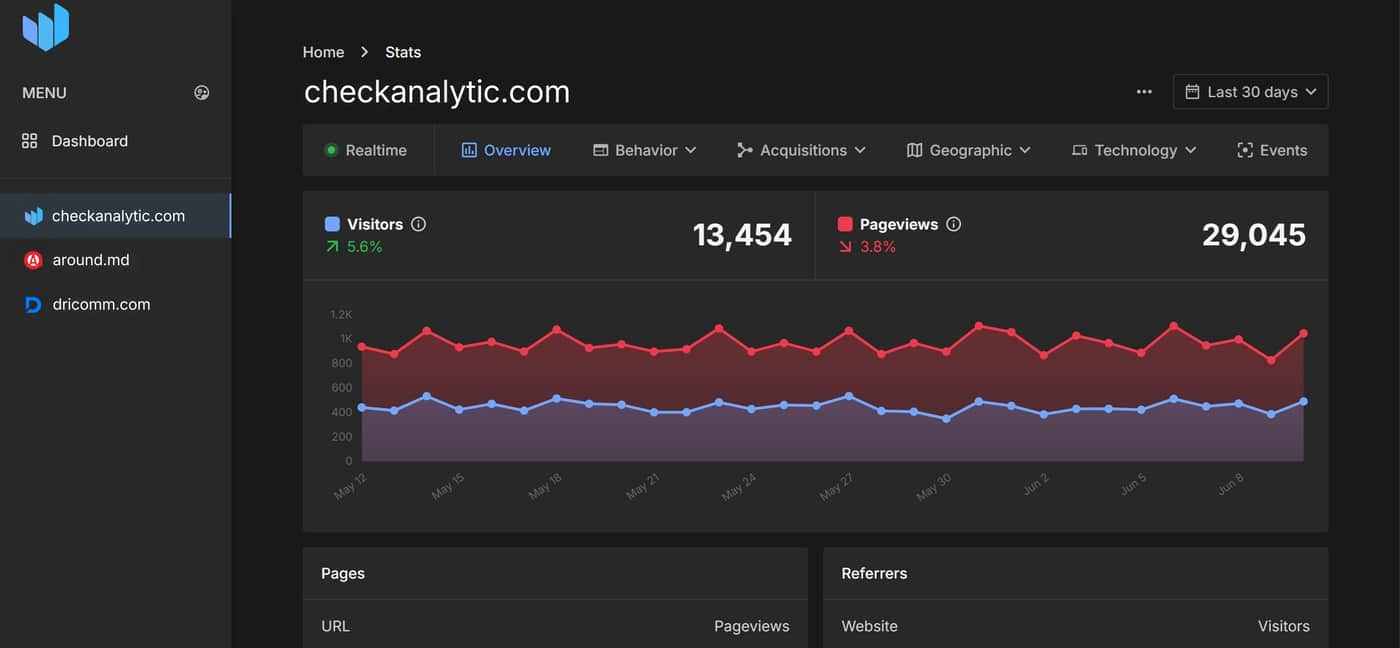
One example of this approach is CheckAnalytic.com : no cookies, no personal data, no consent banners, clear, unsampled metrics focused on essentials.
It’s not a full GA4 replacement — and it doesn’t try to be.
It’s a practical alternative for teams prioritizing simplicity, predictability, and lower compliance risk.
Questions the market still hasn’t answered.
Do all products really need deep behavioral tracking?
Where is the line between useful analytics and unnecessary data collection?
Can fewer, cleaner metrics lead to better decisions?
Different teams will answer differently.
That’s likely why analytics tooling is fragmenting rather than converging.
!!!Conclusion!!!
GA4 isn’t “bad”, and it isn’t “broken”.
It has simply evolved in a direction that doesn’t fit everyone equally well.
For founders and small teams, this creates an opportunity to: reassess what analytics should actually do, simplify their stack and choose tools aligned with their real constraints — technical, legal, and operational.


I really liked your service! I wrote to you on WhatsApp!
Thank you! I spoke with you and we've already solved the problem. Have a nice day!
Very true. GA4 isn’t broken, it’s just overkill for a lot of small teams. In a consent-first world, simpler and more predictable analytics often make more sense.
You're absolutely right! Sorry to ask, but why do you use Google Analytics on your website, and what important data are you collecting?
I registered on your service and took the free plan to try! I have a website on Wordpress, I added the code as in your instructions and the statistics immediately appeared! I'm delighted!
I saw this post and decided to write you a review here))
Thank you very much! I am very pleased with your comment! I hope you enjoy our service!
Interesting
Thank you!
This is a great breakdown of why founders are rethinking tooling instead of just adding more complexity. I’m seeing a similar shift on Reddit itself, teams asking fewer “how do I track everything?” questions and more intent-driven ones like “what signal actually matters for decisions?”
When analytics are simplified, Reddit becomes even more valuable as a discovery and validation layer: real problems, real language, zero cookies. Used correctly, those conversations often replace a surprising amount of traditional tracking.
I completely agree with you! That's why we created an analytics service without cookies and personal user data!
Absolutely, privacy first analytics are becoming the baseline now.
Where we see Reddit add real leverage is before analytics: identifying intent signals, recurring pain points, and decision language that teams can act on immediately.
If you’re open to it, I’d be happy to share how we use Reddit conversations to validate demand and guide growth without relying on cookies or personal data.
Feel free to DM me, and I’ll walk you through a simple use case.
This resonates deeply. The "mismatch by design" framing is spot-on - GA4 was built for enterprises with dedicated analytics teams, not solo founders juggling product, marketing, and compliance simultaneously.
What strikes me most is the cognitive overhead point. Every hour spent debugging consent modes or interpreting sampled data is an hour not spent talking to users or shipping features. For early-stage products, that trade-off rarely makes sense.
The two-layer approach you mention (privacy-first baseline + GA4 only with consent) seems pragmatic. Curious: for teams adopting this pattern, what's the typical delta between the "always-on" baseline numbers and GA4's consent-dependent figures? That gap itself seems like a useful metric for understanding how much visibility you're actually losing.
For teams that use privacy-first analytics as a consistent baseline, discrepancies with GA4 are almost always related to consent.
Visits/pageviews in the baseline are 20-50% higher, sometimes even higher—these are users who haven't consented in GA4.
Trends and relative changes are consistent (increases/declines are visible in both tools).
Absolute numbers in GA4 are lower and less stable, especially when segmented.
What's important:
teams use GA4 as an analytical tool, and privacy-first analytics as a source of truth for "what's really going on."
This is why the baseline is valued not for its granularity, but for its predictability and consistency of data.
That 20-50% delta is really useful context - and the framing of "source of truth for what's really going on" vs "analytical tool" is a helpful mental model.
The consistency point is key. If trends track between both tools but absolute numbers diverge, you can still make directional decisions confidently while knowing your baseline reflects actual traffic. That's often enough for early-stage product decisions.
Appreciate the detailed breakdown.
Thanks for your comment!
Looks like a useful analytics tool — clean UI and real-time insights could really help early creators track growth more effectively.
Thank you! We look forward to seeing you!
This matches what many small SaaS teams are feeling. GA4 isn’t broken — it’s just optimized for a different scale and risk profile. Treating metrics as approximations (not absolute truth) and choosing analytics based on compliance + decision value feels like the right mental shift.
I completely agree with you!
Strong take—and I think this resonates with a lot of small teams, especially in the EU.
GA4 isn’t failing because it lacks features; it’s failing by mismatch. The complexity, consent-driven data gaps, and compliance overhead are often way out of proportion to the questions small SaaS teams are actually trying to answer. Most founders just want reliable signals, not an attribution thesis they need to defend internally.
The point about metrics becoming approximations is key. Once consent and browser behavior distort the dataset, “more tracking” doesn’t automatically mean “better decisions.” It often just means more noise and more risk.
That’s why the shift toward cookie-less, minimal analytics makes sense. Not as a GA4 replacement, but as a deliberate trade-off: fewer metrics, clearer meaning, lower legal and operational burden.
Analytics tooling fragmenting feels inevitable—different risk profiles, different needs. The mistake is assuming one platform should fit everyone.
Thanks for your feedback!