GDPR Compliance: A Cornerstone of Cyber Security
The General Data Protection Regulation (GDPR) has transformed how organisations handle data protection and cyber security. Since coming into effect in 2018, it has set a global benchmark for safeguarding personal information. For UK businesses, GDPR compliance is more than a legal requirement; it is a vital element of building trust and maintaining robust digital defences.
What is GDPR?
The General Data Protection Regulation (GDPR) is a European Union regulation that governs how people’s private information is stored and processed. In the UK, an identical version of the regulation called “UK GDPR” was enacted after Brexit.
GDPR applies to all entities that handle data relating to individuals in the UK or EU, regardless of where those organisations are based. T
Key Principles of GDPR
Here are the GDPR principles (Article 5):
Lawfulness, fairness, transparency: Use a lawful basis. Be open about what you do.
Purpose limitation: Collect data for clear, specific purposes. Do not use it for new, incompatible purposes.
Data minimisation: Collect only what you need. No excess.
Accuracy: Keep data accurate and up to date. Fix or erase errors fast.
Storage limitation: Do not keep data longer than needed. Set and follow retention rules.
Integrity and confidentiality (security): Protect data against unauthorised access, loss, or damage. Use technical and organisational controls.
Accountability: Show you comply. Keep records. Put policies, training, and checks in place.
The Link Between GDPR and Cyber Security
The General Data Protection Regulation (GDPR) requires organisations to put in place “appropriate technical and organisational measures” to protect personal data. This means preventing:
● Accidental or unlawful destruction
● Loss, alteration, or unauthorised disclosure
● Unauthorised access
Cyber security tools and processes directly fulfil this duty.
You can also view cyber security as a way to implement GDPR. The following table gives some examples:
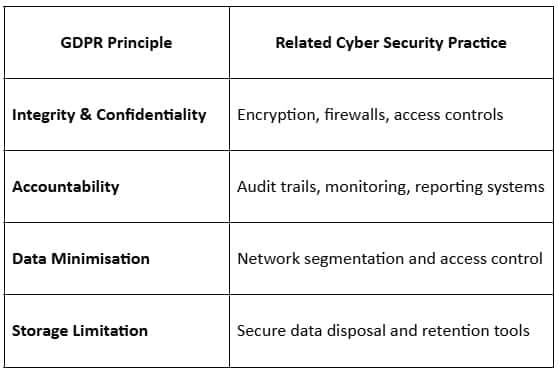
Without these controls, compliance cannot be demonstrated or maintained.
Steps towards tighter compliance can, in turn, improve cyber security. For instance, employees who participate in GDPR awareness training are better equipped to store data securely.
Building a GDPR-Compliant Cyber Security Framework
A GDPR-compliant cyber security framework strengthens an organisation’s ability to protect data and reduce the risk of breaches. It combines technical controls, governance measures, and continuous employee education. Implementing such a framework ensures that compliance is not treated as a checklist but as a long-term strategic priority.
Conducting Regular Risk Assessments
Risk assessment is central to GDPR and cyber security alignment. Organisations must regularly identify, analyse, and address vulnerabilities that could expose personal data. These assessments should review both digital and human factors, from outdated systems to weak password policies.
A structured approach to risk assessment allows businesses to prioritise high-risk areas, allocate resources effectively, and demonstrate accountability under GDPR. Documentation of each assessment also provides evidence of compliance if an investigation arises.
Employee Awareness and Training
Human error remains one of the most common causes of data breaches. A cyber security awareness course is one way to equip employees with the knowledge to recognise and respond to potential threats.
Training should include identifying phishing emails, managing passwords securely, and reporting suspicious activity. Regular refresher sessions help reinforce these lessons and adapt to emerging risks. When combined with GDPR-specific training, it builds a workforce that understands both regulatory and security responsibilities.
Vendor and Third-Party Compliance
GDPR requires that organisations ensure any third parties handling personal data on their behalf maintain the same level of protection. This includes contractors, cloud providers, and marketing partners.
Businesses must assess third-party policies, contractual terms, and security measures before granting access to data. Periodic audits and compliance questionnaires help confirm that partners continue to meet GDPR standards. This shared responsibility reduces the overall exposure to data breaches and reputational damage.
Non-Compliance Risks
Failure to comply with GDPR carries serious consequences. Beyond financial penalties, organisations face loss of trust, operational disruption, and reputational harm that can take years to repair.
Financial and Legal Penalties
The Information Commissioner’s Office (ICO) has the authority to impose substantial fines for breaches of GDPR. Penalties can reach up to £17.5 million or 4% of global annual turnover, whichever is higher. These fines are designed to encourage accountability and ensure that organisations treat personal data protection as a priority.
Legal action may also follow a data breach. Individuals affected by data misuse or loss can seek compensation, adding further financial strain. For businesses that rely on consumer confidence, such outcomes can be damaging to both finances and brand image.
Reputational Damage and Business Impact
Reputational loss often has longer-term effects than financial penalties. When data is mishandled or exposed, public trust erodes quickly. Customers may move to competitors with stronger data protection records, and partners may hesitate to collaborate.
Maintaining compliance helps protect brand integrity and builds customer confidence. Transparent communication and proactive security measures demonstrate that an organisation values privacy and accountability.
Future Outlook
As technology evolves, GDPR continues to shape the standards of data protection and cyber security in the UK and beyond. New threats, such as AI-driven attacks and cross-border data transfers, make ongoing compliance an active and dynamic process rather than a one-time exercise.
Integrating AI and Automation Responsibly
AI tools are increasingly used in data management and cyber security. While they enhance efficiency, they also introduce risks of bias, data misuse, or unauthorised profiling. Organisations must ensure that automated systems comply with GDPR principles of fairness, transparency, and data minimisation.
Responsible use of AI includes maintaining human oversight and clear documentation of decision-making processes. Regular auditing of automated systems helps identify weaknesses before they lead to violations or data exposure.
Continuous Improvement and Collaboration
The future of GDPR compliance depends on collaboration across departments. Legal, IT, and HR teams must work together to ensure policies reflect both regulatory expectations and technological realities.
Continuous monitoring, updated risk management strategies, and engagement with cyber security experts help businesses remain resilient. As cyber threats grow more complex, adapting to new guidance from the ICO and other regulators will remain essential.
A Secure Future Built on Awareness and Accountability
GDPR has redefined what responsible data management means in the digital era. It connects legal obligation with practical cyber security, demanding that organisations protect information not just through technology but through culture and conduct.
Compliance is not achieved through software alone. It relies on awareness, consistent leadership, and strong internal processes. Employees trained through GDPR and cyber security awareness programmes form the foundation of this effort, turning policy into daily action.
Organisations that view GDPR as a cornerstone of cyber security gain more than legal protection. They earn the confidence of their customers, build a reputation for integrity, and establish a secure framework for future innovation.
In a world where cyber risks continue to evolve, aligning data protection with security best practices ensures that trust remains a business’s most valuable asset. True resilience comes not from reacting to breaches but from creating an environment where privacy and protection are built into every decision.

