Gojek Clone App Development in the Philippines, UK, Cambodia, Brazil, Kenya, Vietnam, Thailand & Egypt
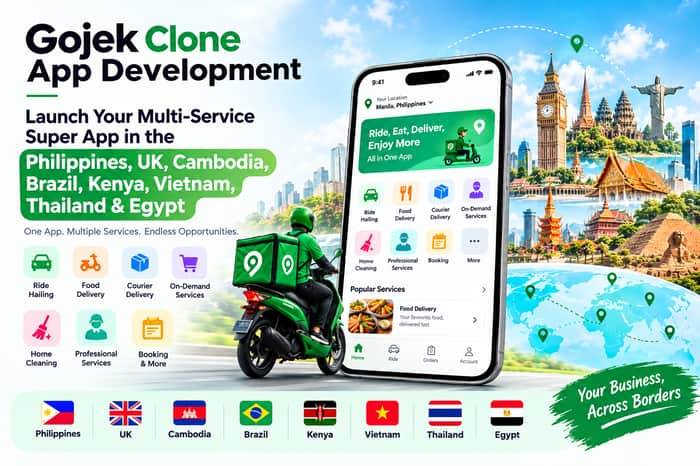
The on-demand economy has changed how consumers access everyday services. Transportation, food delivery, grocery shopping, courier services, home maintenance, and other local services can now be accessed through mobile applications.
This shift has created an opportunity for entrepreneurs to develop multi-service apps that bring several services together under one platform. A Gojek-style application is one popular approach because it allows businesses to create a digital ecosystem instead of operating separate apps for every service.
Entrepreneurs in the Philippines, UK, Cambodia, Brazil, Kenya, Vietnam, Thailand, and Egypt can adapt the multi-service model to their local markets and customer requirements.
A Gojek Clone App provides a ready-made foundation for launching such a platform, while customization allows businesses to create their own branding, services, pricing, workflows, and monetization strategies.
What Is a Gojek Clone App?
A Gojek Clone App is a multi-service application solution inspired by the business model of large on-demand platforms. It allows entrepreneurs to provide multiple services through one mobile ecosystem.
Depending on the business strategy, the platform can include:
- Taxi and ride booking
- Food delivery
- Grocery delivery
- Courier services
- Parcel delivery
- Home services
- Beauty services
- Handyman services
- Laundry services
- Medicine delivery
- Local shopping
The platform can generally be customized according to the selected market.
For example, a business in the Philippines may prioritize transportation and food delivery, while a startup in Brazil could focus on delivery, mobility, and local services.
Why Build a Gojek Clone App for Multiple Countries?
Developing a multi-service platform for different countries can provide access to diverse customer segments.
However, a successful international strategy does not mean launching exactly the same application everywhere.
Each country has different:
- Consumer preferences
- Payment methods
- Transportation patterns
- Service demand
- Pricing expectations
- Regulations
- Languages
- Business competition
Therefore, entrepreneurs should use a flexible technology platform that can be localized for each market.
A customizable Gojek clone can provide the basic technology foundation while allowing the business to make country-specific adjustments.
Gojek Clone App Development in the Philippines
The Philippines has a highly mobile-oriented consumer environment, making app-based services an attractive opportunity for entrepreneurs.
A Gojek-style platform in the Philippines could combine services such as ride booking, food delivery, grocery delivery, courier services, and local home services.
Potential Services
- Motorcycle and car booking
- Food delivery
- Grocery delivery
- Package delivery
- Laundry
- Home cleaning
- Beauty services
- Personal errands
Businesses should study local demand before deciding which services to launch.
Key Opportunity
A startup can begin with one or two core services and gradually introduce additional services after developing a customer and provider network.
Gojek Clone App Development in the UK
The UK provides opportunities for specialized on-demand platforms serving transportation, food, delivery, and household services.
Rather than launching an app with every possible service immediately, entrepreneurs can identify underserved niches and build a focused multi-service ecosystem.
Possible Services
- Ride booking
- Food delivery
- Grocery delivery
- Courier services
- Home cleaning
- Handyman services
- Beauty appointments
- Local delivery
A UK-focused application should also consider privacy, payment, consumer protection, and other applicable regulatory requirements.
Localization Matters
Currency, location services, payment integration, customer support, and service availability should be configured for the intended UK market.
Gojek Clone App Development in Cambodia
Cambodia presents opportunities for mobile-first on-demand services, particularly in urban areas.
A Gojek-style application can bring several services together while allowing businesses to build a recognizable local brand.
Services to Consider
- Taxi booking
- Motorbike booking
- Food delivery
- Grocery delivery
- Courier services
- Local shopping
- Home services
A localized interface and appropriate payment options can make the application easier for customers and service providers to use.
Gojek Clone App Development in Brazil
Brazil is a large market with diverse urban populations and strong demand for digital services.
Entrepreneurs can build a multi-service platform around transportation, delivery, commerce, and local services.
Potential Business Model
A Brazil-focused platform could offer:
- Ride-hailing
- Food delivery
- Grocery delivery
- Courier services
- Package delivery
- Home services
- Local marketplace services
Portuguese-language support and suitable payment integration should be considered during development.
Expanding City by City
Instead of attempting to cover the entire country from the beginning, businesses can launch in selected cities, measure demand, and expand gradually.
Gojek Clone App Development in Kenya
Kenya offers opportunities for technology-driven transportation and delivery services.
A Gojek-style application can connect customers with drivers, delivery partners, restaurants, retailers, and local service providers.
Services That Can Be Added
- Taxi booking
- Motorcycle transportation
- Food delivery
- Grocery delivery
- Courier services
- Parcel delivery
- Home services
Mobile payments are particularly important when planning a Kenyan on-demand platform, so entrepreneurs should select payment integrations that match their target customers and business model.
Gojek Clone App Development in Vietnam
Vietnam's growing digital economy creates opportunities for businesses offering convenient mobile-based services.
A multi-service application can combine transportation, food delivery, shopping, courier services, and other local services.
Possible Features
- Ride booking
- Food ordering
- Grocery shopping
- Delivery booking
- Real-time tracking
- Digital payments
- Ratings and reviews
- Promotions
Businesses entering this market should research local competitors and customer expectations before launching.
Gojek Clone App Development in Thailand
Thailand has a strong tourism, transportation, food, and delivery ecosystem, creating several opportunities for on-demand platforms.
A Gojek-style application could focus on both residents and specific customer segments such as tourists, businesses, and local consumers.
Services to Consider
- Taxi booking
- Motorbike booking
- Food delivery
- Grocery delivery
- Courier services
- Local shopping
- Home services
Language localization, map integration, payment options, and customer support are important considerations.
Gojek Clone App Development in Egypt
Egypt provides opportunities for transportation, food delivery, courier services, and other on-demand applications.
Entrepreneurs can build a platform that connects customers with drivers, restaurants, stores, and service professionals.
Potential Services
- Ride booking
- Food delivery
- Grocery delivery
- Courier services
- Parcel delivery
- Home maintenance
- Beauty services
Arabic and English language support can be considered when designing the user experience for the target audience.
Core Components of a Gojek Clone App
A successful multi-service platform requires more than a customer application.
The ecosystem generally includes multiple interfaces.
Customer App
Customers should be able to:
- Create accounts
- Search for services
- Book rides
- Place orders
- Track deliveries
- Make payments
- Apply promotional codes
- Rate providers
- View booking history
- Contact customer support
Driver and Service Provider App
Drivers and service professionals can use the provider application to:
- Register
- Submit required information
- Set availability
- Accept or reject requests
- Navigate to customers
- Track earnings
- View completed jobs
- Manage profiles
- Receive notifications
Merchant Panel
Restaurants, stores, and other vendors can manage:
- Products
- Prices
- Orders
- Availability
- Promotions
- Sales
- Payouts
Admin Dashboard
The administrator needs centralized control over the entire ecosystem.
Important functions include:
- User management
- Provider management
- Merchant management
- Service management
- Booking management
- Order management
- Commission configuration
- Payment monitoring
- Promotions
- Reports
- Analytics
- Customer support
Important Features for a Global Gojek Clone
While each country needs localization, several features are useful across markets.
Real-Time Tracking
Customers can track rides, drivers, and delivery orders.
Multiple Payment Options
Businesses can integrate suitable payment methods based on the target country.
Ratings and Reviews
Customers can rate drivers, merchants, and service providers.
Push Notifications
Notifications can inform users about bookings, orders, payments, promotions, and status updates.
Promo Codes
Discounts and promotional campaigns can help attract new customers.
Referral Programs
Existing users can be encouraged to invite new customers through referral incentives.
Wallet
A digital wallet can support selected transactions, refunds, promotional credits, or other platform-specific use cases.
Analytics
Business owners can monitor bookings, orders, revenue, commissions, customer activity, and provider performance.
How Does a Gojek Clone App Make Money?
A multi-service platform can use multiple monetization models.
Commission
The platform can charge a percentage of each transaction from service providers or merchants.
Delivery Charges
Customers can pay delivery fees for food, groceries, parcels, and other services.
Booking Fees
A platform fee can be added to selected bookings.
Subscription Plans
Businesses can introduce membership plans offering benefits such as reduced delivery fees or special discounts.
Advertising
Restaurants, stores, and service providers can pay for promoted placements.
Corporate Services
Companies can be offered dedicated transportation, delivery, or business accounts.
Using multiple revenue channels can help create a more diversified business model.
Steps to Develop a Gojek Clone App
1. Select Your Target Market
Determine whether you want to launch in one city, one country, or multiple markets.
2. Research Customer Demand
Identify the services customers use most frequently.
3. Select Initial Services
Avoid launching too many services at once. Begin with services that have strong demand and manageable operations.
4. Choose the Technology Approach
Decide whether a customizable Gojek clone or fully custom development better matches your requirements.
5. Customize the Platform
Adapt branding, language, payment methods, pricing, service categories, and workflows.
6. Integrate Required Services
Connect maps, payments, notifications, communication tools, analytics, and other required third-party services.
7. Test the Applications
Conduct functional, usability, security, performance, and payment testing.
8. Launch an MVP
Start with a focused service offering and a limited geographic area.
9. Collect Feedback
Analyze customer and provider feedback to identify improvements.
10. Expand
Add new services, cities, and features after establishing a stable operational foundation.
Gojek Clone Script vs Custom Development
Entrepreneurs generally have two development approaches.
Gojek Clone Script
A customizable clone provides an existing technology foundation and can help reduce development complexity and launch time.
It can be suitable for:
- Startups
- Entrepreneurs testing an idea
- Businesses seeking faster market entry
- Companies launching multiple standard on-demand services
Custom Super App
Custom development is more suitable when a company requires:
- Unique workflows
- Advanced integrations
- Highly specialized features
- Custom architecture
- Complete product control
The right choice depends on business goals, budget, timeline, and technical requirements.
Final Thoughts
The multi-service app model provides entrepreneurs with an opportunity to combine several everyday services under one digital platform.
From the Philippines and UK to Cambodia, Brazil, Kenya, Vietnam, Thailand, and Egypt, businesses can adapt a Gojek-style platform to local customer requirements.
The key is not simply to copy an existing application. Instead, entrepreneurs should build a localized business model around actual customer demand, suitable services, reliable service providers, secure payments, effective operations, and a strong user experience.
A customizable Gojek Clone App can provide a practical starting point for entrepreneurs who want to launch faster and test their multi-service business model. As the platform grows, additional customization and proprietary features can be introduced to create stronger differentiation.
With the right market research and execution strategy, a multi-service app can become a scalable digital platform serving customers, merchants, drivers, and service professionals through one ecosystem.
Frequently Asked Questions
1. What is Gojek Clone App Development?
Gojek Clone App Development involves creating a multi-service on-demand platform inspired by the Gojek business model. The application can be customized with different services, branding, payment options, and business workflows.
2. Can I launch a Gojek Clone App in multiple countries?
Yes. A scalable and customizable platform can be adapted for different countries. However, each market should be evaluated separately for language, payments, regulations, pricing, services, and customer preferences.
3. Which countries can use a Gojek Clone App?
A Gojek-style platform can be adapted for markets such as the Philippines, UK, Cambodia, Brazil, Kenya, Vietnam, Thailand, and Egypt, as well as other countries where on-demand services have market potential.
4. What services can be included in a Gojek Clone?
Common services include ride booking, food delivery, grocery delivery, courier services, parcel delivery, home services, beauty services, laundry, and local shopping.
5. Can I customize the Gojek Clone for each country?
Yes. Businesses can customize branding, languages, service categories, pricing, payment integrations, location coverage, and other elements according to their market strategy and technical requirements.
6. How does a Gojek Clone make money?
Revenue can come from commissions, delivery fees, booking fees, subscriptions, advertising, promoted listings, and corporate accounts.
7. Do I need separate apps for customers and service providers?
Typically, separate interfaces are useful because customers and providers require different features. The exact application architecture depends on the business model.
8. Can I start with only one service?
Yes. Starting with one or two core services can help businesses validate customer demand before expanding into additional service categories.
9. Is a Gojek Clone suitable for startups?
A customizable Gojek Clone can be suitable for startups that want to enter the multi-service market with a structured technology foundation and gradually expand their platform.
10. What should I consider before launching internationally?
Consider local customer demand, competitors, regulations, payment methods, language, service-provider availability, pricing, logistics, customer support, data protection, and marketing strategy before launching in a new country.
