Gojek Clone Script Development: Can One App Become a Multi-Service Business?
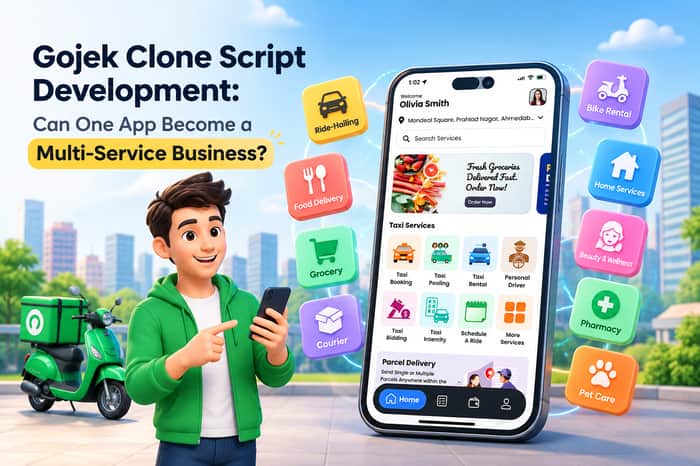
Building an app around a single service can be a good way to enter the on-demand market. But what happens when customers need more than one service from the same platform?
They may want to order food in the morning, book a ride in the afternoon, send a package later, and find a local service provider in the evening. Instead of using several separate apps, many users prefer the convenience of having multiple services available in one place.
That is where the idea behind Gojek Clone Script Development becomes interesting for entrepreneurs.
A Gojek-style platform is not simply about copying an existing application. The bigger opportunity is to create a branded multi-service business where different on-demand services work together under one digital ecosystem.
Why Are Multi-Service Platforms Getting Attention?
Consumer expectations have changed significantly. People are increasingly comfortable using apps for everyday activities such as transportation, food delivery, shopping, logistics, and local services.
For a startup, this creates an interesting business opportunity.
Instead of depending entirely on revenue from one service, a multi-service platform can create several sources of income. It can also give users more reasons to return to the application.
For example, a business could start with:
- Ride-hailing
- Food delivery
- Grocery delivery
- Courier and parcel delivery
- Home services
- Local shopping
The important part is not launching every service on day one. A smarter strategy can be starting with one or two services that have strong demand and gradually expanding the platform.
What Is Gojek Clone Script Development?
Gojek Clone Script Development refers to creating a ready-made or customizable multi-service application inspired by the business concept of platforms such as Gojek.
The goal is to provide entrepreneurs with the technical foundation required to operate their own branded platform.
Instead of developing every component from the ground up, businesses can begin with an existing framework and customize it according to their market, business model, branding, and service requirements.
A typical platform may include separate interfaces for customers, service providers, delivery partners, and administrators.
The business can then configure which services it wants to offer and how those services should operate.
Can One App Really Support Multiple Businesses?
Yes, but the challenge is not simply putting multiple services inside one application.
The real challenge is creating a platform where those services can operate efficiently without making the customer experience confusing.
Consider a user opening the app.
They might see categories such as:
Ride → Food → Grocery → Courier → Home Services
Each category can have its own workflow, pricing structure, service providers, and operational requirements while remaining connected to the same customer account.
This creates an ecosystem rather than a collection of unrelated features.
For entrepreneurs, this approach can also make cross-selling easier. A customer who initially joins the platform for ride booking may later discover food delivery or courier services.
The Technology Behind the Business
A successful multi-service application needs more than an attractive interface.
The technology should support different workflows while keeping the overall system manageable.
Some important components include:
Customer App
Customers should be able to browse services, place orders or bookings, track requests, make payments, communicate with providers, and review their experiences.
Service Provider App
Drivers, delivery partners, restaurants, stores, or other service providers need tools to accept requests, manage availability, view earnings, update order status, and communicate with customers.
Admin Panel
The administration system acts as the control center of the platform.
Administrators may need to manage users, providers, bookings, orders, commissions, payments, promotions, service categories, and platform settings.
Real-Time Tracking
For transportation and delivery services, location tracking can be particularly important. Customers want to know where their driver or delivery partner is and how long the service may take.
Payment Integration
A multi-service business may support different payment methods depending on its target market, including cards, digital wallets, bank-based payments, and cash where appropriate.
What Makes the Business Model Interesting?
The biggest attraction of a multi-service platform is revenue diversification.
A business does not necessarily have to depend on one income stream.
Potential revenue models can include:
- Commission from service providers
- Delivery or service fees
- Customer convenience fees
- Promotional listings
- Business subscriptions
- Advertising opportunities
- Surge or dynamic pricing where appropriate
For example, a food delivery partner might generate commission revenue, while a ride booking could generate a transaction-based commission.
This creates the possibility of building a broader revenue ecosystem around the same customer base.
However, adding more services does not automatically mean higher profits. Every service introduces operational costs, customer-support requirements, provider management, and competition.
The business model needs to be tested before expanding aggressively.
Start Small Instead of Launching Everything
One common mistake entrepreneurs can make is trying to build a super app with every possible service from the beginning.
That can make the product expensive, complicated, and difficult to manage.
A better approach is to identify the strongest local opportunity.
For example, suppose a market already has strong demand for taxi booking and food delivery. Those two services could form the initial platform.
Once the business develops a reliable customer base and provider network, additional services can be introduced.
This creates a gradual growth strategy:
Identify demand → Launch core services → Measure usage → Improve operations → Add complementary services
This approach can reduce unnecessary complexity while allowing the platform to evolve based on real customer behavior.
Customization Matters More Than Copying
The word “clone” can sometimes create the impression that the goal is to reproduce another company's application exactly.
That should not be the objective.
A serious Gojek Clone Script should provide a foundation that can be adapted to a specific business.
Branding, service categories, pricing, commission structures, payment methods, geographic coverage, and workflows can all be adjusted according to the target market.
For example, a platform targeting one city may need completely different services from a platform designed for multiple countries.
The business should therefore focus on solving local customer problems rather than simply reproducing another company's feature list.
Where Does Scalability Come In?
Scalability becomes especially important when multiple services are involved.
A platform that works well with a few hundred users may face very different requirements when thousands or millions of customers start using it.
The architecture should therefore be prepared for increasing users, transactions, service providers, locations, and data.
Businesses should also consider analytics from the beginning.
Understanding which services customers use most, where orders originate, which providers perform well, and where users abandon transactions can help guide future decisions.
Is This Model Right for Every Startup?
Not necessarily.
A multi-service platform requires coordination between technology, operations, marketing, customer support, and service providers.
It also requires a clear understanding of the target market.
Entrepreneurs should ask questions such as:
- What problem am I solving?
- Which service has the strongest local demand?
- Who are my customers?
- How will I attract service providers?
- What will make customers choose my platform?
- How will the business earn revenue?
- Which services should be launched first?
If these questions have clear answers, the technology becomes much easier to plan.
Final Thoughts
Gojek Clone Script Development can be more than a shortcut for creating an on-demand application. It can provide the foundation for entrepreneurs who want to build a multi-service business around a specific market.
But the technology itself is only one part of the equation.
The bigger opportunity comes from choosing the right services, understanding customer behavior, building a reliable provider network, and creating a business model that can grow over time.
One app can potentially support multiple services—but successful multi-service businesses are built by solving real problems one service at a time.
Frequently Asked Questions
1. What is Gojek Clone Script Development?
It is the process of creating a customizable multi-service platform based on the general concept of an on-demand super app. Businesses can adapt its features, branding, services, and workflows to their own requirements.
2. Can I launch multiple services through one app?
Yes. A multi-service platform can combine services such as ride-hailing, food delivery, grocery delivery, courier services, and other local on-demand offerings within one ecosystem.
3. Should a startup launch all services at once?
Not necessarily. Starting with one or two high-demand services can make operations easier and allow the business to validate its concept before expanding.
4. How can a multi-service platform generate revenue?
Possible revenue sources include commissions, service fees, delivery charges, subscriptions, promotions, and advertising, depending on the business model.
5. Can a Gojek Clone Script be customized?
Yes. A properly designed solution can be customized for branding, services, pricing, commissions, payment methods, locations, and other business requirements.
6. Is a multi-service app suitable for a small business?
It can be, provided the business starts with a focused service strategy. A small business does not need to launch every possible service immediately and can expand as demand grows.
