Gojek Clone Script: From Business Concept to Multi-Service Platform
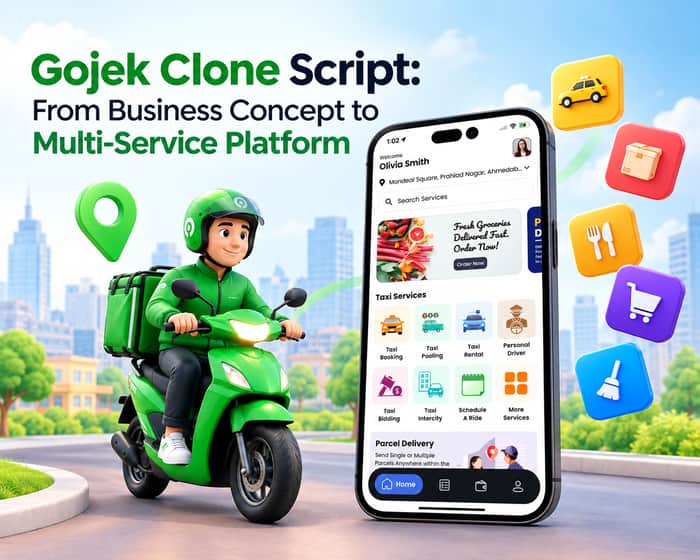
The on-demand economy has changed how people access everyday services. Instead of using separate platforms for transportation, food delivery, shopping, and household services, customers increasingly prefer apps that bring multiple services together. This shift has created opportunities for entrepreneurs to build multi-service platforms that can serve different customer needs from a single application.
A Gojek clone script is one approach businesses can consider when entering this market. Rather than developing a multi-service platform entirely from scratch, entrepreneurs can start with a ready-made software solution and customize it around their business model, target market, and service requirements.
But launching a successful multi-service platform involves more than simply having an app. Businesses need to understand the concept, choose suitable services, build the right technology infrastructure, and create a model that can scale.
What Is a Gojek Clone Script?
A Gojek clone script is a pre-built software solution designed to create an on-demand multi-service platform similar in concept to Gojek. It can combine different services within one ecosystem, allowing customers to access them through a common application.
Depending on the solution and business requirements, a platform may support services such as:
- Taxi and ride booking
- Food delivery
- Grocery delivery
- Courier and parcel delivery
- Medicine delivery
- Home services
- Beauty and wellness services
- Local shopping
- Other location-based on-demand services
The idea is not necessarily to copy another company's platform. Instead, the clone script provides a technological foundation that entrepreneurs can adapt to create their own branded service marketplace.
Why Consider a Multi-Service Business Model?
A single-service application focuses on one specific customer requirement. For example, a taxi application primarily connects passengers with drivers. A multi-service platform expands that model by allowing users to access several services through the same ecosystem.
This approach can provide businesses with several advantages.
1. Multiple Revenue Opportunities
A platform that supports different services can create multiple revenue channels. Depending on the business model, revenue may come from service commissions, delivery fees, booking charges, subscriptions, advertising, or partnerships.
This gives entrepreneurs more flexibility than relying entirely on one service category.
2. Broader Customer Reach
Different services attract different types of customers. Someone may use the platform for transportation in the morning and order groceries later in the day.
By combining services, businesses can address a broader range of everyday requirements and potentially increase user engagement.
3. Better Use of the Existing Ecosystem
Once a business has customers, service providers, delivery partners, and an operational infrastructure in place, additional services can potentially be introduced without creating an entirely separate platform.
For example, a business operating a ride-booking service could later explore courier delivery or food delivery if those services match its target market.
From Business Idea to Platform
A Gojek clone script should not be the starting point of the business decision. The first step is identifying a clear market opportunity.
Entrepreneurs should ask questions such as:
- What services are customers actively looking for?
- Which services are underserved in the target market?
- Who are the main competitors?
- What pricing models are already being used?
- Are there enough service providers to support the platform?
- What regulations apply to each service?
The answers can help determine which services should be included in the initial launch.
Instead of launching ten services at once, a business may begin with two or three high-demand categories and gradually expand. This can make operations easier to manage while providing an opportunity to understand customer behavior.
Important Components of a Multi-Service Platform
A multi-service marketplace generally needs several interconnected components. The exact structure depends on the business model, but a typical platform may include customer, service provider, delivery partner, and administrator interfaces.
Customer App
The customer application is where users discover services, place orders, make bookings, track requests, and communicate with providers.
Useful features can include:
- User registration and profiles
- Location detection
- Service search
- Booking and ordering
- Real-time tracking
- Digital payments
- Ratings and reviews
- Order history
- Notifications
- Customer support
The interface should remain simple even when the platform offers multiple services.
Service Provider App
Service providers need their own tools to manage requests and business activities. Depending on the service, this could include drivers, restaurants, grocery stores, technicians, beauty professionals, or other providers.
Typical functionality may include request management, availability settings, earnings information, navigation, notifications, and customer communication.
Admin Panel
The administrator dashboard provides control over the entire platform. Administrators may use it to manage users, providers, services, transactions, commissions, promotions, complaints, and platform analytics.
A centralized dashboard becomes particularly important as the number of services and participants grows.
Customization Matters
One of the main advantages of using a clone script is the possibility of customization.
Every market has different requirements. A business targeting a city in Asia may have different payment methods, pricing structures, service categories, and operational requirements compared with a company targeting Europe or North America.
Customization can cover areas such as:
- Branding and user interface
- Service categories
- Commission structure
- Payment gateways
- Currency and language
- Pricing rules
- Location-based availability
- Notifications
- Promotions
- Provider workflows
The objective is to make the platform fit the business rather than forcing the business to follow a fixed software model.
Revenue Models for a Gojek-Like Platform
A multi-service platform can use one or several revenue models.
Commission: The platform takes a percentage from transactions completed through the marketplace.
Delivery or convenience fees: Customers may pay additional fees for delivery or specific services.
Subscription plans: Frequent users or providers can be offered subscription packages with additional benefits.
Advertising: Businesses and service providers can pay for increased visibility within the platform.
Featured listings: Providers may pay to appear prominently in search results or promotional sections.
The right combination depends on the market, service category, customer expectations, and operating costs.
Technology and Scalability
A multi-service platform needs technology that can handle growing numbers of users and transactions. Scalability should therefore be considered from the beginning.
Important areas include:
- Secure user authentication
- Reliable databases
- Cloud infrastructure
- Payment security
- GPS and mapping integration
- Real-time notifications
- API integrations
- Data protection
- Performance monitoring
A platform that works well with a few hundred users may face challenges when thousands or millions of users begin accessing it simultaneously. Selecting a technology architecture that can grow with the business is therefore important.
Launching in Phases
Trying to introduce every possible service at launch can make a business difficult to operate. A phased approach can be more practical.
For example, a startup could begin with:
Phase 1: Ride booking and food delivery
Phase 2: Grocery and courier delivery
Phase 3: Home and professional services
Phase 4: Additional local services based on customer demand
This approach allows businesses to collect feedback, improve operations, and determine which categories deserve further investment.
What Should Businesses Evaluate Before Choosing a Clone Script?
Not every clone script will have the same capabilities. Before selecting a solution, businesses should evaluate its technology, customization options, security, scalability, support, and documentation.
It is also important to understand what is included in the package. Businesses should check whether the solution provides customer applications, provider applications, delivery interfaces, web panels, and an administrative dashboard.
The development partner's ability to provide updates and technical support can also influence the long-term sustainability of the platform.
Final Thoughts
A Gojek clone script can provide entrepreneurs with a practical starting point for developing a multi-service on-demand platform. Instead of building every component from the ground up, businesses can begin with an existing technological foundation and customize it according to their market strategy.
However, technology alone does not determine whether a platform succeeds. Market research, service selection, pricing, provider acquisition, customer experience, operational efficiency, and scalability all play important roles.
The strongest approach is to treat the clone script as a business technology foundation, not as the entire business model. By starting with services that have genuine market demand and expanding gradually, entrepreneurs can build a multi-service platform that evolves with their customers and business goals.
