Google Core Update Hit My No-Login Chat Platform Hard — Has Anyone Recovered From This?
Hey everyone,
I'll keep the preamble short because I think a lot of you know this feeling already.
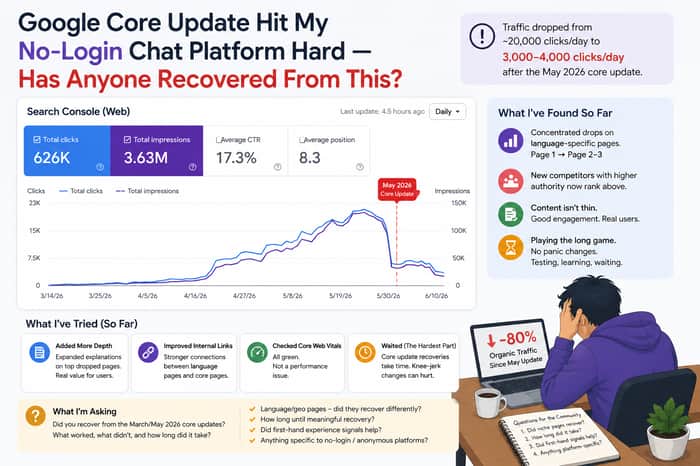
You check Google Search Console in the morning like you always do. The graph looks normal. Then one day it doesn't. The line that was sitting comfortably at 20,000 clicks a day has collapsed to somewhere between 3,000 and 4,000. You refresh. Same numbers. You check if the site is down. It isn't. You check Search Console for manual actions. None. Crawl errors. Nothing obvious.
That's where I've been since the May 2026 core update finished rolling out.
Quick Background
Some of you saw my post from April where I shared how Chatzyo — a no-login, browser-based random video chat platform for Indian language communities — grew from zero to 350K monthly organic clicks in about 6 months.
The strategy was simple: no accounts, no friction, target underserved long-tail queries in Tamil, Telugu, Hindi, and Malayalam. It worked better than I honestly expected.
Traffic was holding strong through March and April. We were consistently hitting 20,000 clicks per day going into May.
Then the May 2026 core update hit.
Daily clicks dropped from 20,000 to 3,000–4,000 per day almost overnight. That's an 80%+ drop. Not a slow fade. A cliff.
What I've Found So Far
I want to be honest: I don't fully understand what happened yet. But here's what digging into Search Console has shown me.
The drops are concentrated on specific page clusters — not sitewide.
The pages that took the biggest hits are the language-specific room pages — the ones targeting queries like "Tamil video chat without signup", "Telugu random chat", "Malayalam chat without login." These were my highest-traffic pages. Now they're sitting on page 2 or 3 for queries they used to own on page 1.
The homepage and a few core pages like the Omegle alternative page are holding reasonably well. It's the long-tail language cluster that got hammered.
Competitors I'd never seen before are now ranking above me.
For several of my best keywords, I went from position 1–3 to position 8–15. What's ranking above me now? Mostly larger platforms with higher domain authority — some with accounts, some without. It feels less like I did something wrong and more like Google recalibrated how much it weights domain authority versus content relevance for this category specifically.
There's no obvious content quality issue I can pinpoint.
This is the frustrating part. The pages that dropped aren't thin. They have real content, genuine user engagement, real session data. Bounce rate on these pages was actually below average. So it's not a classic thin content situation — at least not obviously.
What I've Tried
I haven't panicked and made wholesale changes. Mostly because I've read enough post-mortems to know that's usually how you make things worse.
What I have actually done:
Added more depth to the top dropped pages. Each language room page now has a proper explanation of how the platform works, what to expect, why no signup is needed. Not keyword stuffing — actual useful content for someone landing there for the first time.
Tightened internal linking. The site structure was a bit flat before. Language pages now link more naturally to each other and back to core pages.
Checked Core Web Vitals. All green. This isn't a technical performance issue.
Waited. Genuinely the hardest part. Every instinct says do something. The reality is that core update recoveries take months and making big changes too quickly just muddies the diagnostic picture.
What I Haven't Done (and Why)
I haven't rewritten everything with AI to "fix" the content. If the May update was partly aimed at low-quality scaled content, replacing my pages with AI-generated text seems like exactly the wrong direction.
I haven't deleted the dropped pages. Even at reduced traffic they're still sending thousands of clicks per day. Removing them makes things worse immediately with no guarantee of recovery.
I haven't started building a pile of new pages to compensate. That feels like trying to grow out of a quality signal problem — which doesn't address whatever triggered the drop in the first place.
The Honest Situation
Here's where things actually stand.
The platform still works. WebRTC connections are stable. Users who find Chatzyo still use it — session duration and engagement metrics haven't changed at all. The product isn't broken. The distribution channel is broken.
20,000 clicks a day felt like something building toward sustainability. 3,000–4,000 clicks a day feels like a significant reset. Not fatal — real people are still finding and using the platform every day — but a big step backward after months of consistent work.
The thing that bothers me most isn't the number itself. It's the uncertainty. Core updates are a black box. Google doesn't tell you what changed or exactly what to fix. You read the documentation, read the post-mortems, make educated guesses, implement changes, and then wait months to see if the next update rewards your work or ignores it entirely.
That's a very uncomfortable place to be trying to build something.
One Extra Layer for Anonymous Platforms
I've been wondering whether there's something structurally different about how Google evaluates platforms like Chatzyo — ones that are deliberately no-account, no-tracking, no user data.
There's no Google Analytics on the site — privacy by design. There are no user reviews because there are no accounts. I can't build authority through user-generated content the way a forum or review site can. My trust signals are mostly implicit — real engagement data, real session quality — but none of it is surfaced in a way Google can easily read.
I wonder sometimes if that's a disadvantage I hadn't fully reckoned with. The same privacy choices that make the platform trustworthy for users might make it harder for Google to trust it as a source.
No conclusions here — just something I'm thinking about.
What I'm Actually Asking
Four specific questions for anyone who's been through something similar:
1. Did your language-specific or niche-targeted pages recover differently than general pages after May 2026?
My drops are concentrated in the language cluster. Curious if others with similar niche targeting saw the same pattern or whether it was more spread out.
2. How long did meaningful recovery actually take?
I keep reading "3 to 6 months." Does that match real experience or is that the optimistic estimate?
3. Did making first-hand experience more explicit on the page actually help?
My pages have real data behind them — real connection metrics, real moderation patterns, real user behaviour observations. But most of this is implicit. I'm wondering if explicitly stating it ("here's what we've observed from 350K monthly users") changes how Google evaluates the page.
4. Is there anything worth doing right now or is it genuinely just a waiting game?
The "wait and improve slowly" advice feels right but also feels passive when you're watching a traffic graph that used to look healthy sit flat for weeks.
I'm not posting this for sympathy. Plenty of founders have been through worse and come out the other side. I'm posting because someone in this community has real experience with May 2026 recovery — not blog post advice, actual firsthand knowledge — and I'd rather hear that than read another generic core update guide.
If that's you, I'd genuinely appreciate hearing what recovery looked like and what turned out to be worth doing.
Building Chatzyo in Coimbatore, Tamil Nadu. No login, no accounts, apparently also no immunity to core updates.

The signal I'd be most hesitant to trust right now is the assumption that the update revealed the problem.
An 80% drop definitely tells you something changed.
I'm not sure it tells you what changed.
That's the part that would make me nervous before committing too hard to any particular recovery strategy.
That's a fair point and honestly it's where I'm stuck too.
The drop was clean and sudden — started right after the May update finished rolling out. But correlated with update doesn't mean caused by update and I keep reminding myself of that.
What makes it harder to diagnose is that Search Console shows which pages dropped but not why Google devalued them. The pages that got hit hardest were my language-specific room pages — they had good engagement metrics, low bounce
rate, real session time. Nothing obviously thin about them.
Are you speaking from experience with a similar drop? Curious whether you found a clear cause in the end or just had to make educated guesses and wait.
Honestly, the reason I hesitate to answer is that I've seen people spend months fixing the wrong thing after a drop like this.
Not because they were careless.
Because the story that explains the drop often sounds a lot more convincing than the evidence behind it.
That's what would make me nervous here.
Hard to do that conversation properly in a thread though.
If you're interested, drop your email and I'll send you the longer version.
I'd be interested in hearing the longer version. You can reach me at ergshankarg@gmail.com.
Sent you a note over email.
I think the decision matters more than the surface-level signal here.
This comment was deleted 3 months ago