Google New Update Aug 2026: Become AI's Trusted Source
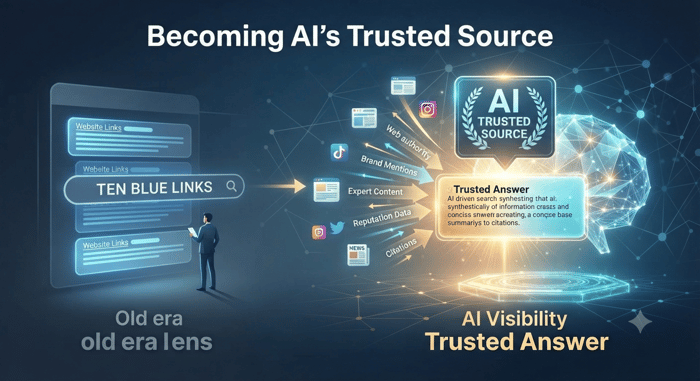
For over two decades, search engine optimization (SEO) had a single, undisputed mission: rank on the first page of Google.
Success was straightforward. Higher rankings meant more clicks, greater traffic, steady impressions, and a predictable pipeline of visitors scrolling through the traditional "ten blue links."
That era has officially ended.
Today, user behavior and search architecture have fundamentally shifted. Instead of navigating to multiple web pages, users are increasingly turning to generative AI search experiences—such as Google AI Overviews, ChatGPT, Gemini, and Perplexity—to receive synthesized, direct answers. Rather than choosing a link, users read a single, cohesive AI-generated response.
This evolution requires a complete rewrite of the digital marketing playbook.
- From Chasing Clicks to Earning AI Citations
The old SEO playbook optimized exclusively for a user's click. The new paradigm shifts the target: become the primary source that AI engines trust enough to cite, summarize, or explicitly recommend.
When a user asks an AI model a complex question, the system crawls its training data and real-time retrieval indices to construct a response. If your content lacks perceived reliability, helpfulness, or clear authority, the model simply bypasses your domain and builds its narrative using a competitor's expertise instead.
- The Mechanics of Generative Engine Optimization (GEO)
To win in this ecosystem, modern marketers must understand how Large Language Models (LLMs) evaluate and synthesize information. AI visibility relies on specific technical and contextual pillars:
Semantic Entity Recognition: AI doesn't just read keywords; it maps relationships between "entities" (people, brands, concepts, and products). Your goal is to ensure your brand is strongly linked to key industry concepts within the AI’s knowledge graph.
Retrieval-Augmented Generation (RAG) Readiness: AI search pulls real-time web results to answer queries. Content that is structured logically, features clear data tables, and directly answers user intent is far easier for RAG systems to parse and excerpt.
Zero-Click Dominance: Even if a user never clicks through to your website, being cited as the authoritative source in an AI summary builds powerful brand equity and high-intent awareness.
- AI Is Already Writing Your Brand Story
Many businesses operate under the assumption that AI only knows what is explicitly fed into a corporate website. In reality, LLMs scrape and synthesize data from across the entire digital ecosystem:
Customer review platforms (G2, Trustpilot, Yelp)
Industry forums and third-party discussions (Reddit, Quora)
Digital PR, news mentions, and media coverage
Unstructured social media conversations and influencer content
If your digital footprint is fragmented, outdated, or filled with unanswered negative reviews, the AI will fill in those gaps automatically, often resulting in an inaccurate or unflattering brand summary. Controlling your digital narrative requires proactive reputation management across every corner of the web.
- Brand Authority as the Ultimate Ranking Signal
Because AI systems are designed to minimize hallucinations and prioritize factual accuracy, they rely heavily on consensus and cross-validation. If multiple trusted sources agree on your brand’s expertise, the AI’s confidence score increases.
Key signals that elevate your brand in the eyes of an AI include:
Consensus Mentions: Consistent, positive citations across reputable third-party publications and industry blogs.
E-E-A-T (Experience, Expertise, Authoritativeness, and Trustworthiness): Content written by verified industry experts with real-world credentials and clear author bios.
Proprietary Research & Data: Original studies, surveys, and unique industry data that other websites naturally link back to and cite.
Brand Sentiment: The emotional tone of public conversations surrounding your products or services.
- Transitioning from On-Site SEO to a Total Ecosystem Strategy
Traditional SEO heavily favored on-site optimizations—such as keyword density, meta tags, and technical site speed. While these remain foundational hygiene factors, they are no longer sufficient on their own.
A comprehensive, modern SEO strategy must incorporate:
Digital PR: Securing earned media placements in high-authority industry publications.
Multi-Platform Presence: Actively participating in communities where AI models frequently harvest conversational data (like Reddit and specialized forums).
Content Diversification: Publishing whitepapers, podcasts, video transcripts, and case studies that feed different types of AI ingestion models.
Unified Messaging: Ensuring your value proposition, mission, and product details remain identical across all digital touchpoints.
The Future Belongs to Trusted Brands
SEO has not disappeared, but it has transformed from a tactical game of keyword manipulation into a high-level strategic discipline.
Winning today is no longer about fighting for the tenth blue link that users scroll past. It is about building a brand so authoritative, transparent, and widely referenced that AI models view your business as the definitive answer.
Your brand will be described by AI one way or another. Make sure it reflects the reality you intentionally built, rather than a fragmented narrative pieced together by accident.
