Google "Quantum Clarity": The Architectural Blueprint for Real-Time Truth Verification at Quantum Scale
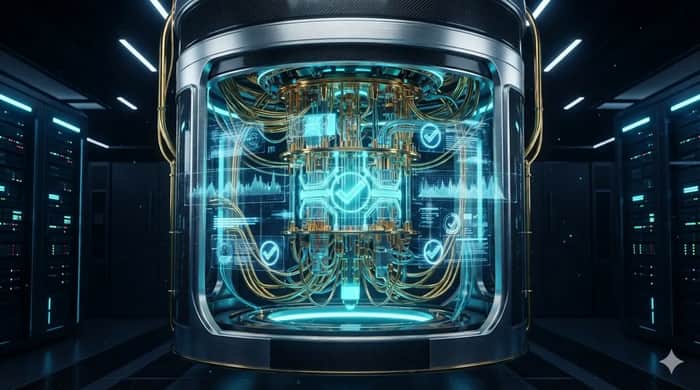
Over the last few weeks, I’ve been researching how technical search architecture will have to evolve to handle real-time deepfakes, LLM hallucinations, and synthetic media at enterprise scale.
As generative AI makes sub-pixel visual manipulation effortless, classical von Neumann computing faces an exponential permutation bottleneck when trying to verify cryptographic signatures and multi-dimensional vector embeddings in sub-100ms response windows.
I published a full technical breakdown on TheFluxRead, but wanted to share the core architectural lessons and technical takeaways directly with the indie builder community here.
- The Core Problem: $O(2^N)$ Scaling on Classical Ingestion
When classical web crawlers index multimodal content, verifying a single piece of media against historical voice biometrics or academic citation graphs creates a massive permutation problem.
+-----------------------------------------------------------------------+
| CLASSICAL SEARCH INGESTION BOTTLENECK |
+-----------------------------------------------------------------------+
| Raw Web Payload ---> Vector Embeddings ---> Probabilistic LLM |
| (Multimodal Data) (High-Dimensional) (Hallucination Risk) |
+-----------------------------------------------------------------------+
|
v
[ COMPUTATIONAL EXPONENTIAL EXPLOSION ]
(Evaluating $2^N$ Permutations for Deepfakes & Citations)
|
v
[ LATENCY FAILURE AT ENTERPRISE SCALE ]
Key Takeaway for Builders:
Probabilistic LLMs predict likely tokens; they don't natively execute deterministic truth-checking. If you're building search tools or data parsers, relying purely on LLM post-processing leaves your system exposed to hallucinations and prompt injections.
- Decoupling I/O from Verification Logic
The architectural blueprint we examined (Google "Quantum Clarity" concept) uses a dual-engine ingestion system:
-
Classical Edge Clusters: Handle high-throughput HTTP requests, DOM parsing, and tokenization.
-
Quantum Core (QPU) Engines: Execute quantum superposition graph-matching to evaluate logic pathways simultaneously.
         +-----------------------------------+
            |   Google Classical Edge Crawlers  |
            +-----------------------------------+
                              |
                              v
            +-----------------------------------+
            |  Tensor Conversion & Tokenization |
            +-----------------------------------+
                              |
      +-----------------------+-----------------------+
      |                                               |
      v                                               v
+-----------------------+ +-----------------------+
| Classical Rankers | | Quantum Clarity Core |
| (Keywords, UX, LCP) | | (Sycamore QPUs) |
+-----------------------+ +-----------------------+
| |
| Standard Signals | Verification Index
+-----------------------+-----------------------+
|
v
+-----------------------------------+
| Verified SERP & Knowledge Graph |
+-----------------------------------+
By leveraging quantum interference, incorrect logical citation paths undergo destructive interference, while validated assertions undergo constructive interference—processing hours of classical graph lookups in milliseconds.
- What This Means for Web Standards & SEOAs search engines pivot toward real-time deterministic verification, traditional keyword-stuffed SEO is losing its edge. Here is what technical founders should adapt to:
Vector Legacy Approach Verified Knowledge Era
Media Auth Metadata Tags C2PA Cryptographic Hardware Signing
Indexing Keyword/Backlink Weights Graph Contract Tracing & DOI Links
Security Standard SSL Post-Quantum Cryptography (PQC / TLS)
Takeaway for Founders & Devs
Whether you are building micro-SaaS applications or enterprise tools, data provenance is becoming a core security layer. Implementing structured RDF/OWL schemas and hardware-backed C2PA metadata early will give your content and platforms a significant authority advantage as search crawlers become more strict.
I’d love to hear your thoughts: How are you currently handling deepfake risks or media provenance in your own tech stacks? Are any of you preparing your infrastructure for post-quantum crypto standards yet?
If you're interested in the full 1,500+ word breakdown—including the math behind the quantum verification Hamiltonian equations, sub-pixel phase coherence analysis, and full brand safety matrices—you can check out the complete piece here:
👉 Read the Full Blueprint on https://www.thefluxread.com/2026/09/google-quantum-clarity-architectural.html
