Google's January 2026 Update: Indie Hackers, Your "Personal Brand" is Now Your SEO
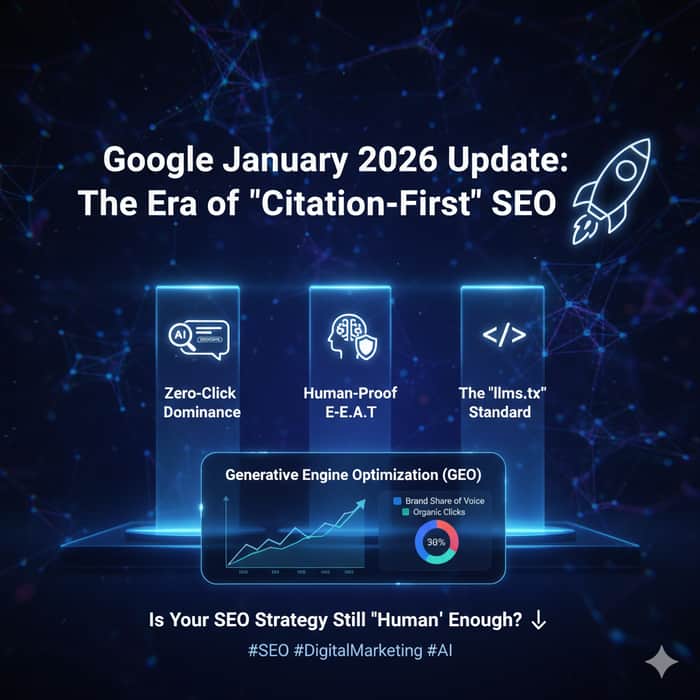
Alright, Indie Hackers, listen up. Google just dropped its January 2026 core update, and it’s a game-changer that specifically favors us. Forget the old SEO playbook of keyword stuffing and link farms – this is the era of Generative Engine Optimization (GEO), and your authentic expertise is its fuel.
Why This Update Is HUGE for Indie Hackers:
"Human-Proof" E-E-A-T is Your Superpower:
Google's AI (powered by Gemini) is now aggressively filtering generic, AI-generated content. It's actively looking for real human experience, expertise, authoritativeness, and trustworthiness.
Your advantage: As indie hackers, you're building in public, sharing genuine insights, and often have a strong personal brand. This direct experience, your case studies, your "build logs" – these are gold. An AI can't fake the journey of launching your SaaS or building your community.
Action: Double down on sharing your personal story, lessons learned, and unique insights. Show, don't just tell.
Citation-First Content & Micro-Niches:
AI Overviews are answering more queries directly. The goal isn't just to rank, but to be the trusted source that the AI cites in its generated answers.
Your advantage: You often target hyper-specific niches. This focused expertise means your content is more likely to be the definitive, "chunkable" answer an AI can extract and attribute.
Action: Create highly focused, factual "mini-articles" or answer sections that directly address specific problems your niche faces. Make it easy for an AI to quote you.
Brand Share of Voice > Organic Clicks:
"Zero-click" searches are rising. Users get answers directly from AI. Your new metric of success is how often your brand/product is mentioned and recommended by AI, not just raw clicks.
Your advantage: Indie Hackers thrive on community, word-of-mouth, and authentic connections. These "social proof" signals (mentions on podcasts, in newsletters, positive community discussions) are what AI is now connecting to verify your brand's authority.
Action: Engage in communities, get your name and product mentioned authentically. Think beyond links – think reputation signals.
The Bottom Line for Indie Hackers:
This isn't about outsmarting the algorithm; it's about being genuinely useful and building a real reputation. Your authentic journey, your unique insights, and your direct experience are no longer just "nice-to-haves" – they are the core of 2026 SEO.
What are your immediate thoughts on this update? Are you leaning more into personal brand or niche content to adapt? Let's discuss! 👇
#IndieHackers #SEO #GoogleUpdate #GenerativeAI #BuildInPublic

This explains why my best inbound this year was via comment threads, not landing pages. The Path B honesty angle (admitting what's not shipped yet) reads as personality in 2026 Google in a way it didn't pre-update. Working on a fulfillment MCP — every "queued, not live" line in my docs has earned more inbound than any positioning page I've written.
yes as indie hacker, the build in public personal experience is a good content itself, how you build it, any value experience you can share with the reader is helping you to promote your product, not just saying you update XX but share how you build, how you use AI coding, what good AI coding skill you are using, this kind of content is valuable for the reader, reader get value info at the same time your product be promoted.
This is spot on, especially the part about AI crawlers and zero-click searches. But there's a layer most people miss — it doesn't matter how great your E-E-A-T content is if Google can't actually see it.
I'm building JSVisible, a tool that compares what your users see vs what Googlebot actually renders. The gap is shocking for most JavaScript-heavy sites. React, Vue, Next.js — Google tries to render the JS, but AI crawlers like ChatGPT and Perplexity don't even attempt it. They just fetch the raw HTML. If your content is injected via JavaScript, you're invisible to the fastest-growing discovery channel on the internet.
So before optimizing for GEO, step one is making sure crawlers can actually read your content in the first place. The best E-E-A-T in the world won't help if it's hidden behind a <div id="root"></div> and a script tag.
Great post — the shift from "rank higher" to "be the source AI cites" is real and indie hackers are uniquely positioned for it.
Great point—you’ve highlighted something many people overlook. Even the best E-E-A-T content won’t make an impact if crawlers can’t properly access or render it. JavaScript-heavy frameworks can definitely create visibility gaps, especially when content is injected client-side.
Your point about AI crawlers and raw HTML is really interesting too. As AI-driven discovery grows, ensuring that important content is available in the initial HTML (or properly server-rendered) becomes even more critical.
Tools like JSVisible sound useful for identifying those gaps between what users see and what bots actually read. Definitely an important reminder that technical accessibility comes before optimization. Thanks for sharing this insight!