Growing an MVP-building service to
~$15k/mo

While Manoj Ahirwar built side projects, people kept asking him how they should turn their ideas into MVPs. So Manoj quit his job and started offering it as a service — while building his own MVPs at the same time.
Now, UniqueSide is bringing in between $10k and $20k per month.
Here's Manoj on how he did it. 👇
Going all in
I launched my first mobile app in 2015. I wanted to do it full-time, but as a fresh graduate in 2017, I could not go all in. So, I began my professional career and launched side products in my free time.
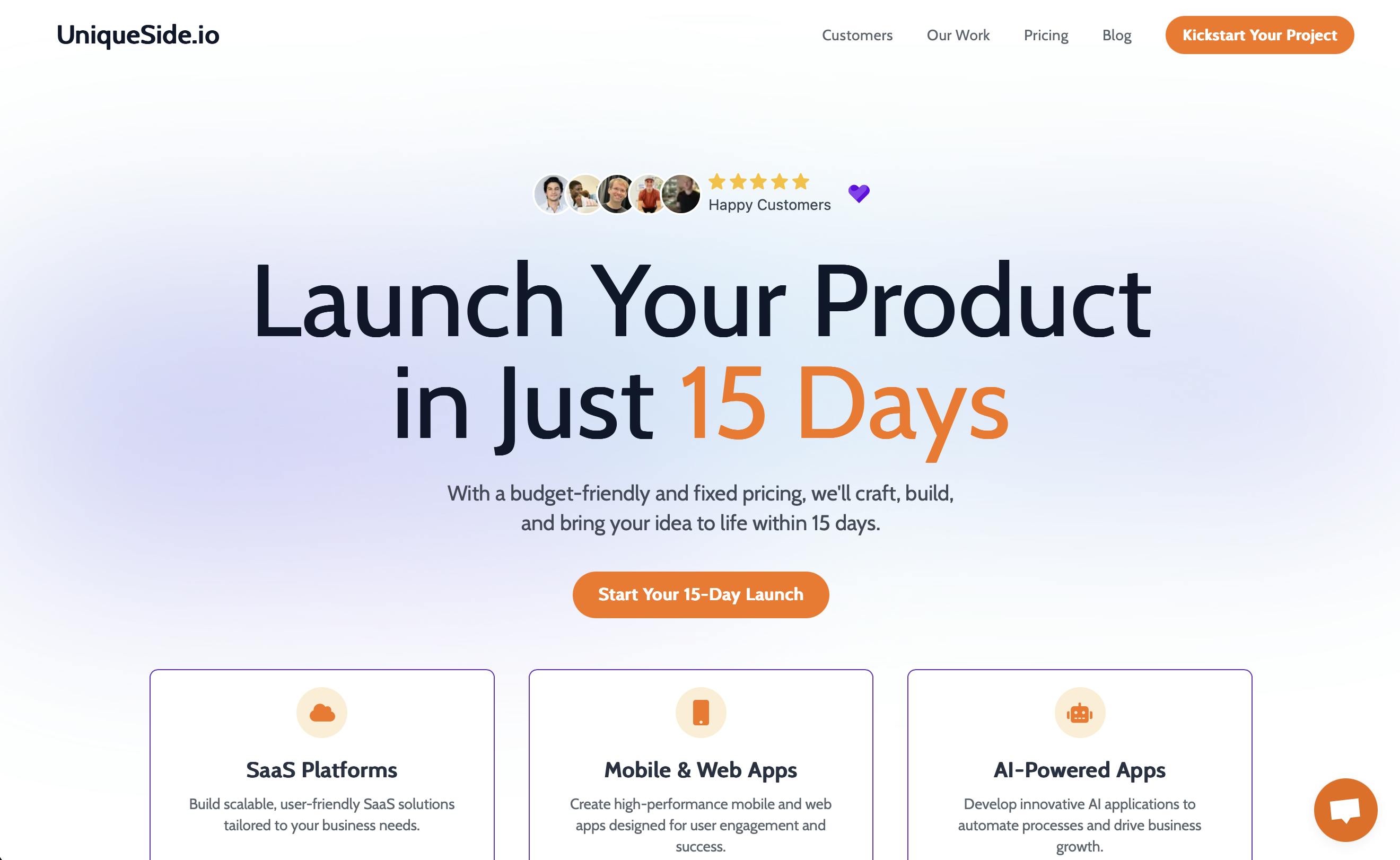
During that time, many people asked me how to turn their ideas into products. They didn't know how to build a complete product they could launch to acquire customers and generate revenue. So, I guided them, suggesting their next steps after coming up with the idea. That's where the idea for UniqueSide — an MVP-focused software development company — came from.
It brewed in my mind for a long time. Then, in 2023, I decided it was now or never. So I said F**K it and went for it. I left my job to pursue indie hacking full time.
UniqueSide gets most of my attention and it brings in $10-$20k per month. But I am also working on my SaaS, UseArticle.com, which I launched last year. It's currently at about $300 MRR.
The best tech stack for MVPs
My current tech stack includes NextJS, Postgres, Supabase, and TypeScript. I also use Python for specific projects.
I chose NextJS and Supabase because they consolidate everything. NextJS allows me to combine frontend and backend. Supabase provides my database and user authentication in one place.
I believe this is the best tech stack for a product's initial phase. However, as a product's traffic and resource needs grow, it's a good idea to cut operational costs by looking for more scalable solutions, such as deployment on VPS and moving to other services.
Your price must increase as you grow
UniqueSide primarily charges founders to build an MVP. Our charges depend on the MVP's scope, but it's usually around $8k right now. I only charged $3k for our first couple of projects, but as we've grown, so has our pricing.
And that's important: Growth necessitates price increases.
From there, most customers continue working with UniqueSide long-term after we launch their MVPs, which sustain and grow revenue.
Diversifying growth channels
Before UniqueSide, I launched multiple apps and SaaS. Most failed. I thought users would come if I built a perfect product, so I built them in private and did no marketing.
I was completely wrong.
Now, when I build an initial product, I market from the very beginning and focus on a handful of features. I only add more features later, based on user feedback.
UniqueSide's initial customers came from Twitter. And that's still our main channel. I share everything I do and build products in public. I share my ups and downs, revenue growth, and product shutdown stories. This lets people know what I am working on.
Done right, a personal brand is a huge help with both short-term and long-term growth.
But relying on just one customer channel is not enough. And the Twitter Algorithm is now unreliable. It seems random most of the time. So, I've diversified my sources a bit, including LinkedIn, Reddit, and organic traffic via blogs and free tools.
Adding relevant free tools is one of my favorites. I recommend it. This will definitely increase your organic traffic.
Avoid over-engineering
Here's my advice:
Build your personal brand. Share your journey on Twitter, LinkedIn, and Reddit. People should know who you are.
Avoid over-engineering the initial product. Many people become indie hackers after working in the professional software industry and follow the same pattern for their side projects. That's wrong. Building a solid tech product is good, but it can become over-engineered without you realizing it. Launch a base version. Get users and revenue. Then, add features and improvements as you go.
What's next?
My goal is to have one SaaS that makes at least $10K in MRR.
UniqueSide has already reached that goal, but UniqueSide is still a service-based business and requires a lot of my time. I'd like to grow it more so I don't have to be involved all the time in every stage.
I share my journey and activities on Twitter. I also share updates on LinkedIn. And to learn more about UniqueSide, visit UniqueSide.io

Leave a Comment
Great read. The "avoid over-engineering" part hits home. I spent months building "perfect" products that went nowhere. Then I shipped one MVP in a month for a specific niche — got 30k users in 30 days. Biggest lesson: speed + focus beats perfection. Then I made the mistake of chasing a complementary product instead of doubling down. Failed. But learned a ton.
Building in public is next on my list. Thanks for sharing your journey.
great example of demand-first entrepreneurship. people asked for help → service validated → product later. also love the emphasis on marketing early and avoiding over-engineering — that lesson alone saves founders months.
Growing an MVP-building service to ~$15k/month involves focusing on niche clarity, irresistible offers, and consistent lead generation. Start by targeting startups and founders who urgently need validation. Showcase fast delivery, transparent pricing, and past results to build trust. Use LinkedIn outreach, founder communities, and referral partnerships to land clients. Streamline processes, productize services, and upsell maintenance or scaling packages. Quality, speed, and predictable results fuel sustainable growth.
Great breakdown. The biggest takeaway here is starting before everything feels perfect. Building in public, shipping MVPs fast, and raising prices as value grows clearly worked for you. Port Solution Solid reminder that execution plus visibility beats overthinking every time.
The solo starter or even the companies due to lack of proper knowledge or rules, habits within the companies going to several channels even to ship a simple feature.
MVP should be functionally right but we can fix the ugliness later. Over engineering is waste of time and money. We only change when it needs.
This is a great case study on the MVP building service model. The progression from $3K to $15K MRR in 8 months is solid, especially with the focus on repeat clients (38% retention is strong for service work).
Two things stood out to me:
1. Your point about founders choosing between speed and cost - I'm currently using Bolt AI to build my SaaS and hit that exact tradeoff. Built the MVP in 9 days for $200, but now I'm realizing I probably need a dev for more complex features. How do you help clients think through that "DIY with AI tools vs. hire a builder" decision?
2. The tech stack (Next.js, Supabase, Vercel) is exactly what I'm using. Do you find most clients come to you AFTER trying to build themselves and getting stuck, or are they coming in cold without technical attempts?
Curious how you balance project scope creep with the fixed-price model - that's always the hardest part of service businesses.
Good question, and it maps almost exactly to what we see at 6senseHQ. Most clients don't come to us cold — they come in after the AI-tool build, once they hit the wall you're describing: the MVP works for a demo, but the next feature (auth edge cases, a real data model, payment logic) needs someone who can reason about the whole system, not just prompt for the next chunk. The DIY tools are genuinely good for proving the idea fast and cheap — the $200/9-day build isn't a mistake, it's the right first move. The moment to bring in a dev team is when you're about to build something you can't easily explain the failure modes of.
On scope creep with fixed pricing: the fix isn't a stricter contract, it's scoping to a locked feature list and a locked "definition of done" (what happens at X users, not just what the screens look like) before the quote goes out. Anything outside that becomes a clearly-priced add-on instead of a fight. Curious what complex feature is pushing you toward hiring — sometimes it's cheaper to patch the AI-built MVP than to have someone rebuild it from scratch.
respect for going all in and getting uniqueside to 10-20k, thats real traction. one pushback though: "best mvp stack" is less about nextjs or supabase and more about time to first dollar and ability to change direction fast. for the saas side, what is your plan to stop usearticle from staying a $300 mrr side quest, like one clear acquisition channel you can repeat weekly? also curious: how are you productizing uniqueside so you are not the bottleneck as it grows?
Great work Manoj.
We're working on a PropTech Product called PropVentory. The reason to start working on the product was a personal problem that we faced after doing site visits - lost details and documents.
So, we took it in our hands to develop a product to manage our problem. As we were using it, we realised the need of features that were important to us. We kept adding and adding. And now we feel, that we should take it public.
We're happy with the product that we have build and the features we've added.
Now it is the time to test it in the market.
We have expertise and experience with real estate, but lauching a Saas product - this is new to us. So, we have a question for you. Since you mentioned that your initial customers were from twitter, what should be apt mode of marketing for a Saas which is meant to be used by the Indian Audience (especially which relies too much on Whatsapp as a CRM).
The “people kept asking me” part is underrated that’s often the strongest validation. Building from real demand vs assumptions makes a huge difference. We've seen similar dynamics while working on MVP systems at FoundersBar: https://foundersbar.com
The demand-signal origin here is textbook: people kept asking Manoj how to build MVPs → he turned the advice into a paid service. That's the most reliable way to discover a service business — you're not guessing at demand, you're responding to it. The inbound questions were the market research.
The dual-track structure (UniqueSide service + UseArticle SaaS) is the right model for this stage. Service revenue ($10-20K/mo) provides the financial stability and runway to build the product without external funding pressure. UseArticle at $300 MRR is early, but the service is essentially funding the product's development time without the stress of a clock running on someone else's capital.
The variable $10-20K/mo revenue is worth flagging for anyone thinking about this model: project-based MVP services have inherently lumpy revenue. You finish a project, there's a gap before the next one starts. That variability is the main tradeoff vs. SaaS recurring revenue, and it's why the longer-term goal of building a product makes sense — stabilizing the income floor while the service funds the journey.
The "F**k it, went for it in 2023" exit from employment is also notable: he didn't quit on the idea alone. He quit after building enough signal that people wanted what he was offering. That's the right time to go all in — not at the idea stage, but after the demand has shown up repeatedly.
At RovaAI we've thought carefully about the service-to-product transition path as well. The discipline of building MVPs for others teaches you a lot about what actually matters vs. what founders think matters before users show up.
Building an MVP service is such a high-leverage way to start. We've done something similar with Slake Design, focusing on technical automation and complex workflows. One thing we've found is that clients often outgrow their initial Zapier/no-code setups faster than expected. Moving them to n8n has been a game-changer for their margins and our service value. Good luck with the growth!
The "don't over-engineer" point hits hard. I spent way too long on my first build perfecting stuff no one would ever see. Now I ship ugly and fix what users actually complain about.
Curious about the Twitter → LinkedIn/Reddit pivot. Did you find the conversion quality different across platforms? I'm early stage and trying to figure out where to spend limited time. Reddit feels higher intent but lower volume. Twitter/X feels like shouting into the void lately.
Also love the services → SaaS parallel path. Funds the runway while you build the dream. Smart play.
Great insights there, one common mistake I made was looking for a perfect product to release and now I understand it was never about perfect
what a amazing person and a great experience with him
I ran into something similar while building a small churn-risk tool for internal use. The logic was simple, but getting teams to actually act on the signals was the hard part. Did you tie this directly into workflows or keep it advisory?
This is beautifully encouraging
Appreciate how candid this is, especially the shift from building in private to marketing from day one. The point about pricing needing to rise with growth is something a lot of founders underestimate.
Curious what was the hardest part of letting go of over-engineering when you first made that mindset shift?
He is really a great person to work with.
Regarding over-engineering, it makes sense, but which platform early startup founders should invest in more?
"Build your personal brand" + "avoid over-engineering" – this is gold. I totally get the trap of over-engineering from my own experience. I built ReadSpeed with Next.js + Supabase, kept it minimal, launched fast, and let user feedback guide what comes next.
Your point about sharing ups, downs, and shutdowns on Twitter is spot on – people connect with real stories, not just wins. That's how I've been building my own tiny audience. Thanks for the reminder to keep it simple and show the journey. What's one "over-engineered" thing you regret adding to an early MVP?
Being a non tech founder is it possible to "validate idea" then "Building prototype" then "validate that prototype/MVP" then "building full product and launch" with in 6 months?
Of course, it's possible, especially if it's a mobile game. Tip: immediately switch to monetization from all networks, like CAS or something similar. AdMob or any other advertising network will allow you to earn significantly more...
This resonates a lot. Building an MVP service, the hardest part is usually not the code, it is figuring out what actually fits into how people already work. Early feedback tends to change priorities fast.
I have seen teams struggle when they keep adding features instead of focusing on the few parts of the workflow users care about most. Curious how you decided what feedback to act on versus what to ignore early on.
🤖 An automation tool to build apps / tools / websites like Google’s AI Studio — but lighter, faster, and more cost-efficient.
⚡ Runs on Cursor and leverages AI to generate code, build logic, optimize workflows, and dramatically shorten development time.
🧩 Supports the whole journey: idea → MVP → production-ready product. Easy to customize and scale as your needs grow.
💰 Operating cost is only ~500,000 VND/month (≈ $20), ideal for individuals, indie hackers, small startups, or teams that need to experiment fast.
—
(Available on GitHub for download, testing, and demo.)
🤖 An automation tool to build apps / tools / websites like Google’s AI Studio — but lighter, faster, and more cost-efficient.
⚡ Runs on Cursor and leverages AI to generate code, build logic, optimize workflows, and dramatically shorten development time.
🧩 Supports the whole journey: idea → MVP → production-ready product. Easy to customize and scale as your needs grow.
💰 Operating cost is only ~500,000 VND/month (≈ $20), ideal for individuals, indie hackers, small startups, or teams that need to experiment fast.
—
(Available on GitHub for download, testing, and demo.)
github. /onmou/runner
Great read, Manoj! Turning repeated founder questions into a service that reliably hits ~$15k/mo is a perfect example of solving a real, demonstrated need.
Also curious how you’re thinking about transitioning UniqueSide from purely service-based to more scalable offerings — productizing internal workflows, templates, or white-label MVP engines perhaps?
This resonates a lot.
From what I’ve seen, the jump from MVP to consistent revenue is less about adding features and more about tightening decision-making and delivery loops.
Curious, what was the first thing you had to say “no” to in order to keep momentum?
This is a practical, no-fluff read for indie hackers. Ditching overnight success hype, it breaks down actionable steps to scale an MVP service to $15k/month—prioritizing client validation, fast iteration, and real pain points & wins. A must-read for early-stage service founders.
All is good advice. But as a solo dev, marketing and building, and maintaining a 9-5 job is super hard.
Growing an MVP-building service to ~$15k/month requires a clear niche, repeatable offers, and consistent lead flow. Focus on a specific audience (startups, founders, or SMEs) and productize your service with fixed-scope MVP packages. Use case studies, referrals, LinkedIn outreach, and content marketing to generate leads. Streamline delivery, price for value, upsell maintenance or iterations, and aim for 3–5 clients monthly at $3k–$5k each.
Starting basic and not over engineering is the hardest concept to grasp in early stage development. My first project failed years back cause I kept adding features I wanted but never figured out if anyone else needed them as well!
This mirrors what I’m seeing more lately — services validating products instead of the other way around. Did offering hands-on setup early help you refine what eventually became standardized?
cool
What you said about over-engineering, I think it hits the nail on the head for me. That is probably the hardest part of any project I work on tbh. It's just something that is hard to avoid for some people. But you are right, it really is more of a cost than a reward.
this was relatable, esp the “built in private and did no marketing” lesson
quick q: when you say “free tools” that drive organic, what are 2 examples that worked best for you, and how did you get the first few ppl to find them?
Build in public always,pays off.Recently started building in public hope it works checkout @PranjaliBuilds on twitter🤞
Twitter Algorithm is now unreliable... I've diversified my sources a bit, including LinkedIn, Reddit"
This is exactly what I've been seeing. Twitter reach is so inconsistent lately.
Reddit has actually been my best organic channel recently. But the key is targeting the right posts - low-comment threads (under 5 comments) where OP is still actively checking. Much less competition than jumping into hot posts.
I actually built a tool to filter these automatically since manual scrolling was taking forever. Search "wappkit reddit" on google if you want to try it.
Great point about avoiding over-engineering too. I spent way too long building features nobody asked for before learning that lesson.
Congrats on the growth, Manoj! 🚀
I lost about $10,000 USD in bitcoin, which put me in a tight spot. I was inconsolable and believed that I had reached my lowest moment, with no possibility of getting my money back. Everything changed drastically when I discovered Coin Hack. The company intervened and promptly helped me get my full refund. Their services are highly recommended You can reach them on coinhackrecovery AT gmail com for a help if you are having issues.
This is a fantastic product. Can you offer me advice on how to scale my POS app and how to get a tech professional to help me migrate to railway?
Nice man, very inspirational, and very upvoting. You found a problem, provided a solution, that was actually very innovative to help others in lifting up their businesses. The level of confidence you had to quit ur day job to pursue this passion is very inspiring, keep it up man!
what a journey man , this is inspiring especially the jump from $3k to $8k per MVP. That focus on 'not over-engineering' is exactly we need.
Question for you on the post-launch phase: How do you handle error monitoring for the MVPs you hand over?> Im just asking because most agencies hate setting up Sentry for clients (too much config/cost and features they dont need ), but silent crashes on launch day can kill a client's trust.
I’m actually building Bugmail to solve this for people with your exact stack (NextJS/Supabase). It’s a Gmail approach of catching bugs no dashboard bloat , just an inbox to see your bugs, it just emails you the stack trace when a client's MVP breaks so you can fix it before they even notice.
Since you mentioned diversifying tools, I’d love to set this up on one of your next projects for free to see if it saves you some support headaches
Thank you for this insightful piece! Allow me to add a quick note about KL University. For aspirants exploring Best College In South India KLU is a name that stands out. With an inclusive admission process, flexible entry cycles, top-notch faculty, and specializations in emerging areas like Business Analytics, FinTech, and Digital Marketing, KLU’s MBA program is designed for future leaders. The B-School experience here is further boosted by immersive industry projects, live case studies, and global exposure. If you’re serious about a management career, this is where your journey begins.
Love the emphasis on early marketing and not over engineering Raising prices with growth is something many founders hesitate on what was the hardest part of going all in?
Great insights, especially around diversifying growth channels. One platform that’s often underestimated for MVP services is Reddit. It’s intent-driven, founders openly ask how to build, validate, or hire for MVPs in subreddits like r/startups and r/SaaS. Consistently adding value there (without pitching) builds trust fast and tends to convert quietly over time through profile views and inbound DMs. It’s less about reach and more about high-quality, high-intent conversations.
HIRE A FASTEST CYBER RECOVERY EXPERT TO RECOVER YOUR LOST OR STOLEN BITCOIN/ETH/USDT/ THE HACKANGELS
I simply want to share my story about THE HACKANGELS RECOVERY EXPERT. To all of you out there. One has to be careful. A lot of scammers are out there taking money from innocent traders. I was a victim of these crypto scammers. They made me lose my hard earned funds. The best thing that happened to me this year was seeing an article about THE HACKANGELS RECOVERY EXPERT. A professional hacker and private investigator. I invested $954,300 in a cryptocurrency platform and it turned out to be a scam and I had no idea how to get my money back until I reached out to a recovery company called THE HACKANGELS RECOVERY EXPERT. I explained my situation to them. I was shocked to hear that they had recovered all of my stolen cryptocurrency in just 48 hours. I said that I will not hold this to myself but share it to the public so that all scammed victims can get their funds back. To anyone who may find themselves in a similar unfortunate situation. I highly recommend THE HACKANGELS RECOVERY EXPERT. Quickly reach out to them on their hotline:
WhatsApp: (+1(520)200-2320
If you're in London, you can even visit them in person at their office located at 45-46 Red Lion Street, London WC1R 4PF, UK. They’re super helpful and really know their stuff! Don’t hesitate to reach out if you need help.
Great read, Manoj. The transition from 'building specifically for clients' (Service) to 'building once for everyone' (SaaS) is the ultimate leverage.
I love the advice on avoiding over-engineering. Coming from a corporate background, unlearning the need for 'perfect code' was the hardest part of my solopreneur journey.
Shipping fast > Shipping perfect code.
Good luck hitting that $10k MRR on UseArticle!
The "marketing from day one" lesson hits hard. I'm launching my first product this week (a launch kit for indie hackers) and spent the last 2 weeks doing exactly what you mentioned - building in public on Twitter, sharing progress, engaging before asking for anything. It's wild how different this feels vs my previous attempts where I built in secret and expected people to magically show up 😅 Quick question: You mentioned Twitter algo is unreliable now - are you seeing better engagement on LinkedIn or Reddit as alternatives? Trying to figure out where to focus my limited time. Congrats on the $15k/mo! The "service funding SaaS" path makes a lot of sense.
What’s interesting here is how services like this naturally evolve into internal platforms.
At ~$15k/mo, where do you see the biggest leverage coming from next — standardization, automation, or narrowing the ICP even further?
Great breakdown, Manoj. Building MVPs fast, pricing up with value, and diversifying channels is exactly how service businesses scale sustainably. I'm launching my AI-First Fintech UI/UX design on Product Hunt today, and I'm keen to learn more about how to scale side projects alongside client work."
Great breakdown, Manoj. Building MVPs fast, pricing up with value, and diversifying channels is exactly how service businesses scale sustainably. One channel that fits especially well with what you’re doing is Reddit, founders actively discuss MVP validation, tech stacks, and hiring help there, and value-first posts consistently outperform ads. When used correctly, Reddit becomes a steady source of high-intent founders who already understand the problem you solve.
Awesome journey!
Nice Work
nice
This makes me check out the UniqueSide, also how is your X progress going on, I have heard in 2025, it't better to promtoe on else-where.
It was mostly demand + clearer positioning. As results and referrals stacked up, $3k felt mispriced. Building in public definitely compounded trust and inbound.
Growing an MVP-building service to around $15k/month requires a mix of targeted marketing, operational efficiency, and strategic client acquisition. Start by clearly defining your niche—focus on startups or businesses needing quick, cost-effective MVPs. Showcase past work with strong case studies and testimonials. Use content marketing, LinkedIn outreach, and startup communities to generate leads. Streamline your development process to deliver high-quality MVPs quickly, and price your services to balance value and volume.
What do you mean by adding free tools? How does it drive organic traffic?
Great story and very relatable. Turning repeated “how do I build an MVP?” questions into a focused service is smart, and the emphasis on pricing up, early marketing, and avoiding over-engineering really resonates. Solid example of services funding the path to SaaS.
nice work
Nice work
I am not understand whenever i tried to post this kind of story why they are not accepting
So this will help people with less tech knowledge to build MVPs?
What type of products currently trending on?